
Minnesota advocates react to Trump’s plan to federally defund gender-affirming care for minors

Under the administration’s proposal, hospitals that provide such care would lose vital Medicare and Medicaid dollars.

December 19, 2025 at 12:01PM
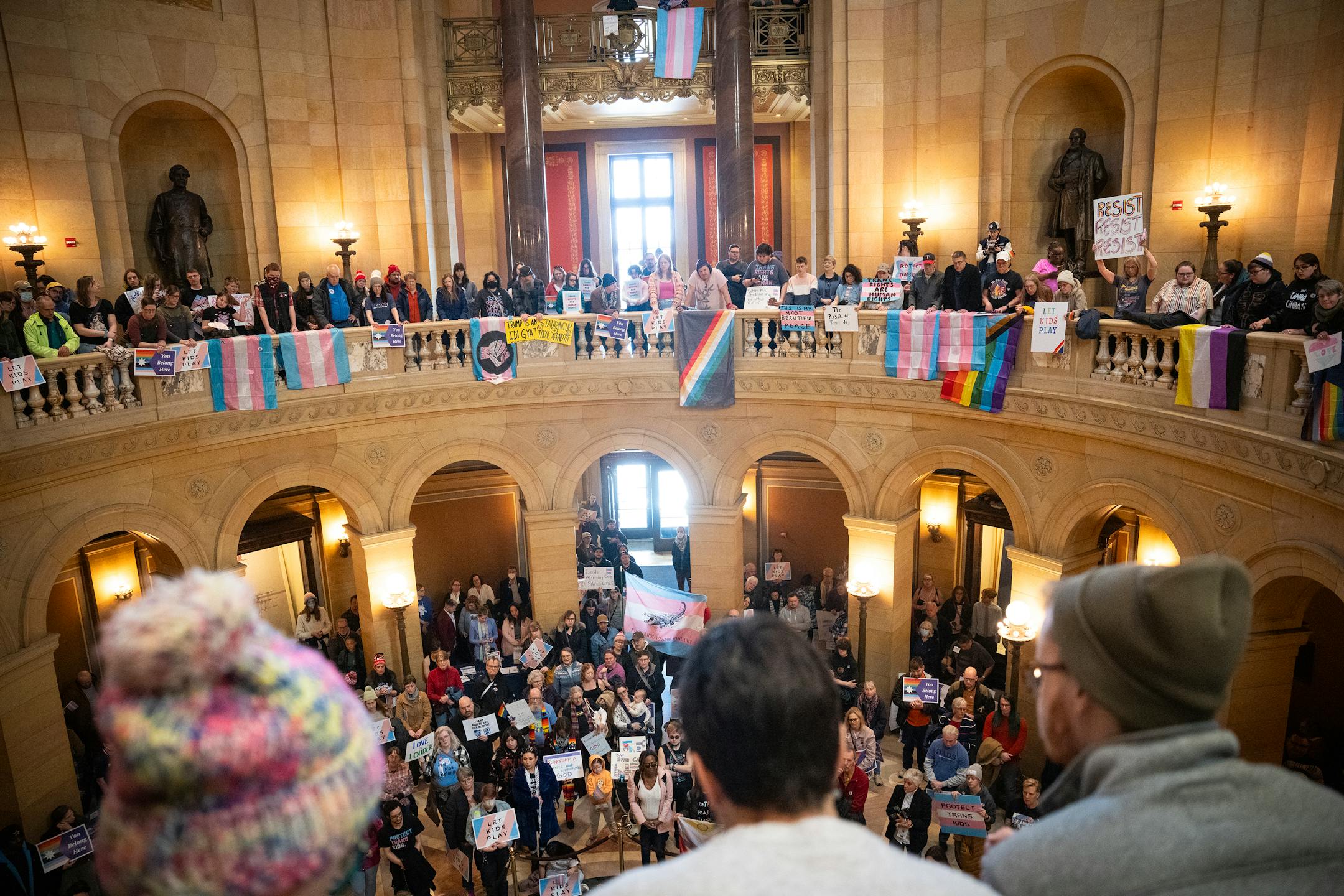
Hildie Edwards with sister Dahlia take time from school to advocate for the "trans refuge" bill up for vote in the Senate at the Capitol in St. Paul, Minn., on Friday, April 21, 2023. In the background are signs opposing and supporting the issue. Hildie Edwards is a transgender activist who has helped pass legislation making Minnesota a refuge for transgender individuals. ] RICHARD TSONG-TAATARII • richard.tsong-taatarii@startribune.com
Hildie Edwards with sister Dahlia take time from school to advocate for the "trans refuge" bill up for vote in the Senate at the Capitol in St. Paul on April 21, 2023. (Star Tribune/The Minnesota Star Tribune)

Hospitals providing gender-affirming care to minors would lose federal Medicaid and Medicare funds under rules the Trump administration’s top health officials proposed Thursday.

The rules would prohibit Medicaid funds from covering gender-affirming care for minors and revoke Medicare and Medicaid dollars from hospitals that provide it. The policy is subject to public comment and will likely face legal challenges. But if enacted, it would effectively ban gender-affirming care by kneecapping hospitals that both provide most of that care and rely heavily on Medicare and Medicaid payments to survive.

KFF, a health policy nonprofit, reported Medicaid and Medicare accounted for nearly 45% of all spending on hospital care in 2023, about $675 billion. Children’s Minnesota could not immediately provide its Medicaid/Medicare reimbursements, and the Minnesota Hospital Association declined to comment because it was still reviewing the announcement from the Center for Medicare and Medicaid Services.

Unlike 27 other states, Minnesota law protects access to gender-affirming care, and the decision from the federal Department of Health and Human Services doesn’t change that. But the news has still created an existential crisis for providers, policymakers and advocates.

President Donald Trump began his second term earlier this year with executive orders that called gender-affirming care “mutilation" and said the U.S. recognizes “two sexes, male and female.”

“This isn’t about a measured approach to science or medicine,” said Kat Rohn, executive director of OutFront Minnesota, the state’s largest LGBTQ advocacy group. “This is really about a wholesale assault on transgender people’s ability to be part of public life.”

Rep. Angie Craig, a Democrat representing the southern Twin Cities metro and outlying rural areas, said in a statement the rules would burden an already taxed health care system.

“Folks in every corner of Minnesota will feel the impacts of these funding cuts,” Craig said.

Democratic Sen. Tina Smith said in a statement the proposal is “another case of this administration forcing the government into the private medical decisions that happen between families and their doctors.”

At a news conference Thursday, Health and Human Services Secretary Robert F. Kennedy Jr. lambasted care for patients whose identity does not match their birth sex, particularly minors, as a mistake by the medical establishment.

“The Trump administration will not stand by while ideology, misinformation and propaganda push vulnerable young people into decisions they cannot fully understand and that they can never reverse,” Kennedy said.

Republican Minnesota Rep. Tom Emmer, the House Majority Whip, shared on the social media platform X a post by White House spokeswoman Karoline Leavitt criticizing “gender ideology insanity” and “junk science.” He did not respond to further request for comment.

Gender-affirming care is treatment for gender dysphoria, or when a person’s gender identity does not match their sex assigned at birth. It includes a range of physical and mental health care backed by the American Medical Association, American Academy of Pediatrics, American Psychiatric Association and others.

Minnesota became an island for gender-affirming care in 2023, when the DFL-controlled Legislature passed a law making it a “trans refuge” state. Many states, including the Dakotas and Iowa, have banned gender-affirming medical care for minors.

Transgender people comprise less than 1% of the U.S. population.

It’s unclear how many providers in Minnesota offer gender-affirming care to minors. Most of it happens at clinics associated with hospital systems in the Twin Cities metro, said Dr. Kade Goepferd, chief education officer and a pediatrician in the gender health program at Children’s Minnesota.

“It’s really too early to know what, if any, changes we may or may not need to make,” Goepferd said. “But I definitely would want our patients and parents of transgender kids in the community to know that today changes nothing in terms of how much we care about the health of transgender young people in this community.”

In a statement, Minnesota Attorney General Keith Ellison said he and his office were reviewing the proposed rules and “will have more to say in the coming weeks.”

“I am committed to vigorously defending Minnesota’s medical providers who do incredible work to treat and care for all Minnesotans, including our transgender neighbors,” Ellison said. “I have already taken the Trump administration to court to stop them from scapegoating the trans community. I will not hesitate to do so again.”

DFL Rep. Leigh Finke, who carried the 2023 legislation and is Minnesota’s first transgender state legislator, said the state has the legal framework to protect access to care. But it’s not guaranteed.

“Care will change in Minnesota if these rules go into effect, but that’s not because we don’t have the protections,” she said. “That’s because the federal government is hell-bent on destroying our access to care.”

Finke said she watched the livestream of the Health and Human Services news conference but hoped others did not.

“The thing that I’m thinking the most about right now is trans young people who are internalizing what this administration is trying to build,” she said, “which is a world where trans kids have no future, and that is bleak. It is heartbreaking.”

about the writers

about the writers

Emma Nelson

Editor

Emma Nelson is a reporter and editor at the Minnesota Star Tribune.

See Moreicon

Christopher Vondracek

Washington Correspondent

Christopher Vondracek covers Washington D.C. for the Minnesota Star Tribune.

See Moreicon

More from Health Care

See More
Hildie Edwards with sister Dahlia take time from school to advocate for the "trans refuge" bill up for vote in the Senate at the Capitol in St. Paul, Minn., on Friday, April 21, 2023. In the background are signs opposing and supporting the issue. Hildie Edwards is a transgender activist who has helped pass legislation making Minnesota a refuge for transgender individuals. ] RICHARD TSONG-TAATARII • richard.tsong-taatarii@startribune.com
Star Tribune/The Minnesota Star Tribune

Under the administration’s proposal, hospitals that provide such care would lose vital Medicare and Medicaid dollars.

card image
card image