U, Fairview and physician group return to negotiating table after public feud

A University of Minnesota Board of Regents meeting slated for Friday was canceled as negotiations resume.

The Minnesota Star Tribune
November 21, 2025 at 11:10PM
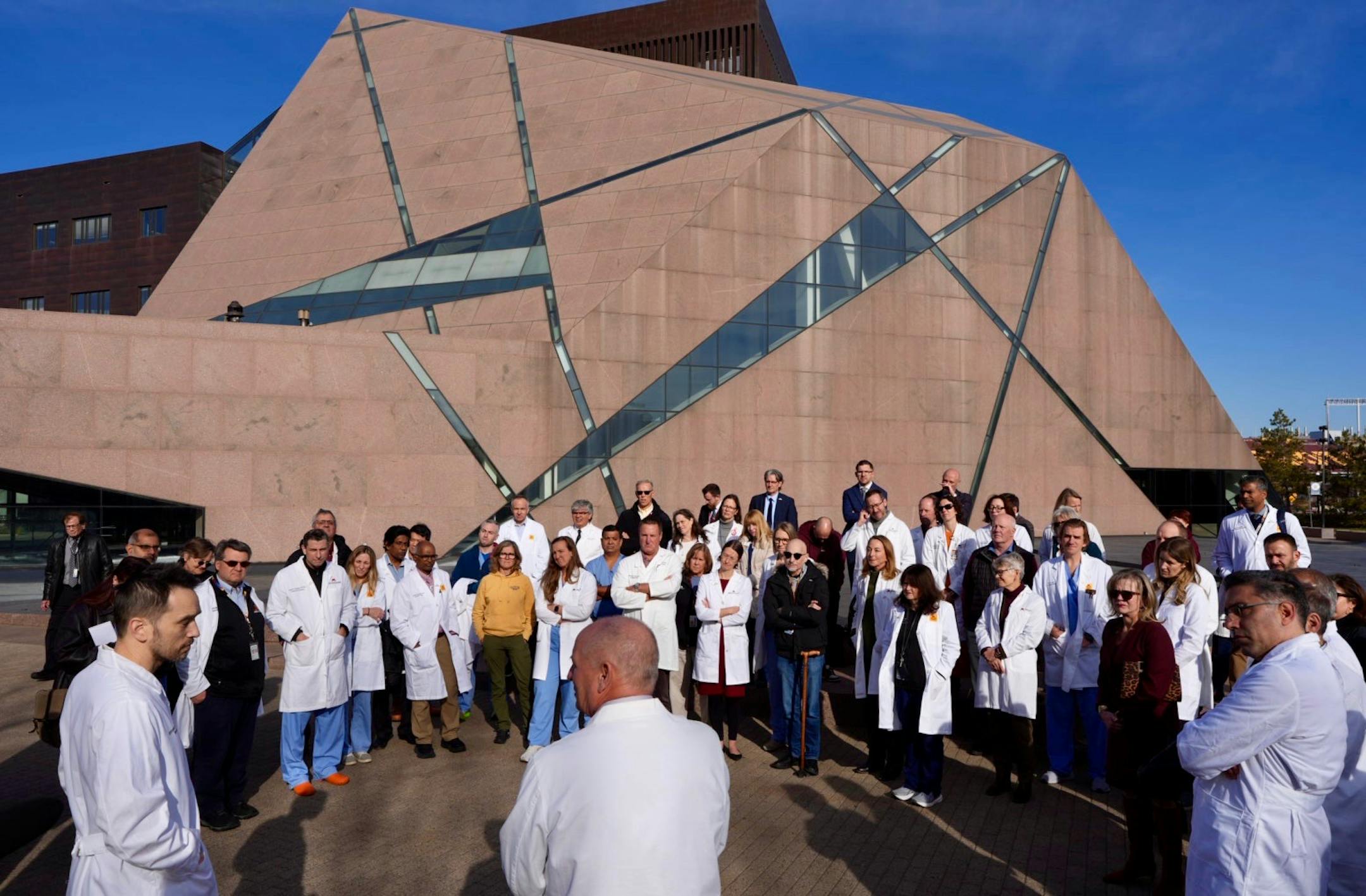
A group of University of Minnesota physicians gather on the U’s campus Friday, following a Board of Regents meeting that was canceled earlier in the morning. (Anthony Soufflé/The Minnesota Star Tribune)

The University of Minnesota Board of Regents scrapped a special meeting Friday and instead the U, Fairview Health Services and M Physicians — another name for University of Minnesota Physicians (UMP) members — are returning to the table for more negotiations.

The conversations will be managed by Minnesota Attorney General Keith Ellison and a new mediator whom all sides agree on.

The announcements came as nearly 70 members of the physicians group, most wearing their white coats, gathered informally Friday afternoon outside McNamara Alumni Center, where the Board of Regents meeting was supposed to be held.

The doctors aired concerns that regents were moving forward without hearing from the people providing care and training, and that the flow of information about efforts to reach a new deal between Fairview, the university and the doctors’ group was less than optimal.

“There’s been a lot of chaos over the last couple of weeks,” said heart failure and transplantation cardiologist Dr. Rebecca Cogswell, addressing UMP CEO Dr. Greg Beilman during Friday’s outdoor gathering. “How should we be communicating with one another [in a way] that does not fuel the chaos?”

The canceled regent meeting, which the doctors had planned to attend as a group, had just one agenda item — considering “options” for the university’s partnership with Fairview Health Services and University of Minnesota Physicians (UMP).

Shortly after the doctors met, Ellison announced that the U, Fairview and M Physicians were returning to the table to negotiate. That was immediately followed by a U news release saying the U was looking forward to the talks.

“The University is fully committed to negotiating in good faith and forging a plan of action that most strongly supports patients and our state,” U President Dr. Rebecca Cunningham said in a Friday letter, adding that hard work and rebuilding trust lie ahead.

Ellison said the parties had made significant progress so far and thanked them for recognizing “time is of the essence in bringing this matter to closure in a way that secures continuity of high-quality patient care, retention of world-class physicians and long-term support for the Medical School.”

Facilitator Lois Quam will remain involved, but Ellison will be heading up the negotiation process with “a mutually agreed-upon mediator to be selected shortly.”

Meanwhile, Fairview said in a news release that it remains “committed to the foundational and binding agreement reached with UMP” but will also participate in the conversations set up by Ellison and a new mediator.

While Fairview said the health system will participate, its statement noted physician departures were much higher than average and that “stabilizing the faculty is an urgent priority.”

Nearly 200 physicians have left UMP since 2024, Fairview Health Services CEO James Hereford said in a letter to Cunningham on Thursday that was obtained by the Minnesota Star Tribune.

On Friday, Fairview’s statement said it would be “irresponsible to allow open-ended negotiations, to revisit terms that have already been settled, or to return to structures that have already failed. The foundational agreement already reached between Fairview and UMP offers a clear path forward.”

Tumult at the U

The last two weeks have been tumultuous at the U after Fairview Health Services and UMP struck a 10-year deal to fund the state’s largest medical school without involving top university leaders. The agreement would support physician training, academic health programs and the continuation of care for more than 1 million Minnesotans.

But U officials, led by Cunningham, blasted the doctors’ pact with Fairview as a “hostile takeover” that doesn’t serve the state. They fear U physicians will lose their role in decision-making and be accountable not to the U but to Fairview’s mission and bottom line.

Since then, U administrators fired several leaders of UMP from their U roles, including Beilman, who negotiated the new clinical partnership, escalating tensions with doctors who teach U medical students and treat patients at M Health Fairview hospitals and clinics.

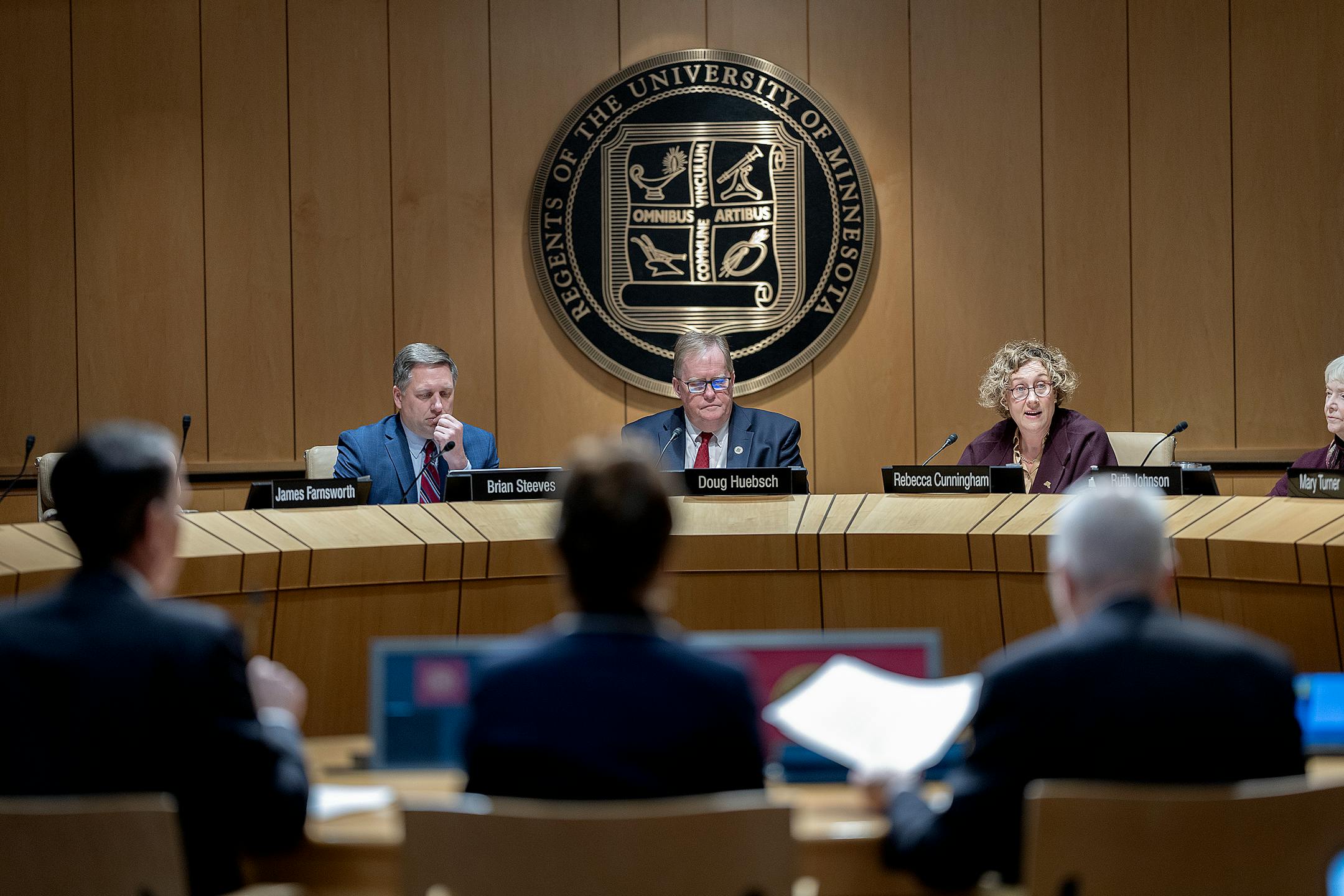
Brian Steeves, left, Douglas Huebsch, center, and U President Dr. Rebecca Cunningham at a Board of Regents meeting on Nov. 13. (Elizabeth Flores/The Minnesota Star Tribune)

Beilman has held town halls and sent regular memos in recent days, and faculty senators are working on a more unified communication plan to prevent rumors from spreading.

In a letter to the Board of Regents sent Friday afternoon, many UMP doctors voiced strong support for the agreement between their group and Fairview, calling it essential to restoring stability after years of uncertainty.

Signed by more than 200 faculty physicians in less than 24 hours, the letter urged the regents to back the agreement, saying the deal “preserves the flow of clinical funds to the Medical School” and strengthens shared governance through reciprocal board representation between Fairview and UMP.

“This structure is not a threat to the University,” the physicians wrote.

The existing pact struck between UMP and Fairview hasn’t been made public except for a summary, and even some doctors and UMP members feel out of the loop, one pediatrician at the U said.

UMP leaders presented the agreement as if it were on behalf of all physicians, but there has been no consultation with the “rank and file membership,” and it was shared as a done deal only after the UMP board approved it, the doctor said.

Most members of the doctors group haven’t seen the 30-page “binding term sheet” of the agreement and have been told they won’t get to see it, the doctor said.

The deal doesn’t appear to address some challenges at the medical center, such as longstanding complaints about imbalances in doctors’ salaries among different medical specialties.

Another medical school faculty member who doesn’t work with patients said they’re deeply concerned about the agreement’s impact on research and education, as Fairview’s contribution to the medical school under the previous contract was making the U “increasingly uncompetitive” with its peers.

The new agreement will likely only make things worse, they said, adding that they trust Cunningham and Medical School Dean Jakub Tolar to advocate for them but have no voice in UMP.

“I am left feeling like a second-class citizen at my institution,” the faculty member said.

The U’s new proposal

One thing U doctors want is more clarity on the new proposal administrators have in mind.

Cunningham told faculty in a Thursday night email obtained by the Star Tribune that she is exploring an “alternate” partnership model. She didn’t include details, though she acknowledged growing unease about how the dispute has unfolded, saying she “advocated heavily to not have this deal be shared publicly.”

Faculty members said they have seen only a general outline of that proposal and are waiting for details, though ophthalmology chair Dr. Silvia Orengo-Nania said it could involve new subcommittees of department chairs and physicians.

“There were elements in this very loose outline that was presented to us that had some of us concerned about how viable it would be over the long term, or even over the short term, but details were not provided,” said Dr. Sophia Vinogradov, head of the U’s Department of Psychiatry and Behavioral Sciences.

Physicians pushed back on any suggestion that the university should own or control the entire health system, as is the case at the University of Michigan, where Cunningham worked previously.

“It works well in Michigan, in Ann Arbor,” said Dr. Brian Hilliard, an internal medicine and pediatric doctor. “This is a much different market.”

Despite frustrations, the doctors at the informal gathering Friday morning stressed their commitment to the university’s mission.

“I could make substantially more money” at other hospitals, Hilliard said. “But I work here because I value this culture, the collaborations, the patients.”

Through the tension, physicians returned to the theme of patient care.

“Your care will continue the way it has been going,” Beilman said. “We will continue to take care of the people of the state of Minnesota that we serve.” Faculty leaders echoed that message, emphasizing that their commitment to the U’s mission has not wavered.

As the group dispersed in the cold November air Friday, Orengo-Nania summed up the mood: “I think everybody wants the same thing. We want to take care of patients.”

about the writers

about the writers

Erin Adler

Reporter

Erin Adler is a news reporter covering higher education in Minnesota. She previously covered south metro suburban news, K-12 education and Carver County for the Minnesota Star Tribune.

See Moreicon

Emmy Martin

Business Intern

Emmy Martin is a business intern at the Minnesota Star Tribune.

See Moreicon

More from News & Politics

See More
card image
card image