
If Timberwolves can generate offense better in transition, they can run with the big dogs

The Oklahoma City Thunder won the NBA title thanks to a great defense, so it’s best to avoid setting up against them.

The Minnesota Star Tribune
October 3, 2025 at 12:13AM
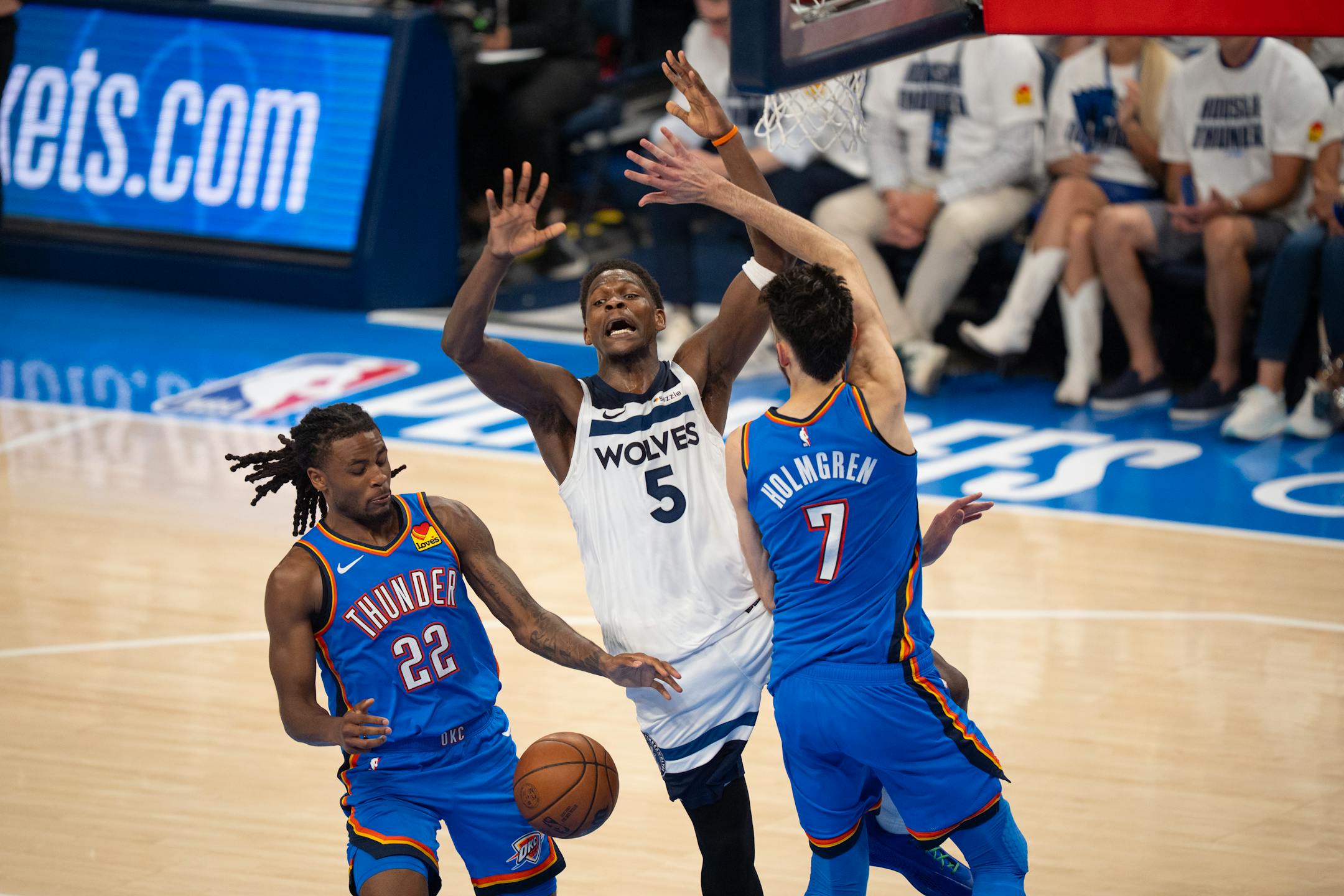
Timberwolves guard Anthony Edwards (5) was thwarted by Thunder guard Cason Wallace (22) and center Chet Holmgren in the NBA playoffs last season. (Jeff Wheeler/The Minnesota Star Tribune)

In the NBA Western Conference finals last season, the Timberwolves played right into the hands of the Oklahoma City Thunder.

To beat the Thunder, who had far and away the top defense in the league, teams have to be able to get out in transition on them. The numbers quantify this. The Indiana Pacers took the Thunder to seven games in the NBA Finals in part because they were wired to play in transition. Indiana was seventh in the league in generating offensive possessions in transition, whether off a turnover or a rebound, last season. The Pacers were fourth in offensive efficiency off those plays, according to the advanced statistical website Cleaning the Glass.

That was the primary way the Pacers were able to counter Oklahoma City‘s grinding half-court defense.

The Wolves? Not so much. They were 27th in generating transition opportunities, and they were last in doing so off defensive rebounds. They played right into Oklahoma City’s hands when they had the ball, because often they were setting up their offense in the half court. That was a disaster for most of the series.

So one way for the Wolves to get better against the Thunder — and just get a more efficient offense in general — is to generate more offense in transition. The Wolves were 13th in efficiency when they got out in transition, they just didn’t do it all that much.

“What you would see last year, we would kill our own transitions,” assistant coach Micah Nori said. “Our defense has been very, very good. We get a lot of stops. But we don’t get a lot of easy buckets because of it. Because I thought what happened a lot last year was Rudy [Gobert] would rebound, and he’d be turning and looking at Mike [Conley], Ant [Anthony Edwards] and Julius [Randle].”

A focal point of training camp is bringing that number up by bringing the ball up the court faster. The Wolves have outlined a general pattern for how to operate off a defensive rebound, specifically if Gobert is the one grabbing it — get the ball to Conley and everyone else gets down the floor, specifically to the corners to spread the floor.

“You want to try to form good habits early on,” Conley said. “And if you get guys, our most athletic guys, running the floor — Julius, you got Ant and Jaden [McDaniels], Rudy, whoever, and me being able to just kind of be the quarterback, I like to throw it ahead. I like to push the tempo and get guys involved.”

ADVERTISEMENT

That means Randle and Edwards shouldn’t be hanging around to get the ball from Gobert and then bring it up. They should be trying to push the pace and push the defense with them. It’s an issue Edwards said he had to correct.

“We did a bad job last year of just everybody coming back to the ball, especially myself, because I love to go get the rock,” Edwards said.

There’s an added benefit to transition for Edwards, who faces frequent double teams in the half-court offense. If the Wolves can get in transition more often, it means he will face fewer of the double teams he receives when they are slow in bringing the ball up the floor. Coach Chris Finch made that same point to Edwards, he said.

“Me getting out in transition should be able to eliminate all those things,” Edwards said.

The games of bench players Rob Dillingham and Terrence Shannon Jr. should more naturally lead to the Wolves pushing the pace. That was one of the ways Finch told Dillingham he could play more minutes, and Shannon found playing time last year thanks in part to his ability to attack the rim in transition.

The starting group not only has Edwards and Randle who can do that, but also McDaniels, whose height allows him to finish over smaller defenders with good efficiency at the rim.

On paper, it’s easy to think of the Wolves as a slow team because of the lumbering Gobert and Conley, soon to turn 38. But they’re not using that as an excuse to be near the bottom in generating transition opportunities.

“Everybody says it every training camp,” Nori said. “Everybody is saying the thing. But for us, it’s building those habits, continuing to talk about that every day, not just the first week of camp.”

about the writer

about the writer

Chris Hine

Sports reporter

Chris Hine is the Timberwolves reporter at the Minnesota Star Tribune.

See Moreicon

More from Wolves

See More
card image
Ella Hall/The Associated Press

The Wolves again made life tough on themselves vs. the worst team in the West, but they left New Orleans with two victories in two games.

card image
card image