Minnesota seeks slice of $50B in federal funds to address rural health crisis

Application process does little to ease fears that Trump administration could favor Republican-led states over next decade.

The Minnesota Star Tribune
September 19, 2025 at 3:11PM
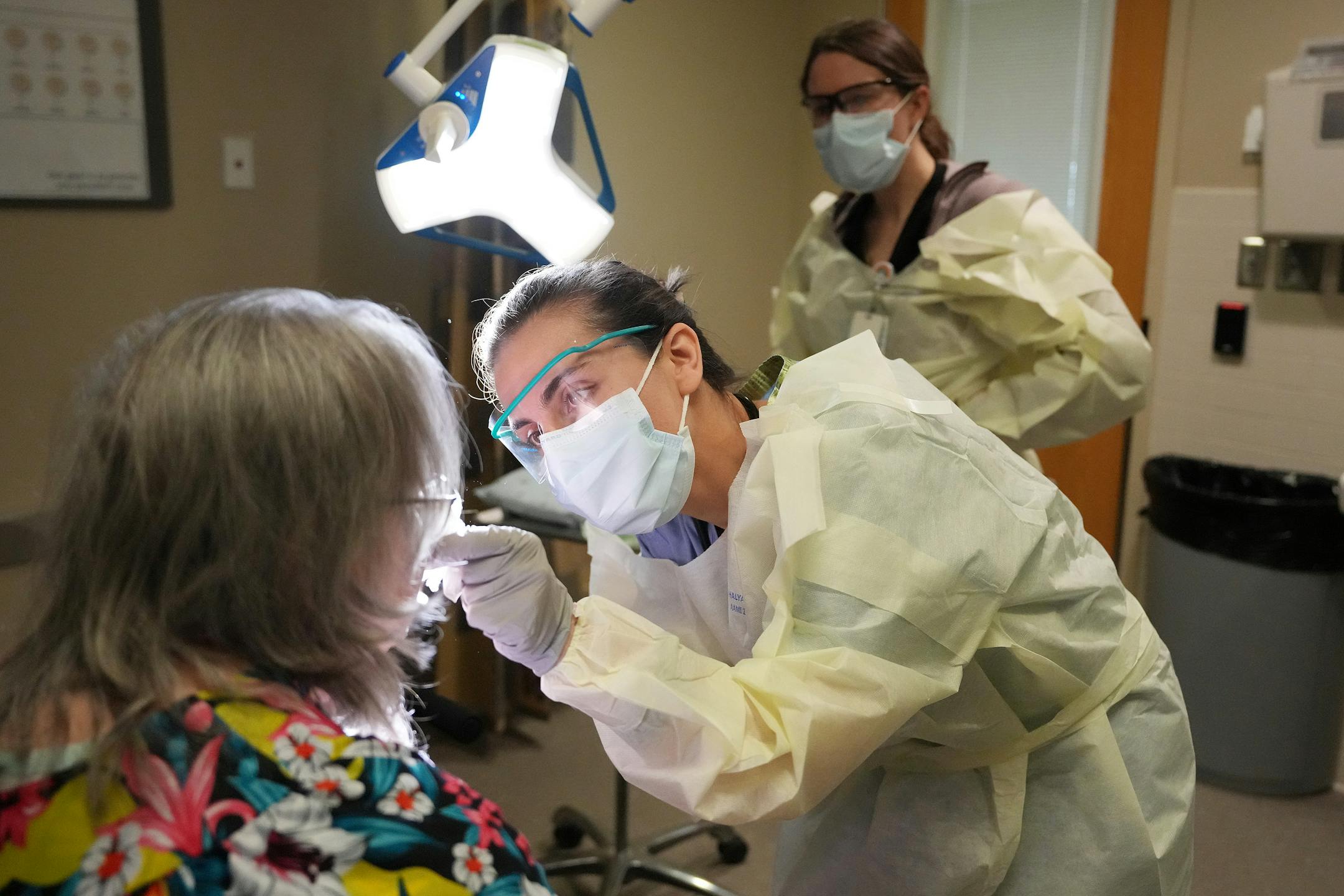
Dr. Alison Raffman, a medical resident at HCMC who spent a month doing rural ER care at Sanford Bemidji Medical Center, treats patient Sandy Helberg for a bloody nose as attending emergency physician Dr. Andrea Patten looks on in February. Some say the state should apply for federal funding to cover similar programs in Minnesota. (Anthony Soufflé/The Minnesota Star Tribune)

Minnesota officials have a little more than a month to petition for their slice of $50 billion in one-time federal funding for struggling rural health care providers and safety-net hospitals.

Deciding how to spend the money, and on whom, is the first challenge. Applying in a way that appeals to President Donald Trump’s administration is the next, especially amid concerns that the selection process could be tilted against Democrat-led states.

The president has been accused before of political bias in decisionmaking, whether targeting left-leaning cities for military anti-crime deployments or closing federal regional health offices in five Democrat-led states.

“I hope to be proven wrong, but I have real concerns that they’ll try to rig this process to reward red states and punish places like Minnesota,” said U.S. Sen. Tina Smith, D-Minn. The senator, who visited several rural Minnesota hospitals earlier this year to highlight their financial pressures, added that she will be monitoring the process.

The federal Centers for Medicare and Medicaid Services (CMS) this week issued a Nov. 5 deadline for states to apply for the Rural Health Transformation funding. The agency also listed “approved uses” that states must pursue and a scorecard for how it will judge applications.

Even with the guidance, the decisions “are largely at the whims of CMS, which can use ‘any factors that [it] determines appropriate,’” said Jeff Smedsrud, a Fergus Falls-based health care reform activist, quoting from the legislation that approved the funding.

The Trump administration pushed a tax-cutting reform package through Congress that is predicted to reduce Medicaid health care spending by $1 trillion over the next decade. The $50 billion in rural health spending, paid out over the next five years, was added to the budget package at the urging of Republican and Democratic lawmakers to give health care providers relief from these predicted cuts.

Minnesota government and hospital leaders said they can’t afford to ignore the Rural Health Transformation money. Thirty-one of 127 Minnesota hospitals were in financial distress at the end of 2023, meaning they had lost money on operations in four of the previous eight years.

“While this funding cannot replace the substantial loss of health care funding from the [budget-cutting] bill, we are interested in this opportunity if it can help bolster a system that is lacking stability,” said Patrick Hogan, a spokesman for Minnesota Management and Budget (MMB). The state agency is handling Minnesota’s application.

Separately, the state rushed to meet a federal deadline this summer for so-called “directed payments” from Medicaid, which would levy a special state tax on Minnesota hospitals but allow them to gain back far more in federal reimbursements. However, the Trump budget limited the potential gains from directed payments as well.

One thing emphasized this week: Federal decisionmakers aren’t interested in helping states and health care providers pay existing bills with the transformation funding. Rather, they want the money to pay for ideas that expand rural access to health care and make it better and more affordable. U.S. Health and Human Services Secretary Robert F. Kennedy Jr. labeled it “the largest investment ever made to improve health care for rural Americans.”

David Herman, chief executive of Essentia Health, said Minnesota would be wise to promote in its application a few promising reform ideas that will excite federal decisionmakers “rather than put a half a coat of paint on each house” and spread the money thinly across the entire health care system. The Duluth-based health system operates hospitals and clinics across northern Minnesota.

“Let’s really go for this,” he said. Minnesota has “a very strong history of being innovative and a very strong history of being effective and efficient at meeting our patients’ needs.”

Herman suggested investments in rural training of doctors and mental health providers, which would provide short-term relief to staffing shortages at rural hospitals and clinics in hopes of convincing the trainees to set up their practices in small towns.

Sanford Health recently launched a partnership with HCMC to rotate residents training in emergency medicine to a hospital in Bemidji — with a similar hope.

States get one shot at applying and little chance to appeal. MMB has been asking for suggestions from health care providers and the public.

Preference goes to states with larger rural populations and more rural health care providers, which could give Minnesota an advantage. The state has the fourth-highest number of critical access hospitals — facilities with no more than 25 inpatient beds that receive federal payment boosts to maintain rural health care access.

Approved uses of the funding include preventing chronic diseases such as diabetes; investing in telehealth and technologies that expand health care access; recruiting and retaining rural medical providers; and rewarding efficient providers that avoid unnecessary or redundant medical care.

Minnesota might have an edge because it has experience in these areas, said Kenneth Westman, chief executive of Riverwood Healthcare Center, a critical access hospital in Aitkin. Riverwood and 18 other small, independent hospitals created the Headwaters Network to save money by pooling resources and finding ways together to be more efficient.

One dilemma for Minnesota: The state could request funding for rural health care alone, but the federal rules also allow the money to be used on safety-net providers in urban areas.

In Minnesota, that includes HCMC in Minneapolis and North Memorial in Robbinsdale. Both are under growing financial strain but operate high-level trauma centers that showed their importance recently in the treatment of multiple victims of the Annunciation Catholic Church and School shooting.

Smedsrud said states should be mindful of the federal decisionmakers, perhaps emphasizing how their proposals will create jobs, which has been a Republican priority, he said.

But he said that ultimately “bold thinkers should think boldly” and propose ideas that will improve health care rather than cater to politicians. Hospitals could even look beyond their traditional roles, he said, and offer healthy food distribution or even child care if that is what their communities need.

about the writer

about the writer

Jeremy Olson

Reporter

Jeremy Olson is a Pulitzer Prize-winning reporter covering health care for the Star Tribune. Trained in investigative and computer-assisted reporting, Olson has covered politics, social services, and family issues.

See Moreicon

More from Health Care

See More
card image
JULIA RENDLEMAN/The New York Times

Carbondale, a liberal enclave within driving distance of 10 states with abortion bans, has become a hub for the procedure.

card image
Nancy Ingham gives newborn Sophia Rash a hepatitis B shot several hours after she was born, Jan. 17, 2006.