

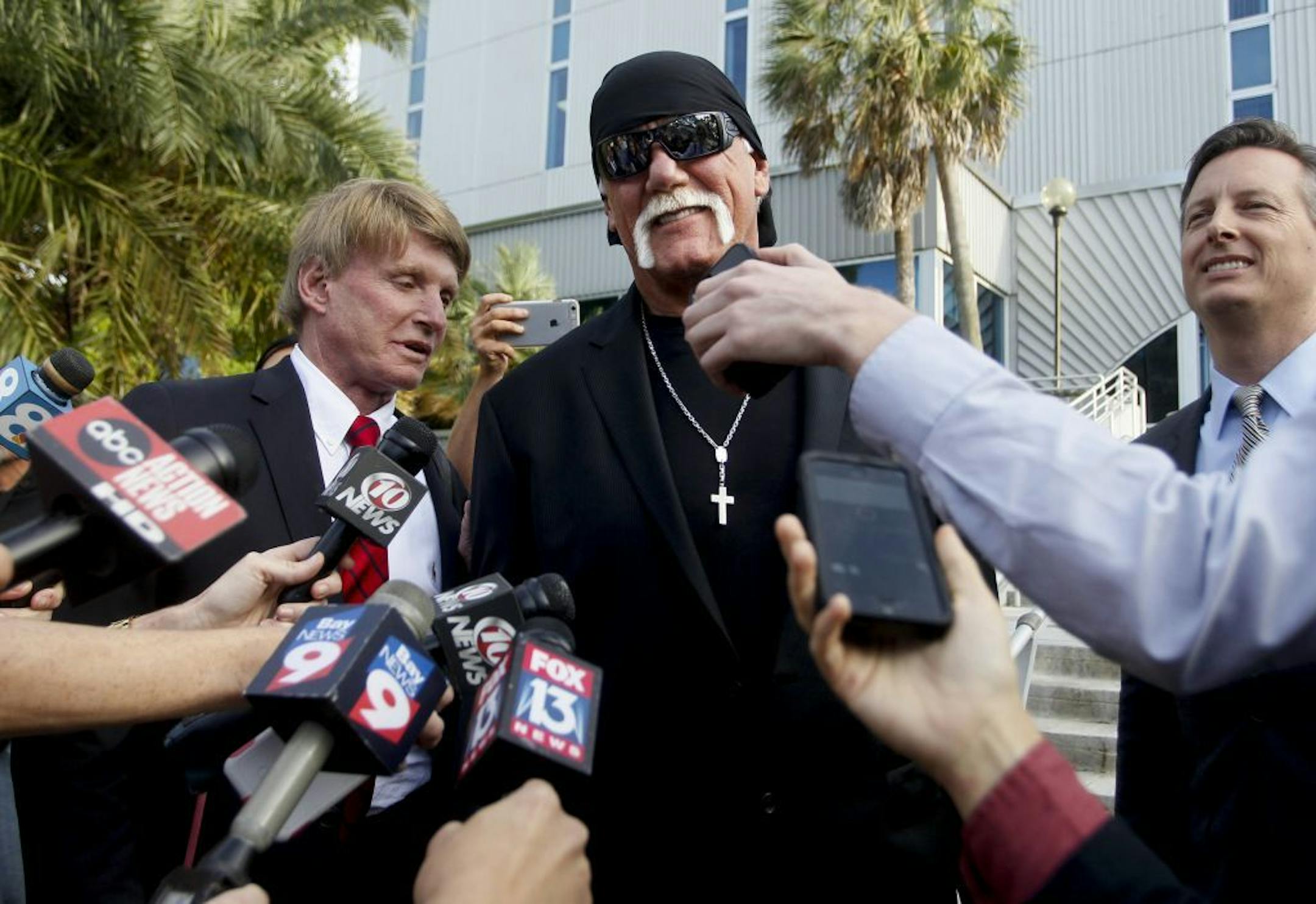
The case of Hulk Hogan v. Gawker has raised important First Amendment issues, which just goes to show that nothing is so ridiculous that it can't raise a serious concern.
As the old legal adage reminds us, hard cases make bad law. A less-well-known adage is also true: Hard cases make good billable hours for attorneys. They had plenty to work with here.
We do not know all the facts, but what we know is absurd: The professional wrestler known as Hulk Hogan, real name Terry G. Bollea, was recorded on video in 2006 having sex with the wife of his friend, Florida shock-radio personality Todd A. Clem, who had changed his legal name to Bubba the Love Sponge Clem.
Gawker, the online media company, which made its reputation by trading in scandal and gossip, somehow got hold of the tape in 2012 and decided it was news that its audience just had to see.
This hurt Hogan's feelings. Because this is America, where the only salve for hurt feelings is bucketloads of money, he sued and members of a jury in Florida dutifully obliged him on Friday.
They awarded him compensatory damages of $115 million - more than the $100 million he sought, perhaps because enough is never enough when it comes to hurt feelings. Of this, $55 million was for economic harm and $60 million for emotional distress. On Monday, they tacked on $25 million in punitive damages. (Gawker is planning to appeal, of course.)
The first thing that struck me is that Bubba the Love Sponge Clem is an outstanding name. This case may turn out to be a disaster for the First Amendment, but journalists writing about it had the rare joy of writing Bubba the Love Sponge Clem, despite this gentleman never appearing as a witness.
Just to write those magic words - and let me be formal, Mr. Bubba the Love Sponge Clem - is an opportunity that comes along only rarely in a journalist's lifetime. A single mention is enough to banish all career worries - the tedium of council meetings, the lack of pay raises, the threat of layoffs, the abuse at Trump rallies.


