

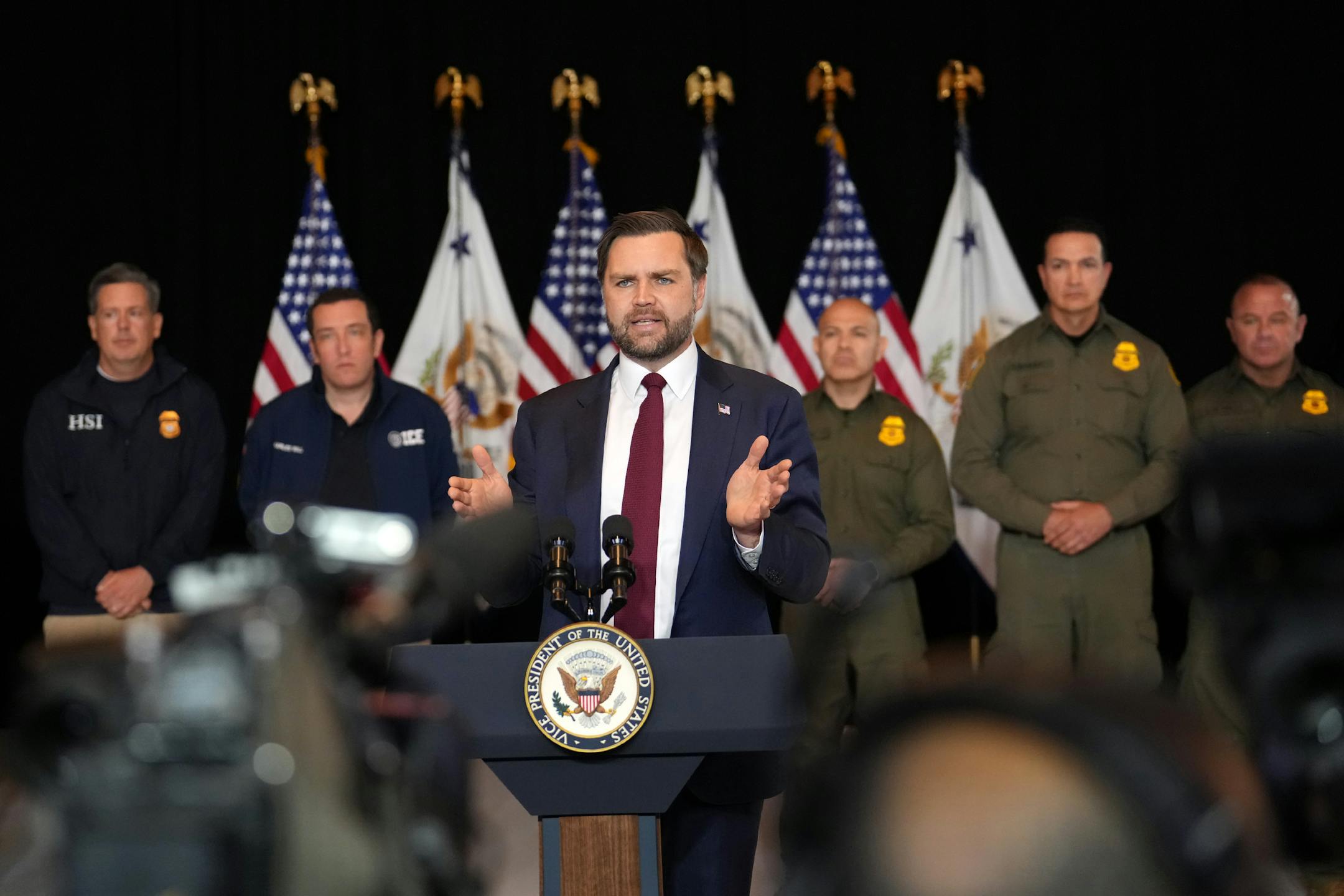
Vice President JD Vance acknowledged chaos in Minneapolis during the federal government’s immigration enforcement surge but said the operation would be smoother with better cooperation from local officials.
Speaking to reporters in Minneapolis on Thursday, Jan. 22, Vance said he doesn’t think the president needs to invoke the Insurrection Act to deploy military for law enforcement because of the large number of federal officers already in the Twin Cities area, but he said that if “chaos gets worse” or more ICE agents get assaulted “that would be a problem.”
“The reason why things have gotten so out of hand is because of the failure of cooperation from state and local authorities,” Vance said.
Vance delivered remarks and answered questions in Minneapolis after privately meeting with ICE agents and business leaders in an effort to “tone down the temperature a little bit.” He said reports of racial profiling or violations of the rights of citizens would be taken seriously and that a small number of officers make mistakes, but he argued that many stories have missed context that help justify the actions of immigration officials.
Flanked by ICE SUVs, federal agents and American flags, Vance said most protesters have been peaceful, but many not. He said “far-left” agitators are to blame for creating an environment of fear for ICE agents who have been followed, harassed or assaulted. Many agents are in Minneapolis just to protect other officers carrying out the operation from crowds, he said.
“Yes, come out and protest, protest me, protest our immigration policy, but do it peacefully,” Vance said. “If you assault a law enforcement officer, the administration and I wanted to show some support for these guys who frankly are operating in a very, very tough environment.”
Gov. Tim Walz responded to Vance in a post on social media saying he is glad Vance “agrees the temperature needs to be turned down.”
But Walz said Minnesota doesn’t need 3,000 ICE agents in the state. “Take the show of force off the streets and partner with the state on targeted enforcement of violent offenders instead of random, aggressive confrontation.”




![Shoppers made their way through a parking ramp at the Mall of America, Tuesday, November 13, 2018 in Bloomington, MN. A new camera-based parking system, currently up and running at the mall, is expected to help shoppers have an easier time finding a place to park. ] ELIZABETH FLORES ï liz.flores@startribune.com](https://arc.stimg.co/startribunemedia/QUXCIHRX6DTG5YE7PMPVXA63AI.jpg?&w=436&ar=3:2&fit=crop)

