
State pushes against federal demands for access to personal data of Minnesotans

The Trump administration says it needs to collect data from agencies that receive federal funds to ensure programs are operating lawfully.

The Minnesota Star Tribune
August 15, 2025 at 10:00PM
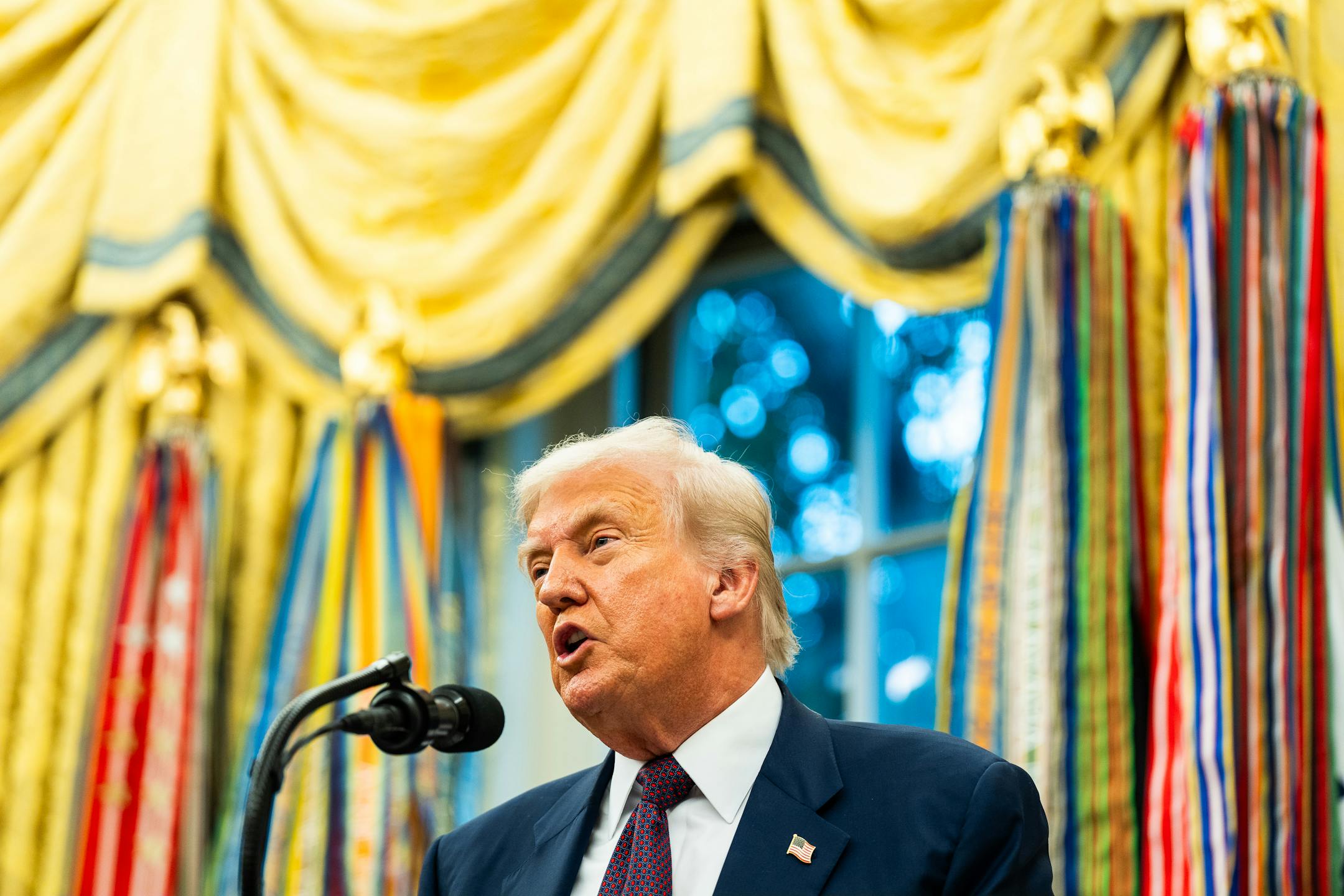
President Donald Trump in the Oval Office of the White House on Aug. 6. (Demetrius Freeman/The Washington Post)

The Trump administration is requesting a trove of personal information from Minnesota government agencies about the state’s residents, including Social Security numbers, addresses and voter registration records.

In May, federal officials asked for personal data from nutrition programs, and in June the administration instructed the state to submit health information and immigration status for individuals who received emergency medical treatment under Medicaid.

The requests are part of a national push from the White House to access data that is currently only held by the states. An executive order issued in March instructs agencies to ensure the federal government has “unfettered access to comprehensive data from all state programs that receive federal funding,” which it said would help it stop waste, fraud and abuse.

So far, Minnesota’s state agencies have largely resisted the federal government’s requests. State officials say they worry the administration will use some of the data to find individuals to target for deportation conduct deportations.

“I view it as a bad faith effort to try to extract information from us that it can use to hurt Americans,” said Minnesota Attorney General Keith Ellison, a Democrat who has signed the state onto a lawsuit resisting the administration’s request for data from the Supplemental Nutrition Assistance Program (SNAP), commonly known as food stamps.

“The federal government has to obey the law,” Ellison said. “They can’t just go on fishing expeditions.”

The state’s response has frustrated some local Republicans, who have pushed for cooperation with the federal government.

“Minnesotans expect their state to collaborate with federal partners to protect public safety, address fraud, and ensure government services are delivered,” said state Sen. Jordan Rasmusson, R-Fergus Falls, in a statement.

Rasmusson accused Ellison and Gov. Tim Walz of “attempting to thwart the Trump administration’s efforts to enforce our nation’s immigration laws.”

Concerns about a mass ‘surveillance system’

The U.S. Department of Agriculture told the state in May to deliver more than five years’ worth of data on SNAP recipients, including names, dates of birth, addresses and Social Security numbers. It also requests the dollar value of the SNAP benefits each participant has received.

A notice issued in July says the federal government will use the data “to ensure the integrity of government programs, including by verifying SNAP recipient eligibility against federally maintained databases, identifying and eliminating duplicate enrollments and performing additional eligibility and program integrity checks specified herein.”

“I think what they’re trying to do is amass massive amounts of data to identify people who they want to go after,” Ellison said. Minnesota has not submitted the data.

The SNAP lawsuit filed by Minnesota and 20 other states says the request is illegal and comes as the Trump administration’s attempts to create “a surveillance system to advance the president’s agenda, including by facilitating the president’s mass deportation efforts.”

In a court filing last month, attorneys for the administration called those claim speculation. While undocumented immigrants are not eligible for federal benefits, they may have children who are U.S. citizens who are.

Federal privacy law requires that data be used according to its original purpose, but John Davisson, litigation director for the Electronic Privacy Information Center (EPIC), a public interest research center in Washington, said USDA is “trying to vacuum up data in an unnecessary way to the federal level for its own future secondary uses and making it into a piggy bank that can be used for whatever law enforcement purpose they see fit.”

EPIC is also suing over the SNAP data request. Previously, safeguards in USDA balanced the need to identify fraud and waste with individuals’ privacy, Davisson said.

A fundamental element of federal privacy law is a set of limitations on data gathering, said Dongsheng Zang, an associate professor of law at the University of Washington. If data is shared too easily between agencies, Zang said, “then the collection of data would be really, really unchecked.”

USDA declined to comment, citing the pending litigation. But in a court filing in response to the EPIC lawsuit, USDA lawyers said “critical information necessary to uncover fraud and determine payment accuracy in SNAP is spread across ... states and territories as well as several private actors.”

Battle in the courts over health data

In June, the Centers for Medicare and Medicaid Services also requested patient data from the Minnesota Department of Human Services. The information requested includes patient ID numbers, diagnoses, birth dates, provider names and addresses and immigration statuses.

CMS regularly requests health data from states in targeted batches as part of routine audits to ensure federal funds are being used in compliance with Medicaid rules.

The agency’s June request said the data was needed to ensure that federal reimbursements were only being paid in cases of where emergency care was needed for patients “without a satisfactory immigration status.”

States are prohibited from receiving Medicaid reimbursements for non-emergency services for undocumented immigrants (and even some non-citizens in the country legally). However, states can get Medicaid reimbursements for emergency care provided to people who are undocumented.

In a statement, DHS said CMS asked for the data by the end of July, but the state agency informed the federal government it would not be able to complete the request by then.

The broad request also came after the U.S. Department of Health and Human Services entered an agreement to share personal data of Medicaid recipients with the Department of Homeland Security. A court recently issued a preliminary injunction against the department, halting the sharing of any information collected from states that sued, including Minnesota.

DOJ wants state voter rolls

Also in June, the U.S. Department of Justice asked Minnesota’s election officials for its voter registration list and other information about the state’s voting systems. Secretary of State Steve Simon’s staff provided some of the requested info but declined to share its voter rolls, saying the DOJ did not give any legal justification for it.

The DOJ has not yet responded to the denial, a spokeswoman for Simon’s office said. The DOJ declined to comment.

Some legislative Republicans have urged Simon’s office to comply with the federal request. Rep. Duane Quam of Byron said he’s raised concerns with county and state elections officials over the state’s voter registration system and allegations of voter fraud, and been disappointed in the response.

“I would love to have the federal government, an outside entity, look into our election registration system,” he said. “Because, frankly, I don’t see the intent or desire in the counties and at the Secretary of State’s office to fix this.”

But the law is on Minnesota’s side, several legal and voting experts told the Minnesota Star Tribune. They say the voting laws Congress passed in the 1990s and 2000s purposefully limit the oversight powers of the federal government in favor of state autonomy. The DOJ’s request of Minnesota and other states is unusual in both its method and scale, they added.

Justin Levitt, a law professor at Loyola Law School and former deputy assistant general in the Civil Rights Division of the DOJ from 2015 to 2017, also cited the federal privacy law that requires the federal government to publicly say why it is making a request, how it will use the data, and more. The DOJ letter did none of those things, Levitt said.

The DOJ letter also said the state could send its data via a secure file-sharing system or via email. The latter would be “insanely stupid,” Levitt said.

“The quality of legal reasoning and the quality of work product is embarrassing,” Levitt said of the letter. “But frankly, I think that the fact that it’s illegal should be more alarming.”

about the writers

about the writers

Allison Kite

Reporter

Allison Kite is a reporter for the Minnesota Star Tribune.

See Moreicon

Nathaniel Minor

Reporter

Nathaniel Minor is a reporter for the Minnesota Star Tribune.

See Moreicon

More from News & Politics

See More
card image
Jose Luis Magana/The Associated Press

U.S. attorney general says alleged serial rapist struck because Minnesota is ‘soft on crime’

card image
card image