Editor's Pick

Editor's Pick

The Trump administration calls them the ‘worst of the worst.’ Here’s what we found.

The federal government has identified only a fraction of the immigrants it has detained. Many have violent criminal records, but few were wanted by police.

January 21, 2026 at 12:00PM
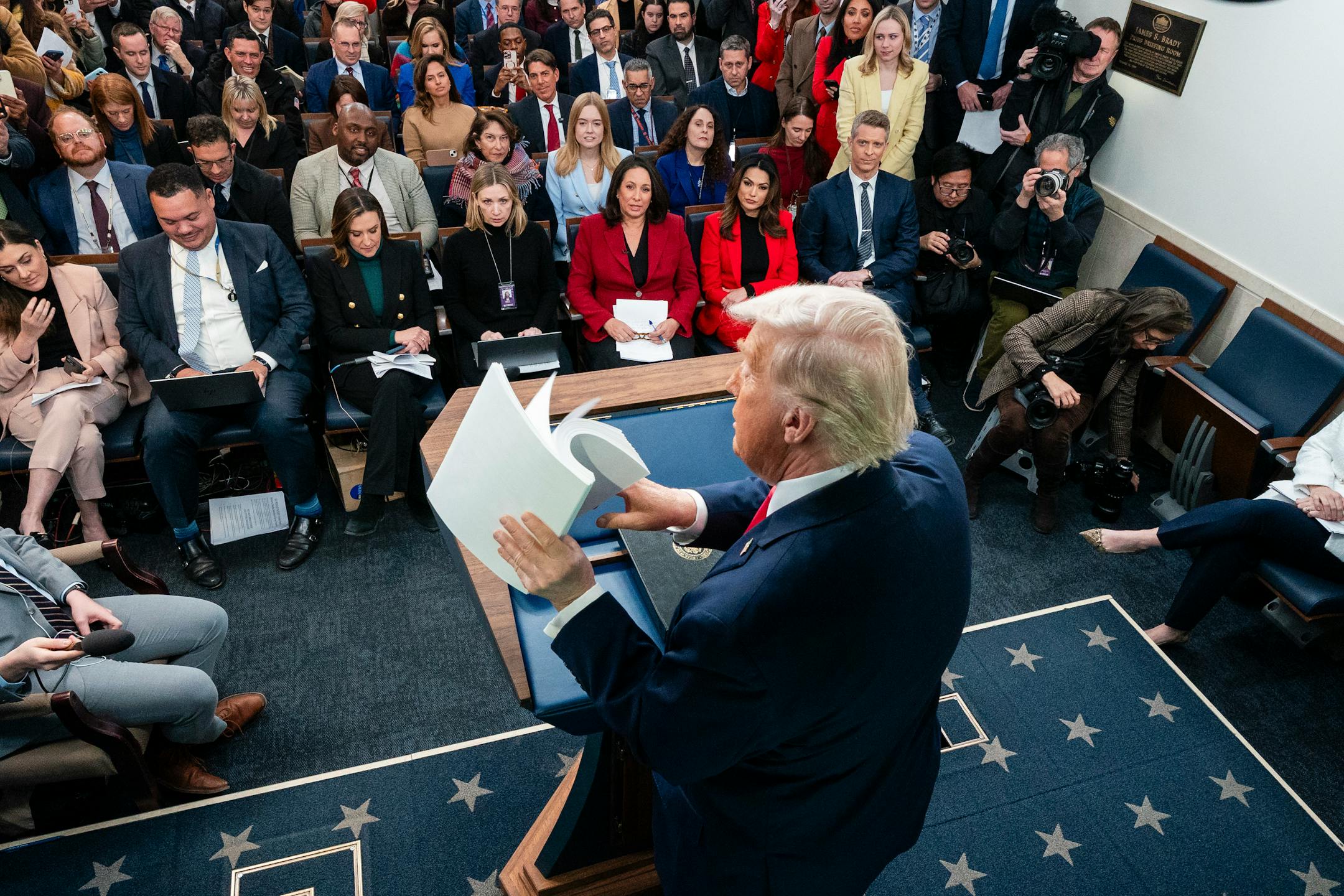
President Donald Trump holds a packet of papers labeled “accomplishments” while speaking to reporters at the White House on Jan. 20. (ERIC LEE/The New York Times)

Federal officials say they’ve arrested 3,000 immigrants in Minnesota since Operation Metro Surge began in December and frequently describe them as the “worst of the worst” — “violent assailants, domestic abusers, and drug traffickers” — who’ve been allowed to run rampant because of the state’s sanctuary policies.

On Tuesday, the Trump administration put on a full-court press to highlight the list, including a Minneapolis news conference by Greg Bovino, a U.S. Border Patrol senior official, and a White House news conference featuring the president.

“Do you want to live with these people?” President Donald Trump asked while holding up mugshots of some of the Minnesota immigrants on the list. “Boy, these are rough characters.”

It is difficult to verify those claims. The U.S. Department of Homeland Security has released the names of only about 240 immigrants who it arrested, and a close review of thousands of pages of court documents, prison logs and other public records shows a more complicated picture.

About 80% of the 240 men on the “worst of the worst” list have felony convictions for crimes like murder, rape, theft, drugs or fraud. But nearly everyone on the list has gone through the court system, served time for their crimes and was not actively wanted by police when they were detained by Immigration and Customs Enforcement.

In many instances, ICE didn’t detain these individuals in the military-style raids that have come to define Operation Metro Surge. Public records show they were picked up after being released from jail or prison and put on parole.

More than a quarter also have no criminal connection to Minnesota except for being held in one of the state’s four federal prisons. Since their crimes were committed in other states, it’s unclear if they set foot in Minnesota beyond serving time here.

Public records show little to no criminal histories for more than a dozen cases aside from traffic tickets, gross misdemeanors and DWIs.

The majority of the immigrants on the list are men from Mexico and Latin America. Despite the Trump administration’s justification that Operation Metro Surge is aimed at stopping fraud in social services programs perpetrated by Somalis, only 23 linked to Minnesota are from Somalia.

In about a third of the instances, the Minnesota Star Tribune wasn’t able to fully verify the alleged criminal histories documented by the federal government or find a record of the individual at all.

The DHS has also added and removed names from the list, so the total number of people on the list has shifted.

The “worst of the worst” list represents about 7% of the 3,000 immigrants Immigration and Customs Enforcement claims to have detained in Minnesota since December. ICE has declined repeated requests to provide the names of people detained in Minnesota.

Federal officials claim, without providing evidence, that 70% of those detained have criminal histories.

DHS and ICE officials did not respond to detailed questions from the Star Tribune about the 240 people identified by the government. Instead, it responded to questions by sending an old news release highlighting those with some of the most serious charges.

Here’s what else we found:

The worst offenders

The Star Tribune found felony convictions for violent crimes like murder, robbery, assault or sex offenses for about 70 men on the list.

People like Aldrin Guerrero-Munoz, a 45-year-old Mexican national. He pleaded guilty to second-degree murder in 2005 for the killing of his 15-week-old son, whose head was smashed against a wall.

In 2015, while still in prison, Guerrero-Munoz was convicted of another violent crime — third-degree assault — after he and another man attacked a fellow inmate who disrespected them, court records show.

An immigration judge ordered Guerrero-Munoz deported in 2017. In October, he was released from prison and detained by ICE, at least a month before Operation Metro Surge started.

Minnesota corrections officials say they always check the citizenship status of prisoners and notify ICE if someone does not have legal status. It’s up to ICE to send a detainer request so the state can notify them when a prisoner is about to be released.

There are also long-time offenders on the list who ICE had a chance to detain previously, but likely had trouble deporting because their home country wouldn’t accept them.

Thongkham Soukaroune, 49, of Laos, was convicted of drive-by-shooting in 1999, which was the first of his five felony convictions. He’s served time in county jails and two stints in state prison, where state corrections officials would have alerted ICE to his noncitizen status.

Soukaroune was released on parole in August and detained by ICE. For decades, his native country did not have a formal repatriation agreement with the U.S. It has recently started accepting deportees.

Criminals from other states

About 70 immigrants on the “worst of the worst” list are in Minnesota because they were serving time in federal prison. Like Minnesota law, federal policies require immigrants who commit crimes to serve their sentences before being deported.

ICE is aware they are in custody and can detain them upon release.

That’s what happened with Sakiru Ambali, a Nigerian by birth and now a Canadian citizen. Ambali was held at the Federal Medical Center in Rochester, a prison for inmates who need specialized care.

Ambali was arrested in 2023 in Germany for stealing $2.4 million in pandemic unemployment benefits from his home in Canada. In 2024, he was sentenced to 42 months in federal prison for wire fraud and aggravated identity theft.

About four dozen on the list faced charges of violating immigration law by illegally re-entering the country after deportation. Illegal re-entry is one of the most common nonviolent offenses for immigrants on the list. The Trump administration now allows people to avoid prison time for that crime if they agree to enter a fast-track deportation process.

The Minnesota portion of the list also includes about a dozen people for whom the Star Tribune could find no state record of past convictions or prison sentences. The list includes two men apprehended near Columbus, Ohio, who have since been removed from the DHS website.

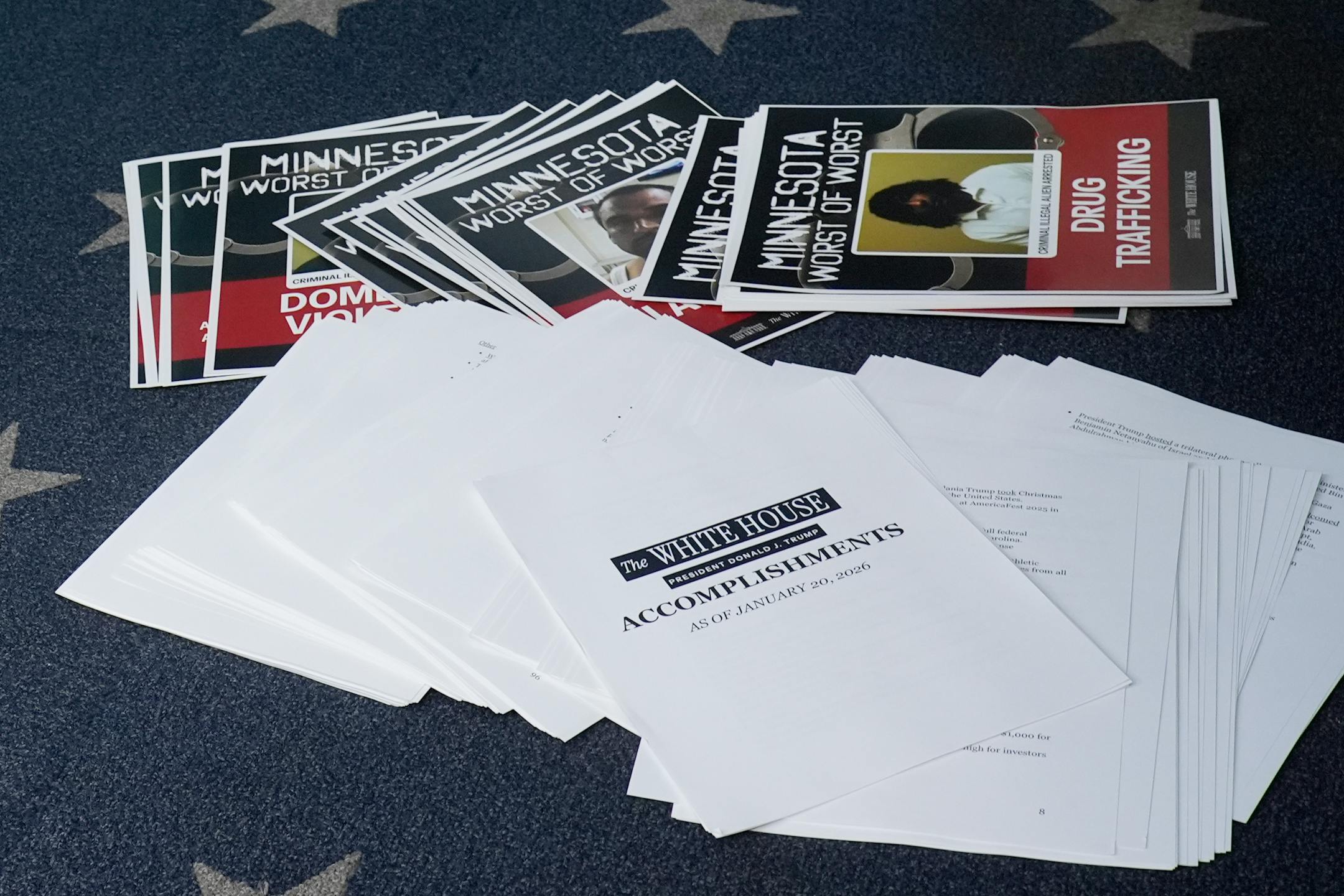
Mugshots and other documents lie on the briefing room floor as President Donald Trump speaks with reporters at the White House on Tuesday, Jan. 20, 2026. (Alex Brandon/The Associated Press)

Other offenders

The Star Tribune could find only petty misdemeanor convictions like speeding tickets or DWI for roughly a dozen people on the list. Others have criminal histories that are decades old and have completed their sentences.

At least one immigrant who was detained by ICE has been released. Federal court records show attorneys for Abdulkadir Sharif Abdi persuaded a federal judge in Nebraska to release him.

Abdi has a criminal history, but his last conviction was over a decade ago. In 2018, immigration officials allowed him to stay in the U.S., and he’s now a well-known addiction recovery counselor.

Court records show Abdi was detained by ICE on Dec. 1 at his Minneapolis home, with federal officials alleging he’s a current gang member. Agents told him they had “orders” and a warrant for his arrest, records show.

Just before Christmas, government attorneys withdrew their opposition to Abdi’s release. A federal judge in Nebraska barred ICE from detaining him again.

Abdi, who did not respond to a request for comment, is still featured on the “worst of the worst” website.

Louis Krauss, Elliot Hughes and Jeff Day of the Minnesota Star Tribune contributed to this story.

about the writers

about the writers

Christopher Magan

Reporter

Christopher Magan covers Hennepin County.

See Moreicon

Jeff Hargarten

Data Journalist

Jeff Hargarten is a Minnesota Star Tribune journalist at the intersection of data analysis, reporting, coding and design.

See Moreicon

More from News & Politics

See More
Michele Tafoya, sideline reporter for NBC Sunday Night Football, lives in Edina with her husband and two children. Tafoya recently joined Tom Barnard on the popular KQ Morning Show.
Brian Peterson/The Minnesota Star Tribune

She is running as a Republican and looks to win the seat held by Democrat Tina Smith, who is not seeking re-election.

card image
card image