One architect’s vision for a transformative new NBA arena in downtown Minneapolis

Designers from Gensler built a conceptual model for a new arena in the Warehouse District to spark conversation and encourage visionary thinking for what the next Timberwolves/Lynx home could be.

The Minnesota Star Tribune
October 30, 2025 at 11:01AM
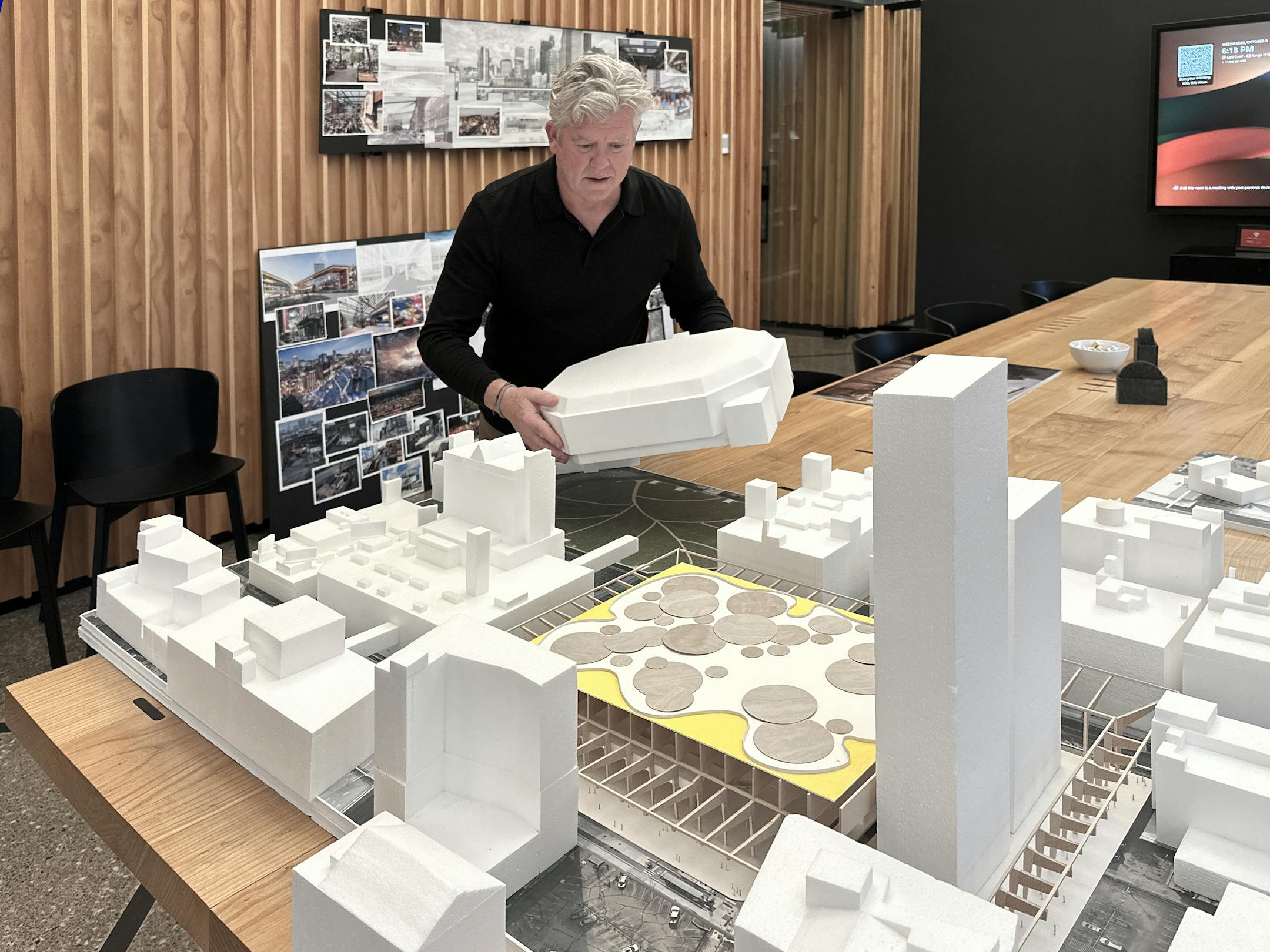
Bill Baxley, a Minneapolis design principal for global architecture firm Gensler, holds a model of Target Center over his team's concept for a new basketball arena blocks away. (Jessie Bauldry/Gensler)

When architect and designer Bill Baxley heard the new owners of the Timberwolves and Lynx wanted a new arena, he and his colleagues started discussing location.

One Styrofoam model later, they had an idea: Build the arena kitty-corner from the teams’ current home, Target Center, on a block and a half of land near the Warehouse District/Hennepin Avenue light-rail stop.

Their conversations went beyond the where. The arena could be embedded deeper into the ground to integrate the concession level with surrounding streets. An extended roof would cover those, creating a public market of sorts. Incorporating that transit station and adding a rooftop park would make the project more than just a sports venue, and building high-rise developments next door could help monetize it all.

Right now, it’s all just a vision that’s years and millions of dollars away from becoming reality. But the prospect of a new professional basketball facility in the Twin Cities has developers and fans alike excited.

Marc Lore and Alex Rodriguez became majority owners of the NBA/WNBA franchises in June, doubling down on their long-stated desires for an arena anchoring an entertainment district that could funnel revenue back into the teams. As public- and private-sector leaders in Minneapolis look to reimagine downtown to meet the post-pandemic era, a new arena could present one of the most seismic opportunities to transform the urban core.

Baxley knows this well as a design principal in the Minneapolis office of Gensler, a global architecture firm that’s designed and renovated professional sports facilities across the country.

The goal of the modeling exercise, he said, was to spark conversations and encourage visionary thinking around the future of the facility. The idea is purely conceptual, and neither the teams nor developers commissioned it.

“I think everybody’s realizing we don’t want to waste a good opportunity to think really big about what we should do,” Baxley said. “This is a big deal for our city. Let’s have those bigger conversations about what we want.”

An urban experience

The land between 1st and Hennepin avenues and 4th and 6th streets is the focus of Gensler’s model.

One version of the concept would displace the historic Masonic Temple, now known as the Hennepin Center for the Arts, as well as the Cowles Center for Dance & the Performing Arts. Same with Gluek’s Restaurant and Bar, a downtown mainstay. Alternatively, the plan could reverse and shift half a block to instead take the place of long-running nightclub Gay 90s.

Baxley, who serves on the Minneapolis Planning Commission, acknowledged gaining control of those sites and permission to redevelop them would be a massive and challenging undertaking in and of itself. But for the purposes of this exercise, he said, imagine there was a plan to relocate the businesses and reuse the Masonic Temple’s facade.

The city would then face an opportunity to rethink a part of downtown that’s struggled with crime and mostly housed parking for years.

Baxley points to the University of Texas at Austin’s Moody Center, which Gensler helped design, as an example of a sunken arena that flows into a public plaza. The firm also helped design the Milwaukee Bucks’ Deer District, a mixed-use neighborhood outside the team’s new Fiserv Forum that includes a public plaza, entertainment venues, restaurants and retail.

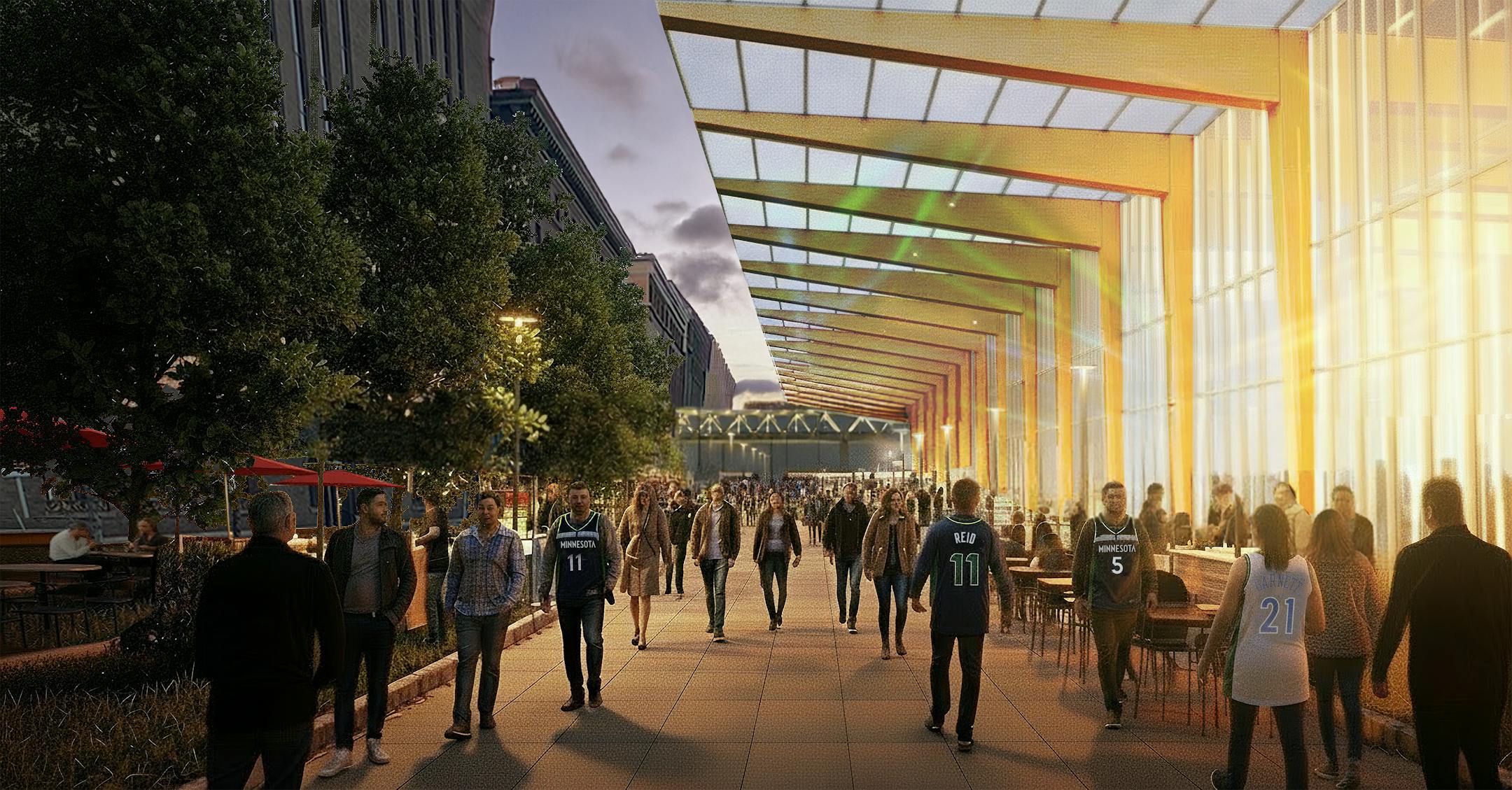
The idea of the extending the arena into downtown’s streets with outward-facing concessions and retail is somewhat novel, Baxley said. His model shows large canopies extending over First and Hennepin, creating shopping arcades that provide some shelter from the weather.

“This idea really starts with: We’re going to design the urban experience first, and the arena is going to fit within that,” Baxley said.

Working within urban confines forces architects to be creative, he added, which can yield the sort of eccentricities that make historic venues like Boston’s Fenway Park and Chicago’s Wrigley Field memorable.

The Gensler concept also features a publicly accessible roof, which could contain green space or additional entertainment experiences, as well as high-rise development that could serve whatever function the market demands — perhaps a mix of housing and offices, Baxley said.

Its location would also link all three Minneapolis professional sports venues — including the Vikings’ U.S. Bank Stadium and the Twins’ Target Field — directly along the light rail, perhaps with a new indoor station.

A rendering from Gensler shows how their concept for a new basketball arena could integrate into downtown Minneapolis' Warehouse District. Street canopies would create space for concessions and retail surrounding the facility.
A rendering from Gensler shows how its concept for a new basketball arena could integrate into downtown Minneapolis' Warehouse District. Street canopies would create space for concessions and retail surrounding the facility. (Gensler)

Unanswered questions

What Baxley’s brainstorm doesn’t address is the future of Target Center, which the city owns. If the teams build a new facility, officials will have to consider whether to find new uses for the current arena or demolish it to make way for new development.

As is, Target Center “is not a great urban neighbor,” Baxley said. “It doesn’t pull in the city in the way that it should.”

The arena is the second-oldest in the NBA and has one of the smallest footprints, a fact that limits renovation possibilities. A lack of loading space makes it harder to attract touring concerts, while comparatively low premium seating capacities represents a lost opportunity to boost revenue.

Fans and real estate developers have speculated about several other potential sites near and around downtown, from the Minneapolis Farmers Market to City Center to an extension of the arena’s current footprint.

A spokesman for the Wolves and Lynx declined a request for comment. In an interview last month, the teams’ new CEO Matt Caldwell said he expects the process of finding a site and building a new arena to take at least five years.

Lore and Rodriguez, who have said they’re prepared to finance the venture privately, have not committed to keeping the arena downtown or even in Minneapolis.

A spokeswoman for Mayor Jacob Frey said the mayor met with Caldwell to express his strong desire to keep the teams in the urban core. Erik Hansen, director of Community Planning and Economic Development (CPED), said the city is in “the earliest stages” of exploring the feasibility of sites as preparation for when the teams are ready to engage.

Gensler’s concept homes in on the Warehouse District. The city and groups like the Minneapolis Renaissance Coalition, a downtown revitalization effort led by real estate professionals, have already targeted that part of downtown for renewal.

Dario Anselmo, the coalition’s president who until recently owned the neighboring Fine Line music venue, said he thinks Gensler’s model is “an incredibly innovative and cool design.”

That said, from the perspective of a venue owner, he thinks of the ripple effects such a project would have on the neighborhood, including effects on parking and traffic. The Renaissance Coalition has discussed other ideas for part of those blocks that could also activate the area in new ways, he added.

“Everybody is watching this,” said Hansen, the CPED director. “We are at an inflection point, and I think you’re going to see a lot of great ideas about how we’re reusing buildings and real estate downtown over the next 10 to 15 years.”

about the writer

about the writer

Katie Galioto

Reporter

Katie Galioto is a business reporter for the Minnesota Star Tribune covering the Twin Cities’ downtowns.

See Moreicon

More from Real Estate

See More
card image
Moses Yuhanna

Billy Turner, a Mounds View grad, bought and renovated the 1922-built St. Paul firehouse to be his Minnesota home base during his NFL career.

card image
card image