A cheerleader for a limping city, St. Paul Mayor Melvin Carter wants another term

Taxes are higher and downtown is more dead than in 2017, but Carter is banking on optimism amid a challenge from Kaohly Her.

October 28, 2025 at 3:00PM
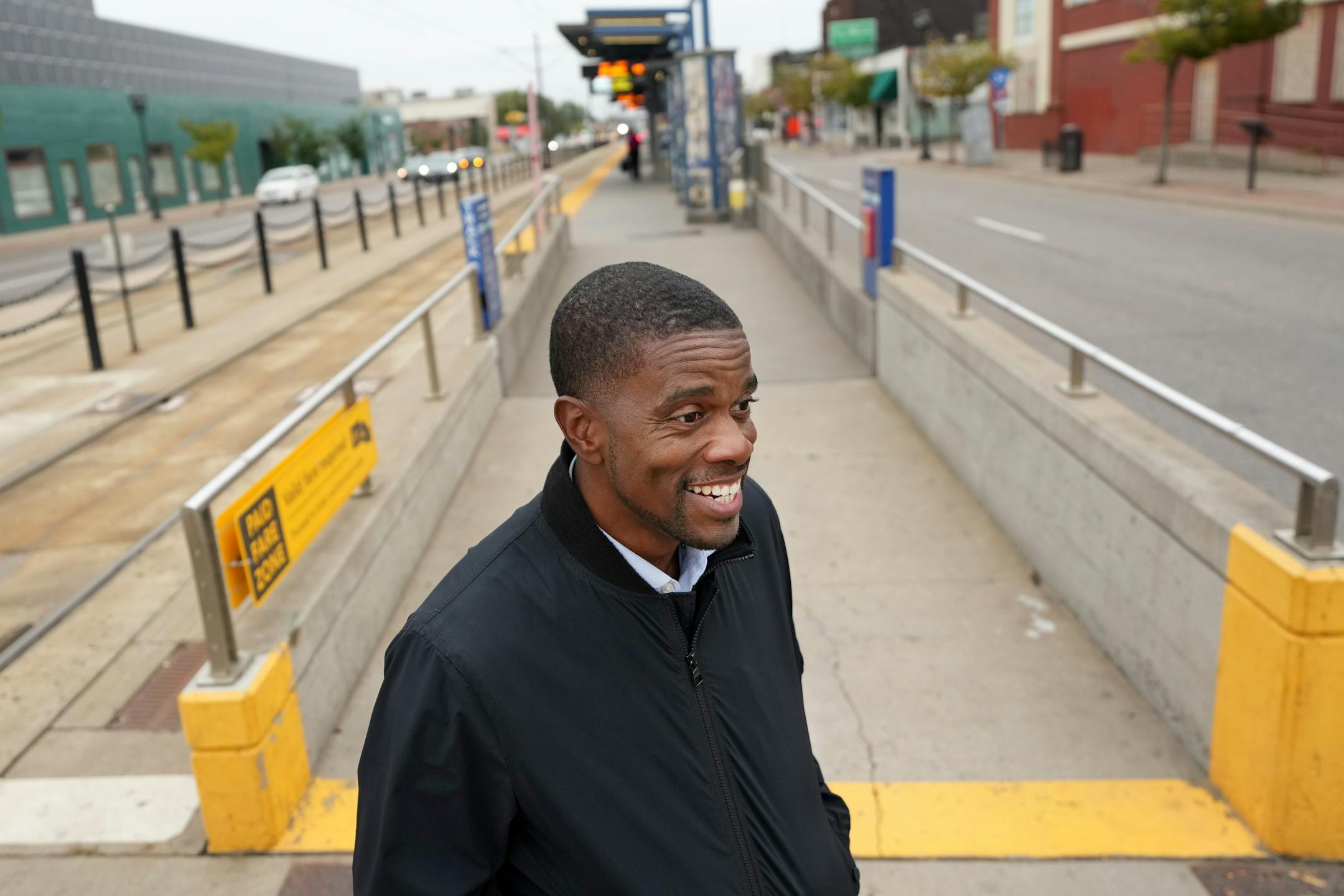
St. Paul Mayor Melvin Carter discusses his vision and plans for tackling some of the city’s biggest challenges during an interview on Oct. 15 at the light rail station near the intersection of Snelling and University in St. Paul. (Anthony Soufflé/The Minnesota Star Tribune)

Getting people pumped up has always been one of Melvin Carter’s strengths.

Almost 30 years ago, the Star Tribune covered a teenage Carter delivering a speech on Martin Luther King Jr. Day.

“Carter’s greatest ability might be the way he tells stories,” the reporter wrote.

Now seeking a third term as mayor of St. Paul, Carter is still using his rhetorical gifts to spin a vision of a city on the verge of renaissance.

In Carter’s telling, St. Paul is making itself anew following the pandemic, unrest after the murder of George Floyd and a nationwide housing crisis, buoyed by bold ideas.

“I don’t think you have to have a pollyannaish view to be an optimist about our city,” Carter said in an interview.

Not everyone is on the same page. To some, St. Paul remains mired in the doldrums, with a moribund downtown, a struggling Midway, and concerns about drug use and homelessness. Following an easy rise to power, Carter faces the toughest challenge of his career from state Rep. Kaohly Her, who is raising questions about whether Carter’s vision is matched by his engagement in the work of running St. Paul.

Kathy Lantry, a former longtime East Side City Council member and public works director under mayors Chris Coleman and Carter, praised Carter’s leadership but also said she thinks St. Paul voters are looking for results — and a clear plan.

“What are you going to do going forward? How are you going to get us back on track? What does the budget look like going forward, that we’re not going to continually have this struggle?” Lantry said.

The ‘best job in the world’

Carter, 46, often says that being mayor of St. Paul is the best job in the world, but he also says his wife tells him he picked the worst years to do that job.

He grew up in the Rondo neighborhood, a fifth-generation St. Paulite and son of a St. Paul police officer, Melvin Jr., and a mother, Toni, who has gone on to serve as a Ramsey County commissioner and a member of the Met Council.

In 2007, not so long after college and his days as a Central High state track champion, Carter was elected to the City Council to represent Ward 1.

Melvin Carter, his then-wife, Alecia, and daughter Maylena, 2, celebrate his winning a seat on the St. Paul City Council in November 2007. (Richard Tsong-Taatarii/The Minnesota Star Tribune)

After handily winning re-election to the council in 2011, Carter resigned in 2013 to take a job with then-Gov. Mark Dayton’s administration, steering early childhood education work at the Department of Education. When former Mayor Chris Coleman announced he would not seek re-election in 2017, Carter jumped into the race with Coleman’s full backing.

That first term saw Carter champion bold progressive policies, including a pilot for a universal basic income program and college savings accounts for newborns.

Then came 2020.

The end of his first term and the beginning of his second saw Carter navigating the city out of COVID-19 and the aftermath of George Floyd’s murder in Minneapolis, when the ensuing unrest left dozens of buildings damaged along University Avenue.

Carter easily won a second term in 2021, in an election that also saw St. Paul voters approve an ordinance limiting most residential rent increases to 3% a year.

In the years after, development stalled in St. Paul. Construction costs and labor shortages slowed construction nationally as the country came out of the pandemic. But major Minnesota developers, including Ryan Companies, pointed to St. Paul’s rent control as the reason they could not move forward on major projects, including Ryan’s development at the former Ford plant site in St. Paul known as Highland Bridge.

After tepidly supporting rent control in 2021, this year Carter successfully advocated for the City Council to permanently exempt all buildings built after 2004 from rent-increase limits. Ryan Cos. re-started construction at the Ford site days after the council passed the change.

Mayor Melvin Carter delivers his annual budget address on Aug. 13, 2024. (Glen Stubbe/The Minnesota Star Tribune)

The comfortable incumbent

Carter announced in January that he would seek re-election, but even since Her entered the race in August, Carter has done minimal campaigning.

Instead, he has used official appearances to position himself as a stalwart defender of the city against the Trump administration, and as a leader of a push for gun control. Carter appeared before the City Council in late October to introduce local gun restrictions, and has advocated for a special legislative session on the issue.

Carter’s campaign pledges match his 2026 budget proposal, with emphasis on bringing funding and attention to drug treatment, downtown apartment subsidies and housing across the city.

Part of Carter’s pitch also points to the city’s progress during his second term.

After the pandemic, with violent crime up in St. Paul as it was across the country, Carter pushed for the St. Paul Police Department to focus on solving nonfatal shootings. He has credited a significant drop in gun violence to that unit’s work, and the Office of Neighborhood Safety, created under Carter in 2022.

“We’re in October and we’ve had eight homicides this year in St. Paul,” Carter noted this month, where a typical year sees between 20 and 30 people murdered in St. Paul.

“Every category of violent crime in this city is down by double digits.”

Mayor Melvin Carter and St. Paul Chief of Police Axel Henry at a news conference following a shooting at the St. Paul Phalen Cub Foods on July 11. (Rebecca Villagracia/The Minnesota Star Tribune)

During debates, Carter has joked about a St. Paul police sergeant who tried to buy a gun from a suspected criminal during a sting operation only to have the seller refuse to meet within the St. Paul city limits.

In 2023, Carter campaigned for a new 1% sales tax to fund street repairs and parks. The money has already paid for street reconstruction on Grand Avenue, a road so old that streetcar rails and cobblestones were still buried beneath the pavement. Carter also oversaw reconstruction of several major downtown streets — a headache in the short term, he said, that is about to pay off.

Still, Lantry said, his campaign could lay out a clearer vision for another term.

“Some of the things that he is touting, I think people are like, ‘Yep, that’s great, don’t raise my taxes,’ or at least, ‘Show me how those things that you’re doing can lessen my tax burden or get me more services,’” said Lantry. She declined to say whom she voted for, as did many St. Paul political operatives and observers friendly with both Carter and Her.

‘We’re the mayor’s office’

In debates, Her has attacked Carter for an uncollaborative style that has alienated colleagues and partners.

“The attitude in the mayor’s office is, ‘We’re the mayor’s office, we don’t have to consult with anyone,’” Her said during a September forum at Johnson High School.

Carter has countered by saying he values community engagement and has helped set up new structures to take input from residents. But the criticism echoes that of some neighborhood leaders, who have voiced frustration about dealing with the mayor’s office and high-ranking city officials.

Meg Duhr, president of the Fort Road Federation, the district council that represents the W. 7th neighborhood, said she has been repeatedly frustrated when trying to work with the city on a controversial garbage truck depot just off W. 7th Street.

“I would like to see more transparency in some of these processes, involving the community in an earlier stage rather than when it’s a done deal,” she said.

Duhr recalled how Carter declared a “state of emergency” after the City Council sided with the district council and other neighborhood advocates to block the truck depot earlier this year. She said his vetoes of the council decision felt “calculated to get around the public process and get around the City Council.”

Ultimately, the city council changed its vote and let the truck depot open. But in the months since, Duhr said, the Fort Road Federation has struggled to get a meeting with Carter and other city leaders to talk about a planned community benefits agreement with the hauler.

“It took four months to get time with Mayor Carter,” Duhr said. “He did like a two-hour interview with a Minneapolis podcaster, the Wedge Live thing. He did that while putting off meeting with his own community members.”

Carter has also clashed with the City Council, though four of the seven council members endorsed him for re-election.

In late 2024, former Council President Mitra Jalali worked with Carter on a compromise 2025 budget, which the council rejected in favor of a lower tax increase and significant cuts to police overtime. Carter used a line-item veto to change the budget, and claimed the council did not have time before a state deadline to override those vetoes.

Jalali said at the time that Carter had not given her or anyone else on the council any indication that he intended to veto any part of the budget.

The questions about police department spending have lingered this year, as the City Council continues to press Carter to get a handle on overtime. With characteristic optimism, Carter points to strong hiring in 2025, including three police academy classes, which he hopes will bring down overtime use in the years to come.

Carter says he hears the city’s doubters, but believes things are on the right track. “I hear folks say essentially they like what we’re doing, but they want to see us do it faster.”

Downtown reset

Since he served as the Ward 1 council member, Carter has shifted his focus from being an advocate for neighborhoods to a business-friendly mayor who sees downtown as the key to a thriving St. Paul.

“Downtown does impact every neighborhood,” Carter said.

He sees opportunity for a reset in the pandemic aftermath, which has left the capital city’s core in grim straits, downtown no longer just sleepy, but eerie.

Vacancies are up, there are fewer workers and fewer places for them to eat and visit. A skyscraper in the middle of the central business district was condemned this year, and a historic apartment building was ransacked by copper thieves and condemned in late 2024.

Rather than courting large companies to move their headquarters to St. Paul, or trying to revive downtown shopping, Carter’s administration has focused on converting office buildings to apartments, and his 2026 budget proposal includes millions of dollars to subsidize those projects.

Yan Chen, another competitor in the mayor’s race, has been critical of that approach, pointing out that one, the Landmark Towers, required significant public subsidy.

With the focus on downtown, some other neighborhoods feel shorted, especially Midway.

“We need strategic interventions and as much attention as downtown has been getting,” said Justin Lewandowski of the Hamline Midway Coalition, the area’s district council.

Downtown investment will benefit the city as a whole, Carter said, by bolstering property values — and taking some of the tax burden off homeowners.

“I got elected saying, ‘We don’t need to just put all this investment in downtown,’” Carter said during an interview this summer, referring to his time on the City Council. But the loss of downtown property values has affected the rest of the city, contributing to rising taxes on homes, and rising rent.

Lee Krueger, the former president of the St. Paul Port Authority who is now a real estate adviser, said business community members’ opinions of Carter are mixed.

“If you talk to the Minnesota Wild, I think that they would probably say he’s really engaged with them. I think there’s some other business owners that kind of feel left out,” he said.

Krueger said he thinks business owners need to get off the sidelines and push more partnership with Carter’s administration, too.

“People who feel like he’s been supporting them, he’s off the charts. Other people feel like they can’t get his attention.”

Mayor Melvin Carter near the Alliance Bank Center in St. Paul in 2024. The 16-story building was condemned this year. (Carlos Gonzalez/The Minnesota Star Tribune)
Correction: An earlier version of this story incorrectly stated Meg Duhr's title. She is the president of the Fort Road Federation.
Correction: An earlier photo caption misidentified Carter's former wife.
about the writers

about the writers

Josie Albertson-Grove

Reporter

Josie Albertson-Grove covers politics and government for the Star Tribune.

See Moreicon

Greta Kaul

Reporter

Greta Kaul is the Star Tribune’s built environment reporter.

See Moreicon