
After Annunciation shooting, Twin Cities mayors want tougher local gun laws

Twin Cities-area mayors say that if the Legislature won’t enact restrictions, lawmakers should at least allow cities to enact their own.

September 2, 2025 at 8:08PM
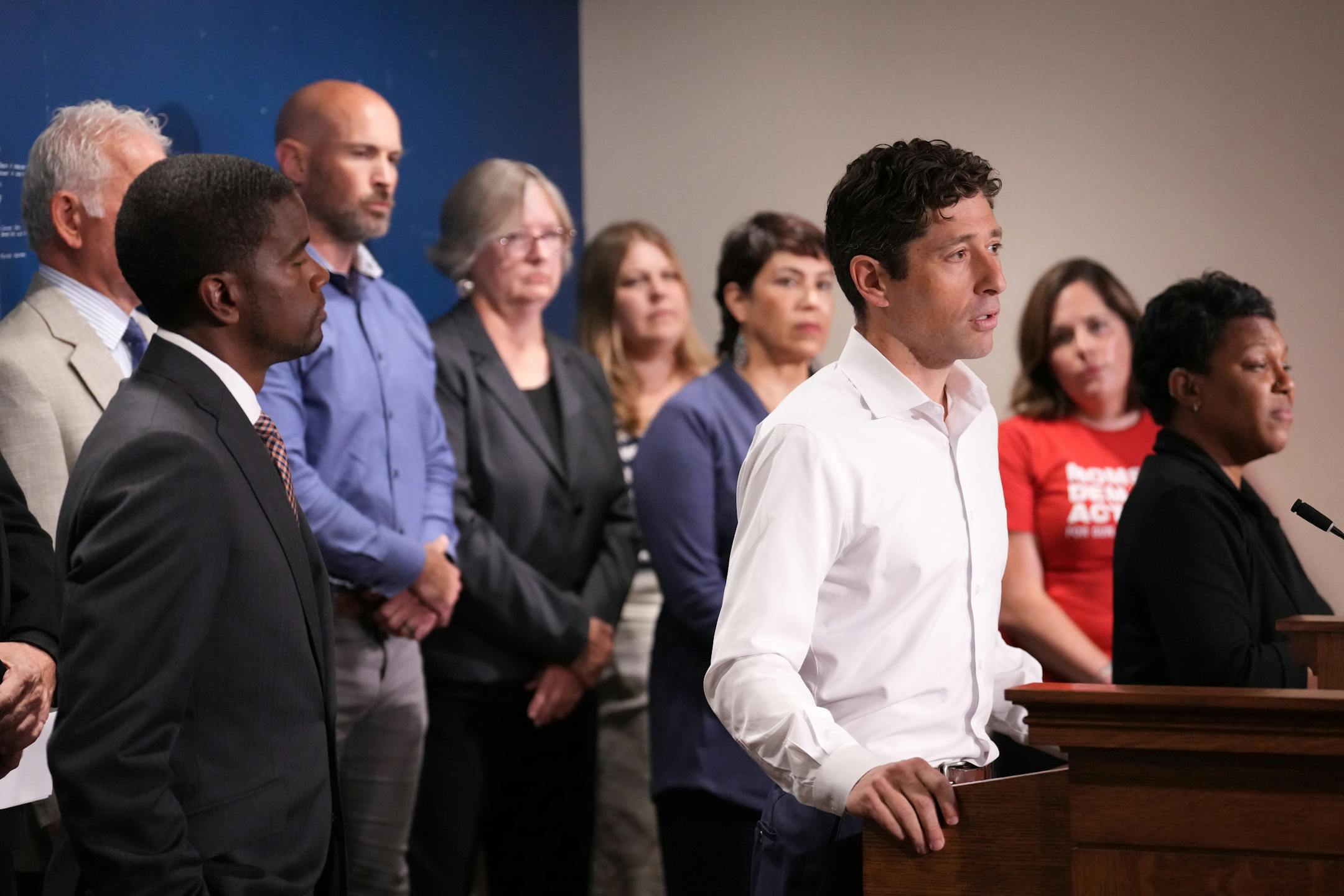
Minneapolis Mayor Jacob Frey speaks during a news conference Tuesday with St. Paul Mayor Melvin Carter, Brooklyn Park Mayor Hollies Winston, representatives from Moms Demand Action and other mayors from around the state to call for legislative action to address gun violence in Minnesota. (Anthony Souffle/The Minnesota Star Tribune)

Minnesota’s top Democrat and a slate of mayors from the Twin Cities and area suburbs ramped up calls for new gun laws on Tuesday in the wake of last week’s mass shooting at Annunciation Catholic Church and School in south Minneapolis.

Minneapolis Mayor Jacob Frey, St. Paul Mayor Melvin Carter, Bloomington Mayor Tim Busse and about a half-dozen other metro-area mayors said state legislators need to convene to enact bans on assault-style weapons and high-capacity magazines.

“It is now time for elected officials to step up,” Frey said at a State Capitol news conference on Tuesday.

If legislators are unwilling, they should at least change a state law that prevents local governments from passing their own gun control rules, Frey said.

Separately, DFL Gov. Tim Walz told reporters on Tuesday morning that he wants to call a special legislative session to take up gun bills after a shooter killed two children and injured another 21 children and adults. Walz said he plans to propose a package of gun bills this week that includes an assault rifle ban.

Political reality

The DFL’s renewed gun-control push faces a political reality, however. An assault-weapons ban in particular would encounter fierce resistance from Republicans in the evenly divided Minnesota House.

It would also face difficult odds in the state Senate; Democrats hold a one-seat advantage in the chamber, but because of a recent resignation, they are one member short of the 34-vote threshold needed to pass bills, pending a Nov. 4 special election to fill an open Woodbury seat. That means they would need at least one Republican to vote with them to pass gun control legislation, if a special session is held before the November election.

Beyond Republican opposition, there also could be resistance from DFL lawmakers in greater Minnesota who might alienate their rural constituents by voting for gun-control legislation. Democrats were unable to pass an assault-weapons ban when they controlled both the Minnesota House and Senate in 2023 and 2024.

The sharp partisan divide over gun control has been highlighted in the aftermath of the shooting at Annunciation, with Democrats pushing for an assault-weapons ban and Republicans saying the state needs to focus on strengthening school security and expanding mental health resources.

Special session for Legislature?

It remained unclear Tuesday whether Democrats and Republicans could even agree to return to the State Capitol for a discussion about possible law changes.

Walz said he has been making calls to legislators to gauge their interest.

“I can call a special session. I can’t run a special session,” Walz said. “And to be very candid, just in a very evenly divided [Legislature], I’m going to need some Republicans to break with the orthodoxy and say that we need to do something on guns.”

GOP legislative leaders said Walz didn’t reach out to them before he publicly signaled interest in calling a special session. Some Republicans said calling a special session without GOP buy-in would result in little more than political theater.

House Speaker Lisa Demuth, R-Cold Spring, said in a statement that she had a “long overdue” conversation with Walz on Tuesday and said any work done in a special session will need bipartisan support.

“The House proved that we can work in a bipartisan fashion last session, and that cooperation needs to continue,” Demuth said. “If Governor Walz and Democrats are focused on partisan accusations and demands, this special session will not be productive for the people of Minnesota.”

Walz challenged Republicans to come to the table, asking, “Are they going to stand in the way of having an honest debate?”

“We might not get it done in there, but the idea that you would not even come back and make a debate I think is untenable,” he said. The mayors, too, said it was time to “call the question,” have a debate, and take a vote.

1985 law in play

The state law that pre-empts local governments from passing their own tougher gun regulations, which the mayors are now targeting, dates to 1985 — and was backed by rural Democrats. Its chief Senate sponsor, an International Falls DFLer, said the law was meant to standardize regulations for handguns across the state, according to Star Tribune archives.

The bill was opposed by lawmakers in the Twin Cities, which had tighter restrictions on handguns, and by DFL Gov. Rudy Perpich, who had vetoed a similar bill the year before. But the bill passed by overwhelming margins in both chambers and Perpich declined to veto it again.

On Tuesday, the mayors said federal legislation would be most desirable, followed by state-level action. But if that proves impossible, said Bloomington’s Busse, then state legislators should at least give cities the power to shape their laws.

“Give the cities the opportunity to lead,” he said.

That, however, could face an uphill climb in the Legislature too. Rep. Paul Novotny, R-Elk River, who co-chairs the House Public Safety Committee that would likely hear gun bills, said existing state law protects Minnesota “from a confusing patchwork of local rules that could turn law-abiding citizens into criminals simply for crossing a city or county line.”

“The Second Amendment does not change depending on your ZIP code, and every law-abiding Minnesotan deserves the same right to protect themselves and their family no matter what city or county they are currently in,” Novotny said in a statement Tuesday.

Any progress that Democrats and mayors could make on gun control could come down to whether they can get at least a shred of Republican support. Of the mayors at Tuesday’s press conference, one, Stillwater’s Ted Kozlowski, said he was represented in the Legislature by a Republican.

Kozlowski told reporters he hadn’t yet talked about the Democrats’ gun proposals with that Republican, Sen. Karin Housley.

“I’m hopeful that she can be a leader on her side of the aisle with this,” he said. “She’s very effective at her job and she’s a parent. I think she’ll understand.”

Housley told the Minnesota Star Tribune that she hadn’t yet reviewed Democrats’ proposals and wasn’t prepared to comment on them.

Nationally, federal law banned assault weapons until 2004. Ten states and the District of Columbia currently ban them, and the U.S. Supreme Court this summer declined to take up challenges to an assault weapons ban in Maryland and a ban on high-capacity magazines in Rhode Island.

Most states, like Minnesota, specifically prevent localities from passing their own gun laws, according to Everytown, an organization that advocates for gun control laws.

about the writers

about the writers

Nathaniel Minor

Reporter

Nathaniel Minor is a reporter for the Minnesota Star Tribune.

See Moreicon

Ryan Faircloth

Politics and government reporter

Ryan Faircloth covers Minnesota politics and government for the Star Tribune.

See Moreicon

More from Politics

See More
card image
Mark Schiefelbein/The Associated Press

A Navy admiral commanding the U.S. military strikes on an alleged drug boat in the Caribbean told lawmakers Thursday that there was no ''kill them all'' order from Defense Secretary Pete Hegseth, but a stark video of the attack left grave questions as Congress scrutinizes the campaign that killed two survivors.

card image