
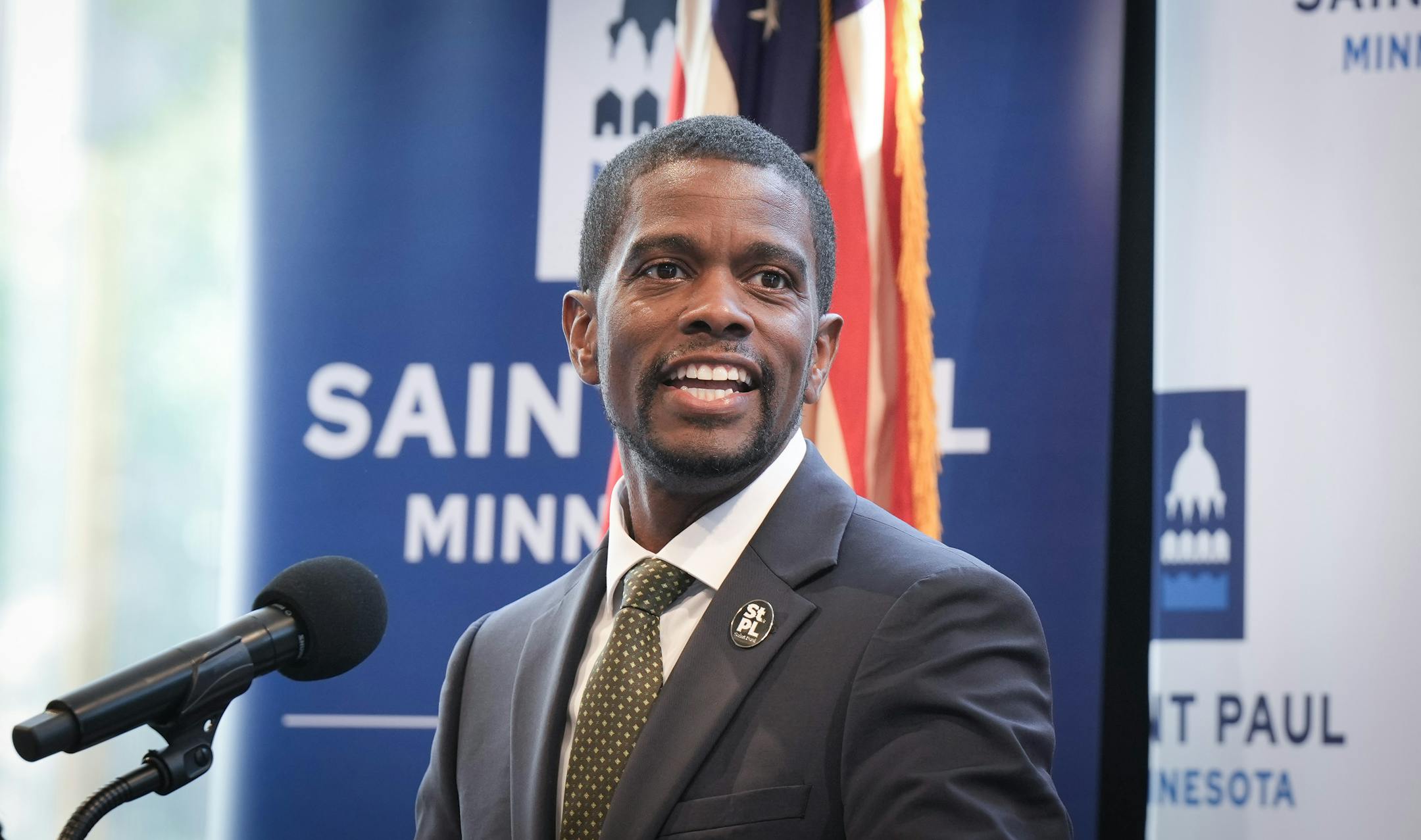
Facing election challenge, St. Paul Mayor Melvin Carter pushes modest property tax increase for 2026

Carter said large tax increases are not feasible: “This isn’t a year for us to pursue pet projects.” Rep. Kaohly Her is challenging him in the fall.

The Minnesota Star Tribune
September 4, 2025 at 11:25PM
St. Paul Mayor Melvin Carter delivers last year's budget address at the Ordway on Aug. 13, 2024, in St. Paul. (Glen Stubbe/The Minnesota Star Tribune)

St. Paul Mayor Melvin Carter on Thursday proposed a city budget with a smaller levy increase than last year, with a boost in funds to prop up downtown construction and drug treatment, and cuts from attrition across the city.

Carter’s proposal for a 5.3% increase in the total money raised from property taxes — an increase of $107 per year for the owner of a median-value home — comes with an election in two months against his first significant challenger since 2017, state Rep. Kaohly Her. Unlike last year’s budget, which saw Carter pushing for a higher levy as the City Council worked to trim the budget, this year’s pitch is far more austere — though Council President Rebecca Noecker said the council would push to lower the levy increase.

Carter’s levy increase is smaller than his proposals in 2025 and far less than the double-digit increases he has proposed in the past, but St. Paul property taxpayers could still see major tax increases from Ramsey County, proposing a levy increase near 10%, and St. Paul Public Schools, which has a $37 million referendum on the 2025 ballot.

“This is a challenging budget moment,” Carter said, with St. Paul squeezed between rising costs and federal funding cuts, as well as decades of deferred infrastructure maintenance.

Her said the budget proposal “finally” started to address some of the problems she has observed in St. Paul, but said Carter has had eight years to take care of neglected infrastructure.

“Those types of things now require us to have an increase in levy,” Her said, accusing Carter of pursuing “pet projects” at the expense of other needs.

Carter delivered the annual speech, where he also called for the city to pass its own gun control law, in a suite at Allianz Field in St. Paul in front of a crowd of city staff and allies.

Here are four highlights from the budget proposal.

No layoffs, but attrition

To provide the same services in St. Paul in 2026 as in 2025 would have cost $23 million more, Carter said. The levy increase covers some of that difference, but he said St. Paul will also cut costs by not filling numerous jobs.

The budget Carter proposed — a total of $887 million in spending next year — does not include layoffs, but trims costs by reorganizing some departments, cutting underutilized hours at rec centers and removes a little-used overnight shift of medics who respond to minor medical calls.

Most significantly, the budget leaves open many staff positions. The most high-profile position that will stay empty is a principal planner for downtown, Carter said, but the city will not fill vacancies across St. Paul’s bureaucracy.

$5 million more for downtown apartments

Carter’s 2026 proposal continues provisions to waive construction permit fees for office-to-residential conversion projects.

New in the 2026 proposal is funding for “gap financing” for the conversions: city subsidies for developers.

Funding for fee waivers and gap financing total $5 million.

Yan Chen, another DFLer challenging Carter for mayor, questioned the viability of the strategy. She also noted that St. Paul’s most-touted conversion project, the Landmark Towers, needed tax breaks to be completed.

$1 million for drug treatment, homelessness

St. Paul’s budget proposal would fund a $1 million surge in drug treatment and response work.

The funding will add to outreach teams who work with unsheltered homeless people in St. Paul.

Carter compared this push to the recent focus from the Police Department on solving nonfatal shootings, a two-year, $13.6 million effort he proposed in 2023. The effort has coincided with a drop in gun violence across the city, and Carter said 2025 is on pace for the lowest number of homicides in St. Paul in a decade.

“We must now apply that same logic to the fentanyl crisis,” Carter said.

$52 million for infrastructure

With Carter’s critics, including Her, focusing on the nuts-and-bolts of city services, his 2026 budget proposal will highlight funds for key infrastructure.

The mayor’s budget proposal includes $51.9 million for work on St. Paul’s parks, streets and sewers. This money will come from the city sales tax, and from a proposed 14% sewer rate increase.

In light of a major sinkhole that opened on W. 7th Street in May, the 2026 budget will include $2 million for major sewer repairs and more frequent inspections.

Online infrastructure is getting a funding boost, too.

As the city is still recovering from a ransomware attack that Carter estimates will cost St. Paul at least $1 million, Carter’s budget adds another million for cybersecurity in 2026.

about the writer

about the writer

Josie Albertson-Grove

Reporter

Josie Albertson-Grove covers politics and government for the Star Tribune.

See Moreicon

More from St. Paul

See More
card image
Sofia Barnett

The City Council will take another week to finalize resolution language. The city will also fund immigrants’ defense and naturalization in 2026 budget.

The setting sun illuminated the St. Paul skyline, with city hall on the left, as seen from Harriet Island Park.
card image