
Readers Write: Fraud in Minnesota, school board races, landlords, carbon-free electricity

Our money stolen, our trust squandered.

The Minnesota Star Tribune
October 26, 2025 at 8:28PM
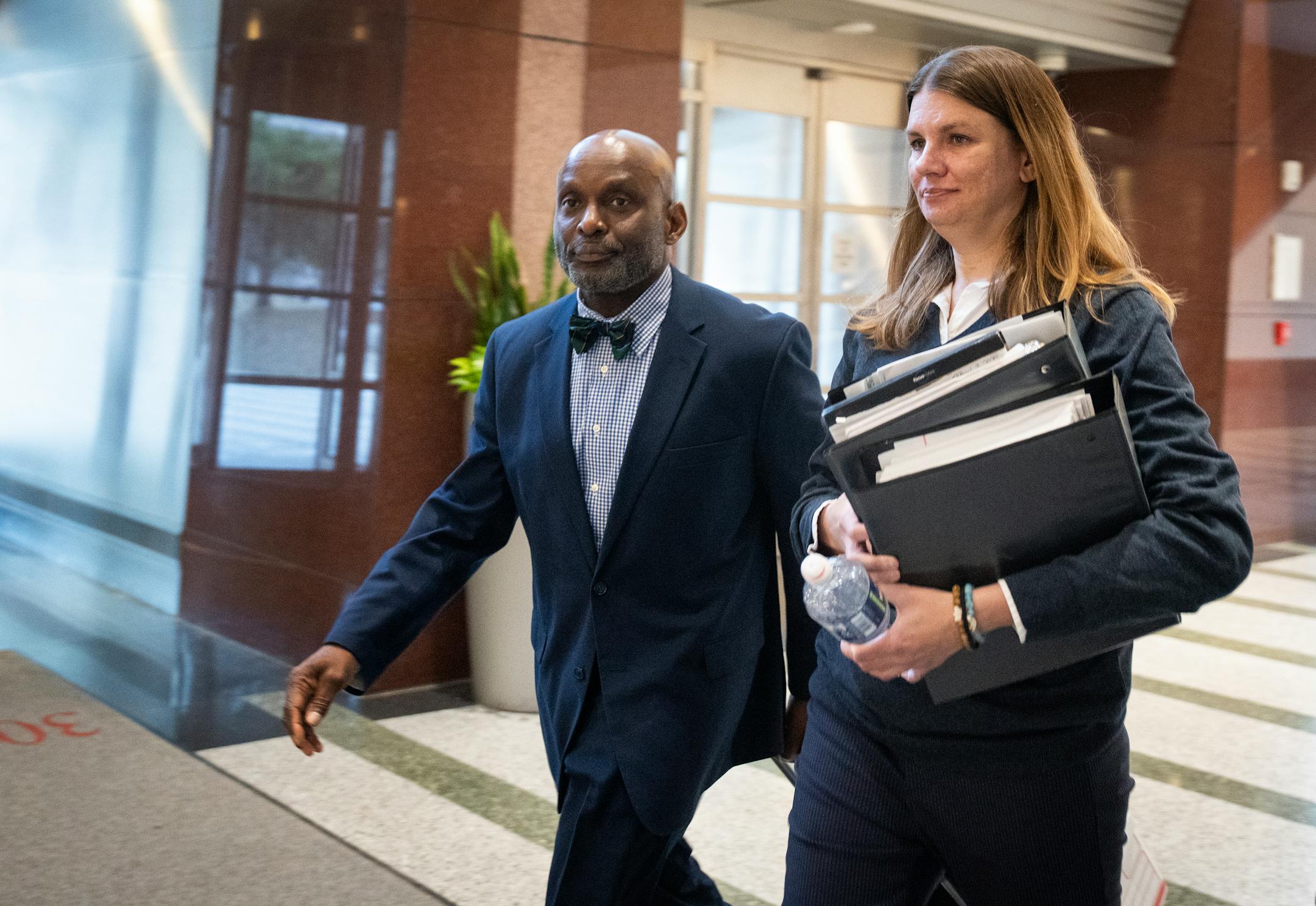
Feeding Our Future founder Aimee Bock, right, walks into court with her attorney, Kenneth Udoibok, at the U.S. District Courthouse on March 12 in Minneapolis. She was convicted on charges of wire fraud conspiracy, wire fraud and conspiracy to commit federal programs bribery. (Leila Navidi/The Minnesota Star Tribune)

Opinion editor’s note: Strib Voices publishes letters from readers online and in print each day. To contribute, click here.

•••

Something has gone terribly wrong in Minnesota. The fraud and waste now exposed in our state government are not minor bookkeeping errors — they represent a moral and fiscal crisis. Recent investigations show that more than $1 billion of taxpayer money has vanished into fraud, mismanagement and neglect.

Feeding Our Future alone siphoned off roughly $300 million that should have fed hungry children. Another $26.3 million was lost through fraudulent unemployment overpayments. Medicaid programs added millions more: $18.5 million in one settlement, $10 million in some of the first Housing Stabilization Services indictments, and nearly $11 million in another Medicaid prosecution.

These numbers are staggering, but what’s worse is the betrayal they represent. Honest Minnesotans work hard, pay their taxes and expect integrity in return. Instead, our trust has been squandered. The breadth and repetition of these schemes raise painful questions — are our own systems, or even state employees, complicit? How could this happen again and again without someone inside saying “stop”?

These schemes represent a collapse of oversight and accountability that every Minnesotan — Republican, Democrat or independent — should find intolerable.

As a retired municipal finance director, I know the scrutiny cities face: every year, every line item audited, every rule enforced. We passed every hurdle the state auditor required. Why doesn’t the state hold itself to the same standards?

It’s time for full federal audits of every major state-administered program and independent CPA reviews every two years. Accountability isn’t optional — it’s the price of good government.

Bonnie Burton, Minnetonka

The writer is retired finance director for the city of Shorewood (2000–2010).

•••

One hundred million dollars’ worth of jewels are stolen from the Louvre in Paris and the director of the Louvre admits failure and offers to resign. Billions of dollars are stolen from the taxpayers of Minnesota and not one person in our state government has admitted failure, offered to resign or been fired.

Jim VanSomeren, Greenfield

SCHOOL BOARD RACES

This vitriol is unsustainable

Anoka-Hennepin has been a place where people with different views lived and worked side by side.

But something is changing — and not for the better.

What we’re seeing in this year’s school board election is not just another campaign (“Political divisions overshadow suburban Twin Cities school board races,” Oct. 6). It’s the local face of a deeper, more dangerous problem: growing political extremism.

Campaign signs are being stolen and vandalized. Volunteers are being harassed. And tens of thousands of dollars are being spent in an effort to control which party has influence on this school district.

This community has already suffered deeply from violence and division. Just months ago, state Sen. John Hoffman, who once served on the Anoka-Hennepin school board, experienced the unimaginable. Simultaneously, our community is still grieving the deaths of Melissa and Mark Hortman — all at the hands of someone driven by hatred and radical thinking.

That should have been a wake-up call.

Political extremism, in any form, on any side, is a threat to democracy, public safety and basic human decency. We cannot ignore it, excuse it or tolerate it because it’s “local.” It starts in yard signs and Facebook groups, but it ends in real pain and real loss.

This is bigger than a school board race. It’s about who we are as a community — and what we’re willing to stand up for.

It’s time to draw the line. It’s time to speak up. It’s time to choose respect over rage … and truth over extremism.

Find Parents For Good on Facebook; help us bring this community back together.

Michelle Powers, Ramsey

•••

Voters in the Hopkins School District deserve accurate information before electing three school board members in a few weeks. However, a recent letter omitted crucial information and included inaccuracies (“Vote for this capable school board trio,” Readers Write, Oct. 19).

Under the current superintendent, district-level administrative spending grew from $3.2 million in 2017 to $10.9 million in 2024, over a 230% increase. Inflation over that period was about 31%. Regular instruction spending increased 28%. The transportation budget increased 103%, even as families face unreliable bus service and expanded “no-bus” zones. More than a third of Hopkins students open-enroll elsewhere, and from 2018 to 2024 the district lost more students than it gained each year.

The letter also wrongly claimed that the board does not approve curriculum. Minnesota Statute 123B.09, Subdivision 8, authorizes school boards to “prescribe textbooks and courses of study.” The Hopkins board recently voted to approve a new elementary math curriculum, confirming that curriculum approval is indeed its legal responsibility.

There are only two candidates with the background and insight to address the district’s challenges: Johanna Hyman and Eric Mandel. Both are parents of current Hopkins students and attorneys who understand board governance and state law. They value the district’s diversity and strengths but recognize the issues that need to be addressed. They believe equity means giving every child the supports they need to succeed, not cutting bus service or accelerated learning options.

Vote Hyman and Mandel on Nov. 4 for a balanced, accountable and student-focused school board. Learn more at hymanforhopkins.org and ericmandel4hopkins.com.

Rachael Faeth, Hopkins

VACANCIES

Landlords don’t benefit from empty units

The notion that landlords intentionally keep properties vacant is fiction (“Cities must do more to ensure that available housing is filled,” Strib Voices, Oct. 15). No property owner benefits from an empty unit — it’s a financial loss. Rent is gone, while taxes, insurance, utilities and maintenance costs continue. Even a tax write-off doesn’t come close to covering those losses.

The proposed “vacancy tax” is political theater disguised as housing policy. It assumes malice where economics is the true culprit. Construction costs have soared, interest rates are high and city regulations add months — even years — to projects. Each added fee, restriction and mandate drives housing costs higher and discourages new development.

If Minneapolis leaders truly want more affordable housing, they should make it easier to build and maintain — not harder. Simplify permits, reduce red tape and encourage investment. Punishing property owners for market realities won’t fill a single home. It will just drive more investors — and housing — out of the city.

Bruce Dachis, Minneapolis

ELECTRICITY

Biomass isn’t carbon free, and it pollutes

Regarding “Minnesota should reject burning trees and trash for electricity” (Strib Voices, Oct. 24): Not only are these forms of energy incompatible with Minnesota’s carbon-free law, burning biomass and garbage for energy emits more greenhouse gases than coal plants per unit of energy produced. These energy sources also have serious public health implications.

Biomass energy facilities emit nitrous oxide, sulfur dioxide, carbon monoxide, particulate matter and volatile organic compounds. Garbage incinerators emit these same pollutants, plus hazardous air pollutants like lead, dioxins, furans, PFAS and mercury,

Air pollutants from burning biomass and garbage contribute to serious health impacts including cancer, cardiovascular and respiratory disease, stroke, asthma, reproductive and developmental problems and premature death. We should take a lesson from Europe, where a growing share of energy produced from woody biomass burning is harming health. An estimated 40,000 excess deaths per year are attributable to biomass smoke in Europe.

Garbage incinerators specifically harm the communities in which they’re located, which are mostly low-income and communities of people of color, where people are already experiencing more chronic illness and premature death than residents of richer, whiter communities.

The Public Utilities Commission should not allow these harmful and inefficient technologies to be counted as “carbon free.” Minnesota’s 100% Carbon Free Law mandates that local benefits must be maximized, including reducing air emissions in environmental justice areas. This is an opportunity for the PUC to adhere to the law, while bringing a modicum of justice to these communities.

Kathleen Schuler, Minneapolis

The writer is a board member and state policy director for Health Professionals for a Healthy Climate.

about the writer

about the writer