Medtronic’s high-stakes Hugo surgical robot finally gets American regulators’ nod

Following concerns that Medtronic was overspending on the high-tech system and not developing it fast enough, FDA clearance is a major victory for the Minnesota-run medtech company.

The Minnesota Star Tribune
December 4, 2025 at 8:02PM
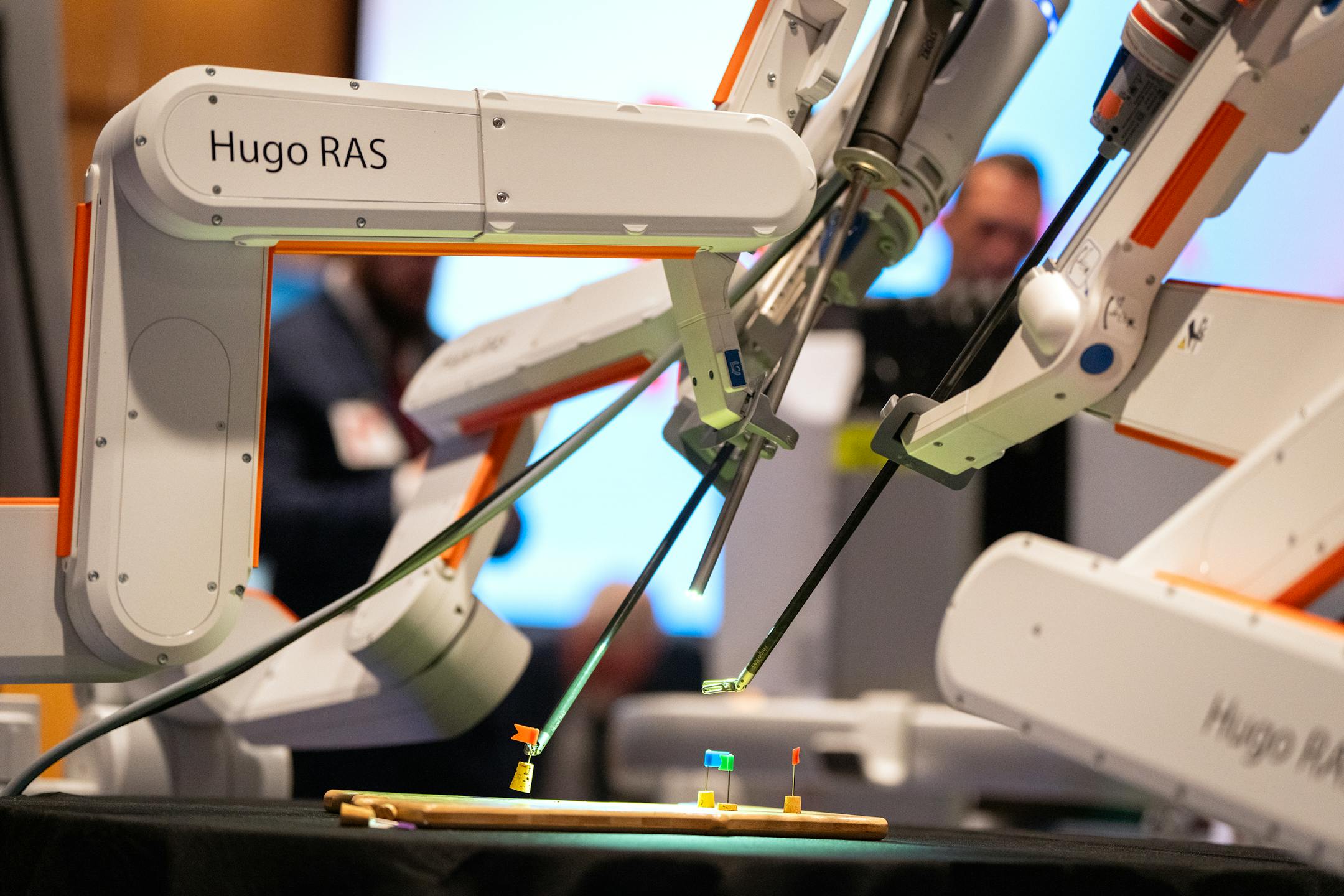
Abby Olah, a Medtronic summer intern from the University of Tennessee, participates in a demonstration of the Hugo robotic-assisted surgery system with Joshua Batesole, program manager for proctor development with the medical education team at Medtronic, during an event hosted by the Minnesota Business Partnership at Medtronic headquarters in Minneapolis on July 10. (Leila Navidi/The Minnesota Star Tribune)

Hugo is about to joust da Vinci.

It’s not a battle between Renaissance geniuses. Instead, a commercial fight is brewing between massive medtech companies to control the future of the multibillion-dollar field of surgical robotics.

Having announced U.S. Food and Drug Administration clearance on Wednesday, Medtronic can now widely market its Hugo robotic-assisted surgery system to American hospitals. The decision puts the Minnesota-run medtech giant in a position to become the first formidable competitor to the broadly used da Vinci robotic surgical system from Intuitive Surgical, which pioneered the field.

For Medtronic, the clearance is an important victory following concerns that company leaders overspent on Hugo and the device took too long to materialize. Now, the company must prove that its robot, which executives praise for its surgical flexibility, stands out.

Bill Peine, Medtronic vice president of surgical research and technology, acknowledged in an interview months ago that Intuitive created the industry for robotic systems that can operate on internal organs.

“I’m very appreciative of what they’ve been able to do,” Peine said. “But ... it’s time for more competition.”

Medtronic CEO Geoff Martha has previously cited Hugo — a technology one analyst previously estimated cost $500 million a year to develop — as an innovation that can instill confidence in investors. Medtronic stock has grown more quickly than many competitors’ this year following a long period of underperformance.

Geoff Martha, Medtronic chair and CEO, speaks at the Minneapolis Convention Center on Oct. 9. (Richard Tsong-Taatarii/The Minnesota Star Tribune)

Hugo, which surgeons operate via video game-like controllers and a three-dimensional monitor, has already performed tens of thousands of procedures in dozens of countries. The FDA clearance allows Medtronic to market its system for use in soft-tissue urologic surgical procedures.


Executive Vice President Mike Marinaro, who leads the company’s medical surgical portfolio, said people considered surgical robotics systems basically science fiction just decades ago. Now, they are the center of health care and the approach of choice for several surgical specialties, he added.

Peine, who arrived at Medtronic in 2013 to help spearhead the company’s expansion into robotics, said his team essentially developed the technology behind Hugo from scratch.

“It’s a challenge to get into this field,” he said. “Making these robots takes a big commitment and the right team.”

Supply chain issues and manufacturing problems hindered its rollout following the pandemic, executives said late in 2022.

Marinaro said in an interview months ago that the system is “as complex as anything that Medtronic has ever built.” He added that the company used the time to make certain it had come to the proper design for the system.

“From a timeline perspective, while everyone would always love to move faster, these are complex technologies,” Marinaro said. “And to get it right, it does take some time, and that’s what we’re doing.”

The result of this development: Medtronic created a multi-part mammoth of a system named Hugo.

“We chose the name Hugo to be almost a person’s name because we wanted the robot to be a member of the OR team,” Peine said, referring to the operating room.

People try out the Hugo robotic-assisted surgery system during a demonstration at an event hosted by the Minnesota Business Partnership at Medtronic headquarters. (Leila Navidi/The Minnesota Star Tribune)

The system’s several surgical arms act as high-tech extensions of a doctor’s hands. Nine tools shaped for the system can attach to the arms’ ends to perform tasks.

The system allows surgeons to make slower, steadier movements than hands alone can perform. Laparoscopic procedures, in which a surgery occurs through a tiny cut, previously felt like “tying your shoes with chopsticks” without the technological boost from surgical robotics, Peine said.

“We’re amplifying their hands, their eyes and their brain,” Peine said.

A surgeon looks through a special set of glasses at a screen displaying the perspective of the surgical arms. Using controllers, one can make fine movements with tools like Medtronic’s widely used LigaSure device to seal blood vessels.

By capitalizing on Medtronic’s expertise in stapling and vessel sealing, Hugo can differentiate from Intuitive tech, Peine said. Unlike Intuitive’s da Vinci, these pieces aren’t fused together and can navigate around the surgical suite. The system’s modularity will also allow for quicker adoption of new surgeries, he added.

Now, Medtronic just needs to sell it.

Marinaro said the company plans to target physicians and surgical centers with whom the company already partners. Rajit Kamal, Medtronic’s vice president and general manager for robotic surgical technologies, said the company isn’t just pitching hospitals a surgical system but also its leadership status in surgery.

“These customers are not new to us,” Kamal said in an interview Thursday. “We are not new to them. We have been their long-term partners. They knew this was coming.”

Marinaro said robots are “here to stay” in medtech. Medtronic is now looking to expand Hugo to hernia and gynecological procedures.

“Competition is a good thing,” Marinaro said. “It makes all of us better. And our customers are telling us that they’re eager for choice.”

The sculpture of the “rising person,” Medtronic’s corporate logo, outside the Medtronic headquarters in Fridley. (Jeff Wheeler/The Minnesota Star Tribune)
about the writer

about the writer

Victor Stefanescu

Reporter

Victor Stefanescu covers medical technology startups and large companies such as Medtronic for the business section. He reports on new inventions, patients’ experiences with medical devices and the businesses behind med-tech in Minnesota.

See Moreicon

More from Business

See More
card image
Leila Navidi

The Winona-based company’s President and Chief Sales Officer Jeff Watts will become chief executive July 16.

card image