Medtronic’s stock crests $100 for the first time in years

Medtronic defies the pressure, raising guidance after expectation-beating results.

The Minnesota Star Tribune
November 18, 2025 at 4:00PM
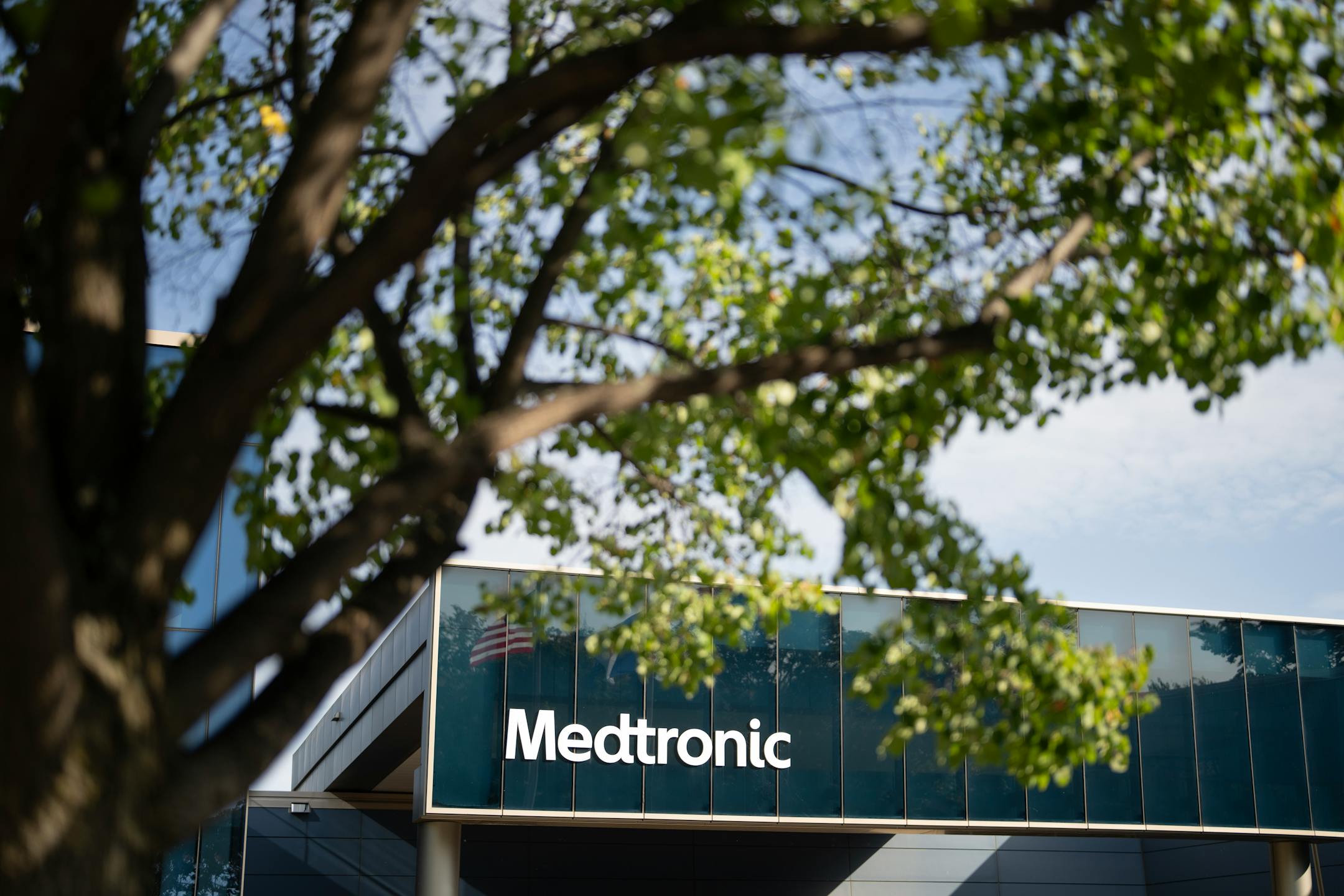
Medtronic beat Wall Street’s profit and sales expectations for the most recent quarter. (Jeff Wheeler/The Minnesota Star Tribune)

Minnesota medtech giant Medtronic found positive momentum Tuesday morning as it faced down what top executives see as a critical moment for the maker of innovative medical devices and procedures for the heart and other key organs.

The company beat Wall Street’s profit and sales expectations for the most recent quarter, and investors seemed satisfied. The stock price rallied to grow nearly 5% by mid-morning Wednesday, exceeding the symbolic threshold of $100 a share for the first time since May 2022, despite major stock indexes falling due to concerns about a looming bubble in artificial intelligence.

CEO Geoff Martha highlighted growth in several key innovative product areas, including a novel ankle implant treating urinary incontinence, a medical procedure that treats hard-to-solve hypertension, and a catheter procedure called pulse field ablation treating the common fluttering-heart condition atrial fibrillation.

“These are game changers, and they’ll power our trajectory,” Martha said in a quarterly call with investors Tuesday. “And at this pivotal inflection point in our growth journey, we recognize the need to capitalize on the incredible market opportunities before us.”

Competitors such as Boston Scientific largely beat sales expectations for the most recent quarter, although Abbott’s non-medical device segments proved a drag on companywide sales figures. Zimmer Biomet, which makes orthopedics products, fell short of Wall Street predictions after facing troubles in noncore segments that added up to a revenue hit for the company, CEO Ivan Tornos told analysts.

Evercore analyst Vijay Kumar said Medtronic has some “wind in their sails” in driving revenue growth, and the company’s messaging on profit execution has become consistent.

“I’m not surprised to see that reaction,” Kumar said of the stock lift. “I think it’s a fair and justified reaction.”

Medtronic’s quarterly report was the first in nine months in which it did not announce major shakeups. The company said in May it would spin off its high-growth but lower-profit diabetes business. Then in August, it disclosed that Elliott Investment Management, a firm know for activist investments, had bought a large stake in the company.

Despite tariffs that could cost Medtronic about $185 billion for the fiscal year, the company raised its organic revenue growth guidance. Analysts have long hoped Medtronic would lift its profit margins.

Conversation during Medtronic executives’ morning call with analysts focused on its renal denervation hypertension tech, and Altaviva, the newly approved device non-invasively implanted into a patient’s ankle to solve a common overactive bladder condition.

Company officials are seeing “very positive signs” after the first weeks of the U.S. launch of the urinary incontinence tech, Martha said.

“The procedure is minimally invasive,” Martha said, “doesn’t require sedation, and the patient goes home with a therapy activated so they’re not waiting for follow up appointments to feel the results.”

Martha called Medtronic the “runaway leader” in a procedure called renal denervation, which recently received key Medicare approval. Medtronic’s Symplicity Spyral renal denervation system presents a multibillion dollar opportunity, Martha said, with an addressable market of 18 million people with uncontrolled hypertension in the U.S.

Now with Medicare coverage “and commercial payers coming online faster than anticipated, this isn’t a question of ‘If?’ or even ‘How big?’ It’s a question of, ‘How fast?’” Martha said.

The company has ramped up physician training, market development and consumer awareness programs, Martha said. An ad for the blood-pressure procedure displayed in U.S. Bank Stadium as the Vikings faced off against the Bears on Nov. 16.

Medtronic is ramping up advertising for its renal denervation procedure, including an ad at U.S. Bank Stadium during a Vikings game. (Joe Carlson/The Minnesota Star Tribune)

Pulse field ablation again led growth for the company, with the company’s franchise treating atrial fibrillation growing more than 300% in the U.S. and international markets. Demand is high, Martha said, as customers tell company officials they want to purchase additional Affera systems to cut patients’ risks of having strokes.

“Physicians tell us that they appreciate not only the shorter procedure times that they’re seeing with Affera,” Martha said, “but increasingly, they’re calling out its outstanding durability as well.”

In recent weeks, several Medtronic executives announced their departures.

The company disclosed in a regulatory filing that Greg Smith, executive vice president for enterprise operations, would retire in December to “join a private equity-held organization.” Before joining Medtronic in 2021, he was a supply chain executive at Walmart, the Goodyear Tire & Rubber Co., and packaged food giant Conagra Brands.

Ken Washington retired as chief technology and innovation officer on Nov. 14. The former Ford and Lockheed Martin executive said on LinkedIn that Medtronic’s mission to alleviate pain, restore health, and extend life “drives everything” at the company. “That sense of purpose inspired me every day to bring my best to the role,” he added.

about the writer

about the writer

Victor Stefanescu

Reporter

Victor Stefanescu covers medical technology startups and large companies such as Medtronic for the business section. He reports on new inventions, patients’ experiences with medical devices and the businesses behind med-tech in Minnesota.

See Moreicon

More from Business

See More
card image
Daniel Gustafson

Steepleview Farm & Equestrian Center, a 69-acre estate about a 40-minute drive from the Twin Cities, underwent a $4.5 million rebuild after the 2023 blaze.

A pedestrian strolled by the U.S. Bank Center in October, a few weeks before the 25-story office tower headed to auction with a starting bid of $1 million, far less than its assessed value. Court records from the summer cited extensive maintenance needs, including elevator malfunctions and code violations in the parking structure.
card image