Mayo, Nvidia launch AI supercomputer to diagnose diseases more quickly

Rochester-based Mayo Clinic is using the technology to fuel its large-scale project to pull new insights from droves of pathology data, which may help with diagnostics.

The Minnesota Star Tribune
July 28, 2025 at 1:30PM
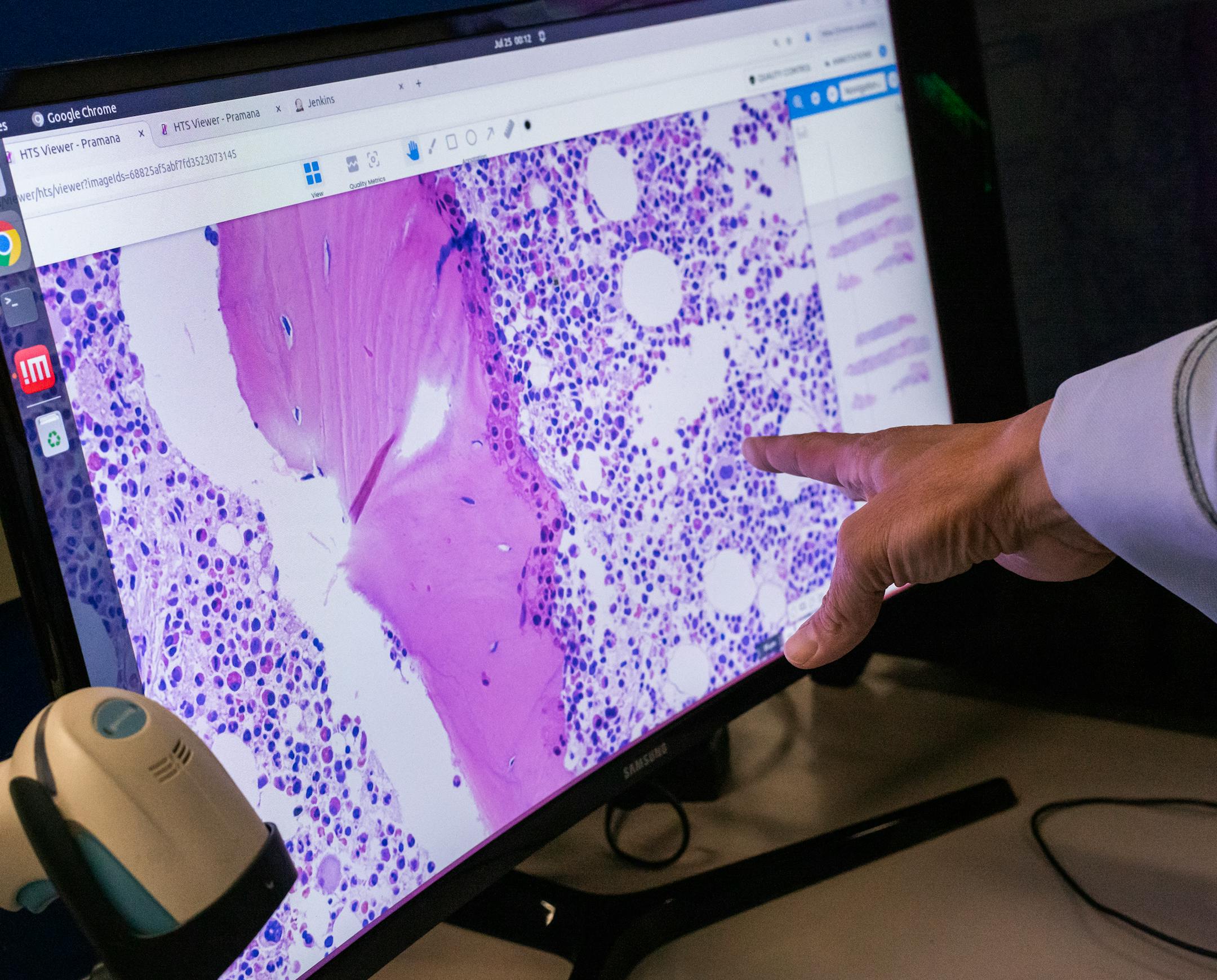
A digitized slide of a bone marrow sample at the tissue registry in Rochester. (Richard Tsong-Taatarii/The Minnesota Star Tribune)

Mayo Clinic has collaborated with the world’s most valuable company to launch the first supercomputer in a hospital using a new AI technology that could shorten the diagnosis time and hasten treatment of deadly diseases.

It’s the first time AI chipmaker Nvidia’s technology will be used this way in health care on a large scale.

“The confluence of the [AI computing power] that we’re talking about, the data, and the clinical knowledge coming together could be kind of a once-in-a-generation opportunity to truly transform how medicine is practiced,” said Jim Rogers, CEO of Mayo Clinic Digital Pathology.

The technology will help Mayo build AI models to make advances in clinical areas such as pathology, the diagnosing and understanding of diseases. Mayo did not share the system’s cost.

Mayo Clinic's first supercomputer in health care that uses Nvidia's latest technology at a large scale is located in Brooklyn Park. The SuperPOD has 128 graphics processing units. (Mark III Systems)

Dr. Matthew Callstrom, medical director of Mayo’s strategy department and leader of the generative AI program, said scientists will someday be able to build AI models around the droves of Mayo de-identified pathology data to help them understand high-stakes ideas such as the staging and progression of cancer.

The investment comes as Mayo revs up its broader AI strategy, including partnerships with Google, Microsoft and the genomics-focused AI company Cerebras.

Executives of the world-renowned health system hope AI can relieve administrative workload and facilitate medical breakthroughs.

Matt Redlon, Mayo’s vice president of digital biology for Mayo Clinic Digital Pathology, said the system’s capabilities are three to four times stronger than Mayo’s previous technology. Rogers said the infrastructure is “rocket fuel” for accelerating innovation.

“This acquisition marks a transformative leap in digital pathology and precision medicine capabilities,” David Niewolny, director of business development for health care and medical at Nvidia, said in an email.

Specifically, Niewolny added, the technology will allow Mayo to fully digitize its enormous pathology archives in hopes of revealing new insights from aggregated patient data.

The system relies on Nvidia computing infrastructure called DGX SuperPOD. It’s a large computing “cluster” that, in Mayo’s case, uses 128 high-powered chips called Blackwell graphics processing units (GPUs).

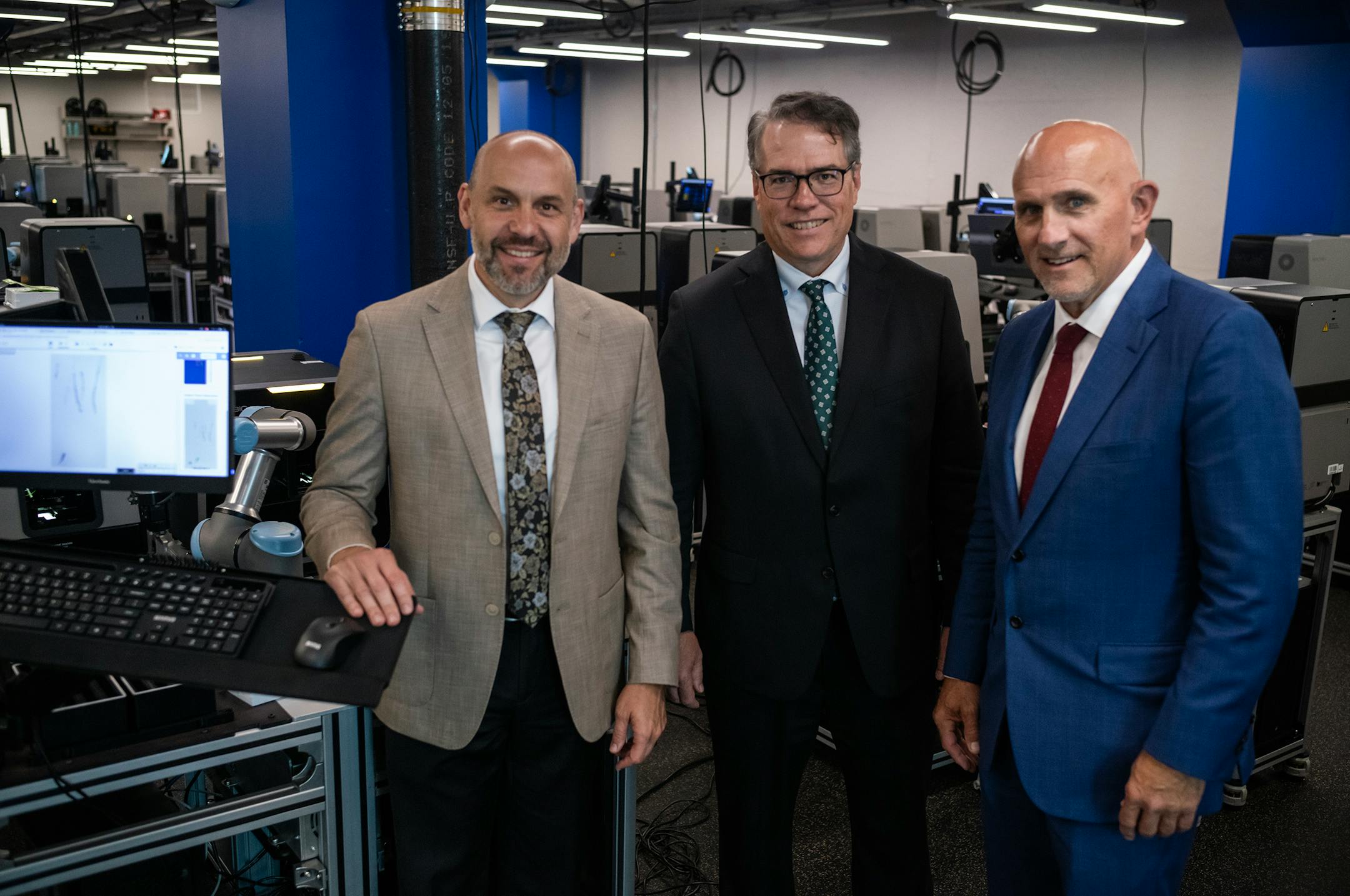
Matt Redlon, from left, Jim Rogers, and Dr. Matthew Callstrom are part of an initiative at the Mayo Clinic to digitize tissue samples for artificial intelligence data at the tissue center in Rochester. (Richard Tsong-Taatarii/The Minnesota Star Tribune)

The clinic will have to reckon with environmental groups that say AI data centers add stress to the electric grid and use a lot of water. Rogers acknowledged these concerns, explaining Mayo considered sustainability in its decisionmaking. The clinic uses air cooling technology, executives said, rather than liquid cooling.

“We’re using the most efficient resources for the right projects,” Rogers said. He added that the clinic is striving to find “the most efficient way to get the best solution to the patient and to the provider as quickly as possible.”

Niewolny said the SuperPOD is designed to maximize performance per watt, which reduces the environmental footprint. The cluster ranks among the most sustainable AI systems globally, he added.

Since the early 1900s, Mayo has worked to standardize health data. In recent years, it has increased efforts to digitize records and samples, and now its AI models are analyzing them to find insights.

But the process wasn’t moving fast enough.

Callstrom likened the Nvidia tech to the transition from postal mail to fax to the internet. “It’s basically that much of a leap in terms of technology and data flow,” he said.

Redlon said the technology is not the clinic’s first high-tech computing cluster, but it’s the first time the clinic is using this SuperPOD, which Nvidia describes as an “AI factory.”

While many institutions rely on cloud-based access to use AI, Mayo’s decision to build and run its own cluster on-site reflects both its ambition and its resources, said chief AI implementation officer Micky Tripathi.

“Very few organizations have the resources — both the financial resources but also the skill sets — to be able to say we actually want to have our own, so that we can do everything that we need to do,” he said.

Dr. Andrew Norgan, chief medical director of digital pathology, said using cloud-based systems sometimes doesn’t scale economically “if you want to be able to address very large problems and do it over a long period of time.”

Over the past seven years, the Mayo pathology department has undergone a “revolution in the digitization of our practice,” Norgan said. Instead of looking at pathology slides under microscopes, the clinic now creates “gigapixel images of each and every slide that we make. And we make close to 3 million slides a year.”

So far, Mayo has digitized 12 million slides, said Dr. Joaquin Garcia, medical director of Mayo’s digital pathology program. The digitization will allow Mayo to build AI models to make faster, more efficient and more accurate diagnoses.

“Pathology’s gone from an analog world,” Callstrom said, “where one set of eyes will see it, to now we can actually distribute it and share it and then start to build better understanding and new capabilities on top of that.”

Norgan said humans are only able to access some percentage of the data in a slide. Combining insights from the slides with additional information from patient records can lead to better patient-care decisions, he added.

“AI is now opening up a whole new world to us,” Callstrom said.

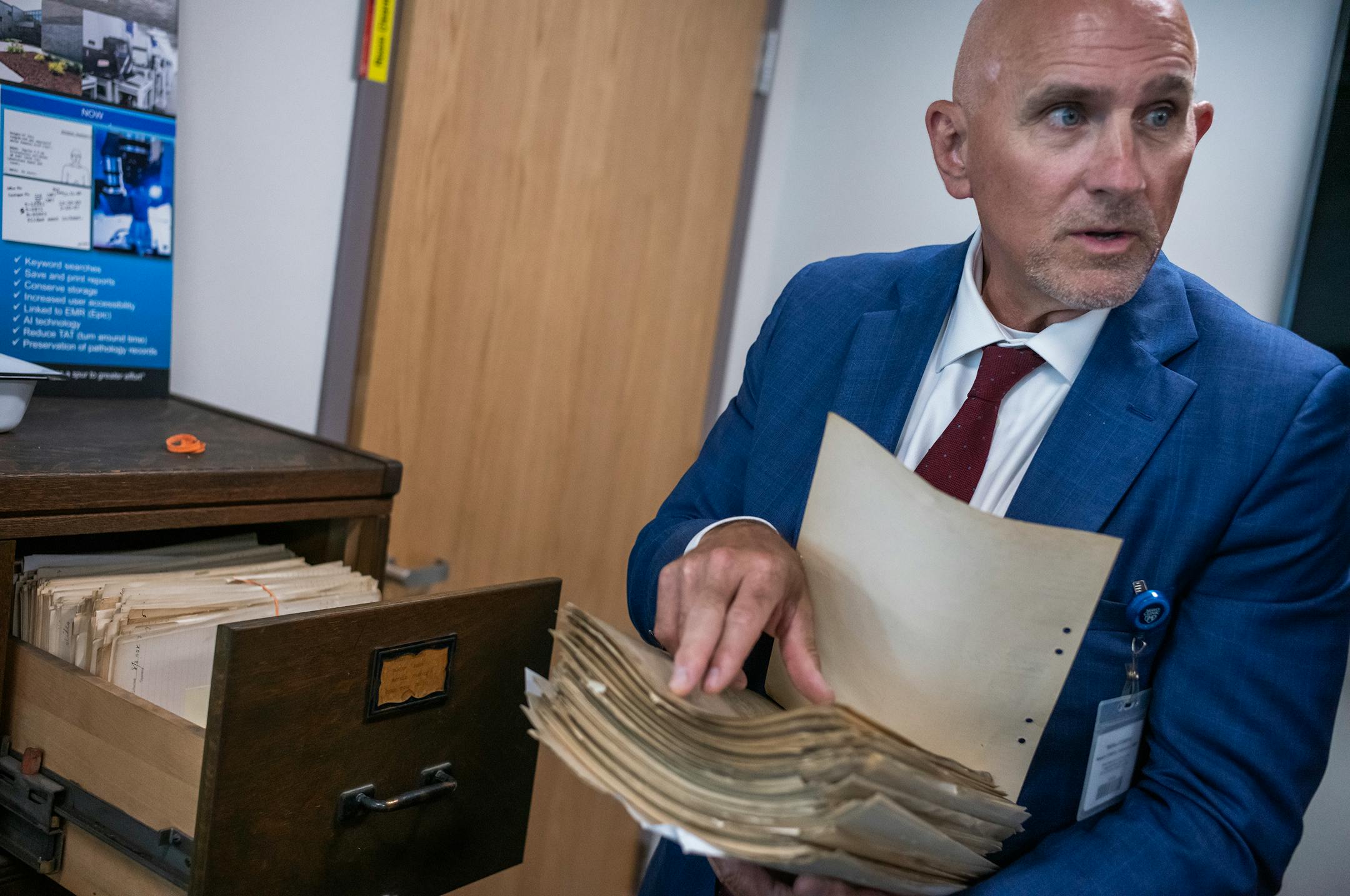
Dr. Matthew Callstrom checks out some patient files from the early 1900s that show how long the Mayo Clinic has been tracking patient data. (Richard Tsong-Taatarii/The Minnesota Star Tribune)
about the writers

about the writers

Emmy Martin

Business Intern

Emmy Martin is the business reporting intern at the Minnesota Star Tribune.

See Moreicon

Victor Stefanescu

Reporter

Victor Stefanescu covers medical technology startups and large companies such as Medtronic for the business section. He reports on new inventions, patients’ experiences with medical devices and the businesses behind med-tech in Minnesota.

See Moreicon

More from Health Care

See More
card image
Leila Navidi/The Minnesota Star Tribune

Following concerns that Medtronic was overspending on the high-tech system and not developing it fast enough, FDA clearance is a major victory for the Minnesota-run medtech company.

Nancy Ingham gives newborn Sophia Rash a hepatitis B shot several hours after she was born, Jan. 17, 2006.
card image