
St. Paul-based Ecolab sees gold in surge of new AI data centers

The company has reorganized its business and committed more to research to capitalize on the opportunities in massive growth of AI and the data centers that power it.

The Minnesota Star Tribune
July 23, 2025 at 11:00AM
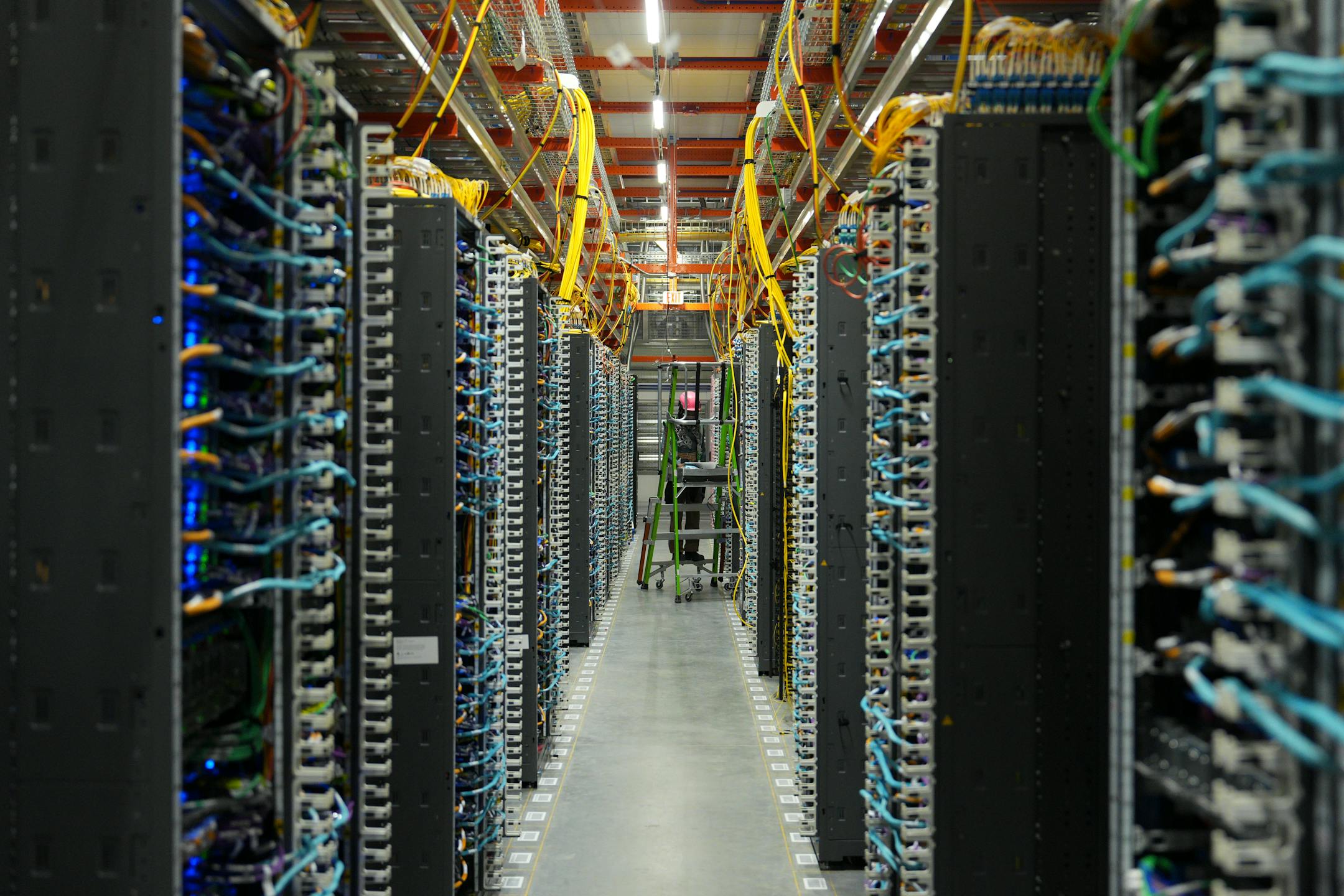
Racks of servers at the new Amazon Web Services facility in New Carlisle, Ind., where the tech giant plans to build around 30 data centers, on June 3, 2025.
The massive growth of AI data centers has presented new business opportunities for Minnesota companies such as Ecolab. (AJ Mast/The New York Times)

As artificial intelligence fuels a global surge in computing power, the sprawling data centers behind it are scaling up faster, running hotter and packing in more machines than ever.

The explosive growth, in Minnesota and around the world, is providing big opportunities for companies including 3M, nVent and Xcel Energy. Ecolab is reorganizing its business units as it makes a huge bet on the industry’s growth.

In Minnesota alone, at least 11 large-scale projects are in various stages of planning or development, including Meta’s $800 million facility in Rosemount, set to be completed next year.

These aren’t traditional server farms; they are mega centers designed specifically for AI workloads, which demand far more electricity and produce far more heat than conventional computing.

“The data center industry is such a gold rush right now,” said Thom Jackson, a mechanical engineer for Dunham Associates who designs cooling systems for data centers.

Ecolab’s play to grab data center business

Amid that rush, Ecolab sees an opening. The St. Paul-based Fortune 500 company, known for industrial cleaning and water treatment, is betting that its expertise in sustainable water use and advanced cooling technologies will become essential infrastructure for AI.

This year, Ecolab renamed its Global Industrial segment “Global Water,” reflecting the company’s growing focus on high-tech water solutions for industries such as chipmaking. The segment brought in $1.8 billion in sales in just the first quarter of 2025.

“The Global Water business segment is a critical pillar,” said Josh Magnuson, executive vice president and general manager of Ecolab’s Global Water division at Nalco Water.

Ecolab Chairman and CEO Christophe Beck told McKinsey in May that the company is investing in AI data centers because it estimates that, by 2030, AI will consume as much power as the entire country of India and as much water as the U.S. population drinks.

Ecolab has since shifted much of its research and development toward data centers and semiconductor manufacturing, Beck said, “because we will do it in a way that uses less energy and water.”

Ecolab is rolling out technologies designed specifically for AI workloads. One of its newest offerings is the 3D Trasar technology for direct-to-chip liquid cooling, which uses metal plates mounted directly to computer processors to capture heat and transfer it to a closed-loop liquid cooling system.

The liquid is then cooled and recirculated, and the system reduces water use by 15% and significantly cuts energy consumption, Magnuson said. It also uses AI to monitor the liquid coolant’s temperature, pH and flow rate in real time.

“AI can be key to solving some of the very challenges that it creates,” Magnuson said in a press release.

How new tech is being used

Digital Realty, one of the largest data center operators across the globe, is already using Ecolab’s AI-driven tools at scale. Ecolab deployed technology that detects anomalies that could be signs of system problems at 35 of Digital Realty’s water-cooled U.S. facilities. It’s expected to reduce potable water use by 15 percent, or 126 million gallons a year.

But Ecolab’s pitch isn’t just environmental. It’s economic. Cooling accounts for a significant portion of both water and electricity use in data centers. Reducing those inputs means cutting costs.

“Nobody wants to pay a high energy bill,” said Jackson, who designs cooling systems for data centers.

In Minnesota, these economic and environmental concerns are now reflected in a new state law requiring companies proposing data centers that will use more than 100 million gallons of water per year to obtain approval from the state, demonstrating they have both an adequate water supply and have considered ways to conserve it.

“When I think about a data center, and if somebody says, ‘Well, it’s sustainable’ — what’s the definition there? What’s the metric?” said Jason Moeckel, assistant division director for the Minnesota Department of Natural Resources (DNR).

Direct-to-chip liquid cooling, like Ecolab’s tech, has become the mainstream choice for AI-focused data centers, Jackson said, because it pulls heat straight from the processor efficiently.

Other facilities rely on refrigerant-based systems, similar to air conditioners, or submerge their servers entirely in liquid coolant.

Some, such as the Meta site in Rosemount, plan to use closed-loop dry cooling systems that minimize water use. A Meta spokesperson declined to say whether Ecolab technology would be used at the site.

In Pine Island, near Rochester, the construction firm Ryan Cos. has proposed a large data center that would use air-cooling rather than water, specifically to minimize water use.

How the industry is changing Ecolab’s tools

Ecolab’s cooling tools are already embedded in the industry. Its 3D Trasar technology has been used for years in traditional data center cooling, helping customers save more than 830 million gallons of water in 2023 alone, said Katie Ericsson Wanek, a senior communications manager at Ecolab.

But what’s really driving the spike in water and energy consumption among AI data centers isn’t necessarily the cooling method, Jackson said. It comes down to size.

“The perception is that all data centers use a lot of water,” he said. ”But the scale of these buildings is getting so much larger that total water usage is increasing.”

There is a give and take between water and energy use when it comes to designing cooling systems for data centers. “If a data center can use water, they can use less electricity to cool the same amount of data center equipment,” Jackson said.

Moeckel said the Minnesota DNR will notify developers about local water constraints before they apply for water-use permits.

During the permitting process, the DNR reviews requested water volumes to ensure compliance with state law. However, sustainability isn’t always straightforward — sometimes using water can be the greener choice, he said.

about the writer

about the writer

Emmy Martin

Business Intern

Emmy Martin is the business reporting intern at the Minnesota Star Tribune.

See Moreicon

More from MN Fortune 500

See More
Hormel headquarters in Austin, MN. ] GLEN STUBBE * gstubbe@startribune.com Friday September 11, 2015 Despite woes throughout the food industry, partly due to consumers turning away some from processed foods, Hormel has managed to continue prospering -- even though a good part of its business -- Spam, chili -- is about as processed as you can get. But the company's turkey and pork offerings are riding a hot protein trend. And over the past two years, it's made some of the biggest acquisitions in
Glen Stubbe/The Minnesota Star Tribune

The Spam-maker has experienced a string of tough years, including 2025, but analysts predict a stronger year to come.

card image
card image