
Northeast Minnesota data center wins key approval as hundreds protest

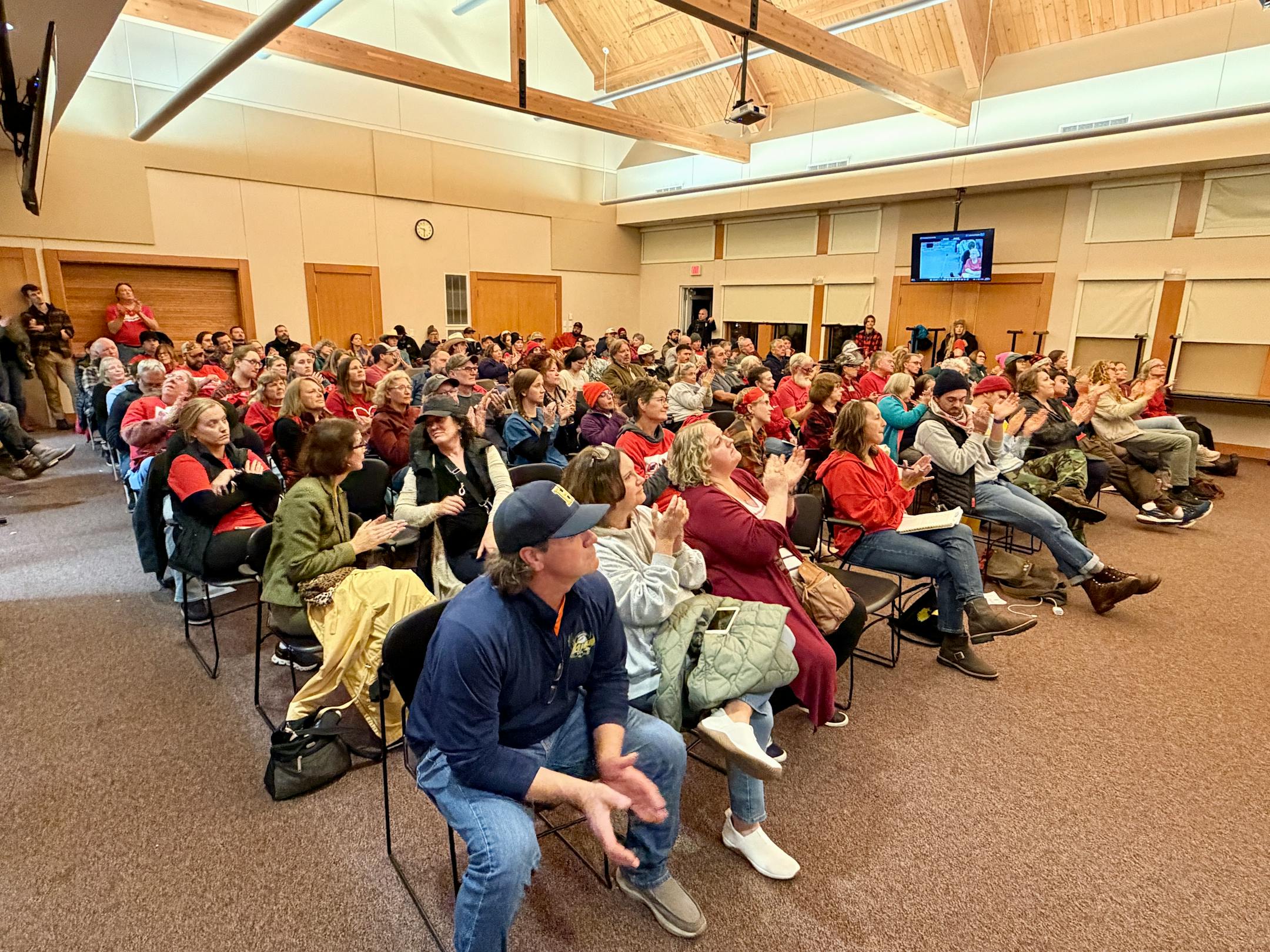
More than 300 people filled Hermantown’s council chambers and an overflow room before spilling into hallways, as others waited outside during a 5-hour rezoning hearing.

The Minnesota Star Tribune
October 21, 2025 at 4:06PM
People applaud after listening to a speaker at Hermantown's City Council meeting Monday night. About 200 sat inside an overflow room to watch a discussion on a data center proposed inside the city. (Jana Hollingsworth/The Minnesota Star Tribune)

HERMANTOWN, MINN. – A northeast Minnesota data center came closer to realization Monday, despite intense resistance from residents who filled City Hall to capacity.

The City Council voted unanimously to rezone land after hearing mostly opposition from nearly 70 people over four hours.

Hundreds in Hermantown, known more for its high school hockey prowess than activism, have coalesced in protest of a large-scale data center proposed for a rural corner of town. Fears of rising electricity, property tax and water costs; noise pollution; effects on the environment and quality of life have many objecting to the proposed 1.8 million-square-foot project.

They are fears echoed across the state as other large-scale data centers are considered by developers, with tech companies looking to boost their computing power to handle artificial intelligence needs. Meanwhile, community leaders are afraid of getting left behind in the future of economic development.

One of the country’s largest companies — its identity still unknown — has filed a proposal with Hermantown to build an immense data center campus in the southwestern portion of the city.

A citizen group called Stop the Hermantown Data Center has quickly mobilized to hold meetings that have drawn more than 100 people each, order lawn signs, build a website and file a petition to the Minnesota Environmental Quality Board asking for a tougher environmental review than the one initially approved. It is also seeking nonprofit status and considering legal action against the city.

Hermantown and Mortenson, a construction and engineering firm working on the project, had for months declined to disclose the nature of the company, finally revealed through public records requested by the Minnesota Star Tribune last spring. The lack of transparency has drawn complaints from residents and some environmental groups.

That was evident Monday night as dozens of speakers, often emotional or angry, took city officials to task for what they saw as secretive dealings.

(Sign up for the Minnesota Star Tribune’s North Report, covering Duluth and northeastern Minnesota.)

Solway Township resident John Gustafson lives less than a mile from the proposed building site. He’s had suspicions about a data center for the past year, hearing rumors of property sales and owners signing nondisclosure agreements. But public emails, revealed in data requests, between city officials dating back a year detail a “stunning amount of deception,” he said, to move the project along without public input.

And residents in Hermantown and beyond will ultimately subsidize it through things like higher utility rates, Gustafson said before the meeting, so “it’s just plain offensive.”

A new state law says data center companies must bear the cost of joining the power grid, as opposed to passing costs to customers.

The controversial issue drew people from beyond Hermantown, including Duluth, Esko, Proctor and Superior, Wis. Some, whose backyards border the proposed site, talked about losing their privacy and access to forested land filled with wildlife.

Hermantown resident Nicholas Rhinehart said the project doesn’t fit with the city’s identity, and he worried about losing its “country living” feeling.

Data centers, he said, “can reshape a community’s footprint.”

Among supporters, Mickey Pearson from Area Partnership for Economic Expansion warned councilors that by saying no, they would be rejecting economic development and “pulling up the ladder behind us.”

Others hoped for lower property taxes via a bolstered tax base from a data center.

Councilor Brian LeBlanc said the vote wasn’t approval of the project. Beyond that, there was little discussion from the decisionmakers, which prompted jeers and chants of “shame, shame, shame” from the crowd.

Hermantown resident Emily Helgeson said widespread opposition began when some residents started a Facebook page to share information, considering the secrecy surrounding the data center. It mushroomed into a bigger effort, she said, when residents learned how swiftly votes to advance it were coming before the City Council.

Resident Katie Hawkins said in an interview that it’s the job of the city government to listen to its community, and it has become clear that a large percentage opposes a data center.

“I’m not interested in that type of economic development,” she said, “especially without transparency and consent and encouragement from the public.”

While some city employees have signed nondisclosure agreements, Mayor Wayne Boucher said none of the councilors had.

No large-scale data centers operate yet in Minnesota. Facebook’s parent company will be the first, with its Rosemount project.

Environmentalists have raised concerns about the staggering amount of electricity that data centers need and questions about water use.

The company and city have not released how much electricity the data center would consume. Electric supply contracts are overseen by state utility regulators.

The application says the unknown company will build four concrete buildings — each 300,000 square feet and 50 feet tall — “designed to house the IT infrastructure required to store, process and transmit the data utilized in everyday digital services for users worldwide.”

During the meeting, councilors heard details of the project from representatives from Mortenson, Minnesota Power and Kimley-Horn, an engineering consultant.

Hermantown officials have said they were giving the developer time for due diligence while following state transparency laws, including compliance with public record requests.

Other cities, including Monticello, have described such proposals within their boundaries as data centers.

The City Council decision paves the way for developers to begin seeking a development agreement with the city, along with several state and federal permits.

Walker Orenstein of the Minnesota Star Tribune contributed to this story.

about the writer

about the writer

Jana Hollingsworth

Duluth Reporter

Jana Hollingsworth is a reporter covering a range of topics in Duluth and northeastern Minnesota for the Star Tribune. Sign up to receive the new North Report newsletter.

See Moreicon

More from Duluth

See More
card image
Rising above the treeline (Top of this photo), on the shore of Birch Lake, the Twin Metals Copper Nickel Mine Plant site and Tailings Management site is part of the proposed plan. ] In theory, the copper-nickel mine Twin Metals wants to build in the headwaters of the Boundary Waters Canoe Area Wilderness is a zero-discharge mine — a closed loop that will endlessly recycle millions of gallons of water, including rainwater and the polluted process water it uses to extract ore and