
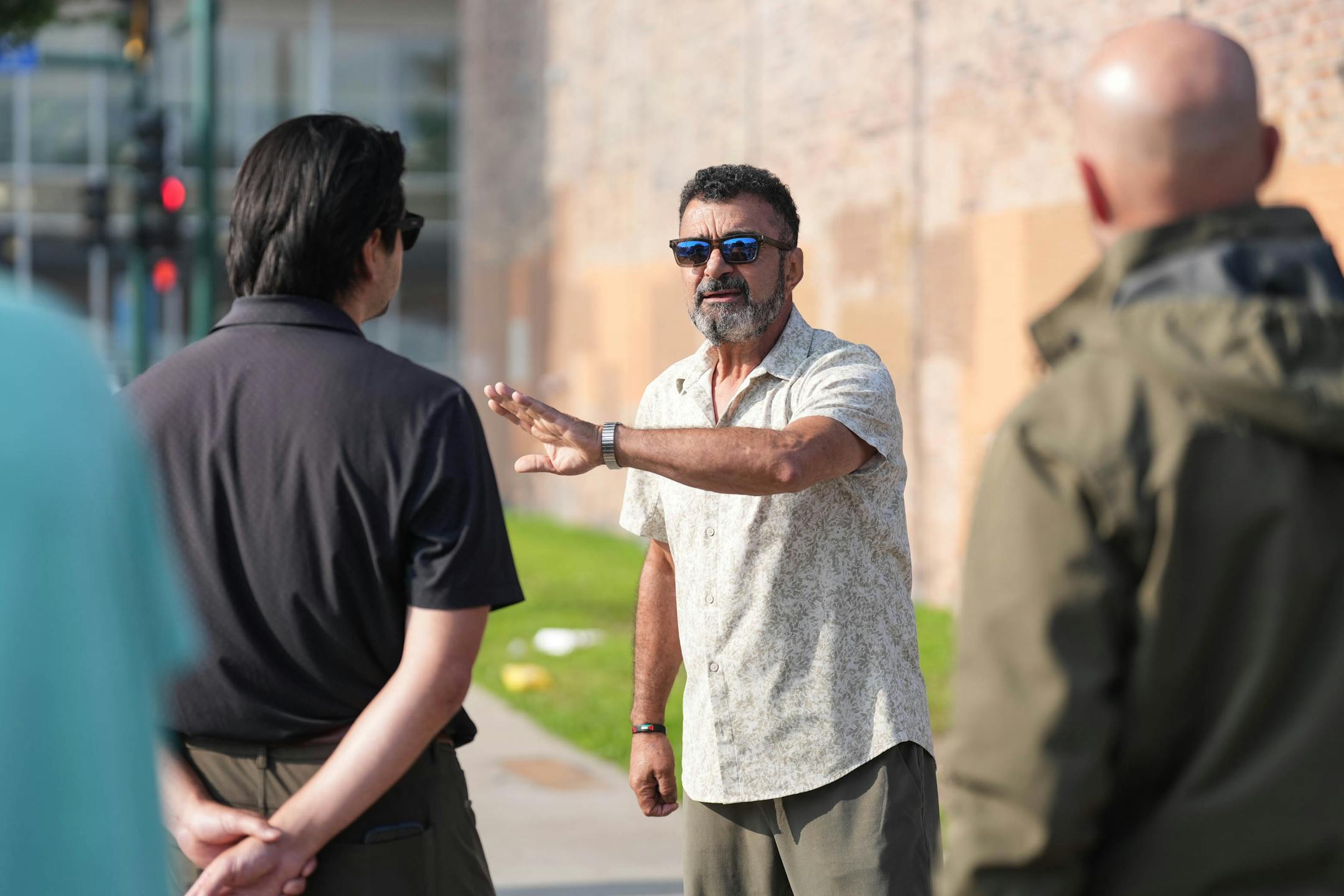
Who is Hamoudi Sabri and why did he set up a private Minneapolis homeless encampment?

Before the mass shooting this week at the landlord’s E. Lake Street encampment, the owner had been feuding with the city, where his name carries prominence.

The Minnesota Star Tribune
September 16, 2025 at 10:45PM
Earlier this year, Hamoudi Sabri tells mayoral aide Michael Ohama he would not allow the city to remove tents from his property. The city ultimately stood down. (Susan Du/The Minnesota Star Tribune)

Minneapolis property owner Hamoudi Sabri is now at the center of a messy dispute with the city following a mass shooting late Monday at a homeless encampment he had established on his property near Lake Street earlier this summer.

Here’s more about Sabri and his feud with City Hall over the encampment.

Who is Hamoudi Sabri?

Sabri is a prolific commercial developer and landlord and whose Palestinian American family owns properties throughout Minneapolis and around the Lake Street immigrant business corridor.

His brother Basim Sabri, who owns the Somali shopping center Karmel Mall, served prison time for bribing a former Minneapolis City Council member about 20 years ago. Basim has not been involved in Hamoudi’s activism on homelessness in Minneapolis.

Neither brother is new to litigation concerning their real estate holdings, but the civil complaint that the city filed against Hamoudi Sabri this month over his Lake Street encampment off 28th Avenue S. was the first time the two parties have butted heads as direct adversaries in a lawsuit.

Sabri had vowed to fight the city in court, but city workers on Tuesday disbanded his encampment, potentially making the legal fight irrelevant before the first hearing.

Why the private encampment?

Sabri has said that he set up his encampment in the first place because addiction-driven unsheltered homelessness had plagued Lake Street all summer, and he wanted to bring attention to the transient population’s need for longer-term solutions. He blamed Minneapolis’ persistent problems with drugs and crime on local government and the mayor.

He set up the encampment in the parking lot of one of his vacant commercial buildings.

“If this city truly treated these shootings like the emergencies they are, people would already see grief and trauma counselors on the ground,” Sabri said after the shootings. “We would see a citywide emergency response — with outreach workers, harm reduction teams, and housing navigators deployed. We would see safe places to stay opened immediately — hotels, Navigation Centers, emergency shelter beds. Instead, the mayor’s answer is the same tired move we’ve seen for years: displacement. Bulldoze people’s tents, fence off their space, and call it leadership.”

What is Sabri’s history with homeless encampments?

Sabri first experimented with hosting homeless encampments on his private property in the winter of 2021, when he allowed people to move into a semi-vacant property he owns on N. 5th Street in the North Loop neighborhood. He told the Minnesota Star Tribune at the time that he’d encountered difficulties developing the property after the pandemic, and was considering building a dog park when tents appeared. He permitted homeless people to stay until they could find permanent housing.

That encampment lasted for months with the help of volunteers who supplied food and survival gear, and attempted to build tiny homes. Activists thwarted city workers’ attempts to clear the camp, but as time went on and the population grew, garbage accumulated in the surrounding snow banks, the porta-potties overflowed and propane fires engulfed tents. The city ultimately swept the North Loop camp, with Sabri’s consent and participation, in March 2022.

Why did Sabri try again on Lake Street?

Earlier this year, the city of Minneapolis cracked down on encampments, with Police Chief Brian O’Hara issuing a special order clarifying police have the ability to intercede when they find illegal camping. Large encampments mostly disappeared, and Frey controversially claimed that the city had reduced the unsheltered homeless population to less than 30 individuals citywide.

Despite the drastic reduction in tent encampments, neighborhoods continued to experience large gatherings of unsheltered people in active addiction along the Midtown Greenway and under bridges throughout south Minneapolis.

Sabri said he was tired of seeing unsheltered people breaking into his properties for shelter and wanted to bring them together in one place, where resources could be concentrated. He invited people to move into a long-vacant property he owns at 2716 E. Lake St., a block that sustained heavy damage in the civil unrest following George Floyd’s murder in 2020.

Encampment leaders and volunteers attempted to keep out drug dealers and violent perpetrators, but hygiene problems mounted as Sabri failed to rent hand-washing stations and portable toilets, and the city refused to supply them. As tensions rose between Sabri and his neighbors, including other business owners and nearby apartment residents, the landlord resisted closing his camp and displacing its occupants. He said the city did not have the authority to enforce its anti-camping ordinance on his private property.

Last week, the City Council voted to approve a lawsuit seeking a court order.

On Monday, the second of the two Lake Street shootings forced the camp’s closure “due to urgent safety and health concerns,” according to a city news release.

about the writer

about the writer

Star Tribune staff

See Moreicon

More from Minneapolis

See More
card image
The Minnesota Star Tribune

Scott W. Carlson, 67, was charged with third-degree assault Monday in connection with a July attack against the same woman that left her hospitalized with facial, eye fractures.