City clears Minneapolis landlord’s homeless encampment hours after mass shooting

Four people suffered life-threatening injuries in a shooting on Hamoudi Sabri’s vacant lot. City officials vowed to close it down, despite potential legal challenges.

The Minnesota Star Tribune
September 17, 2025 at 1:35AM
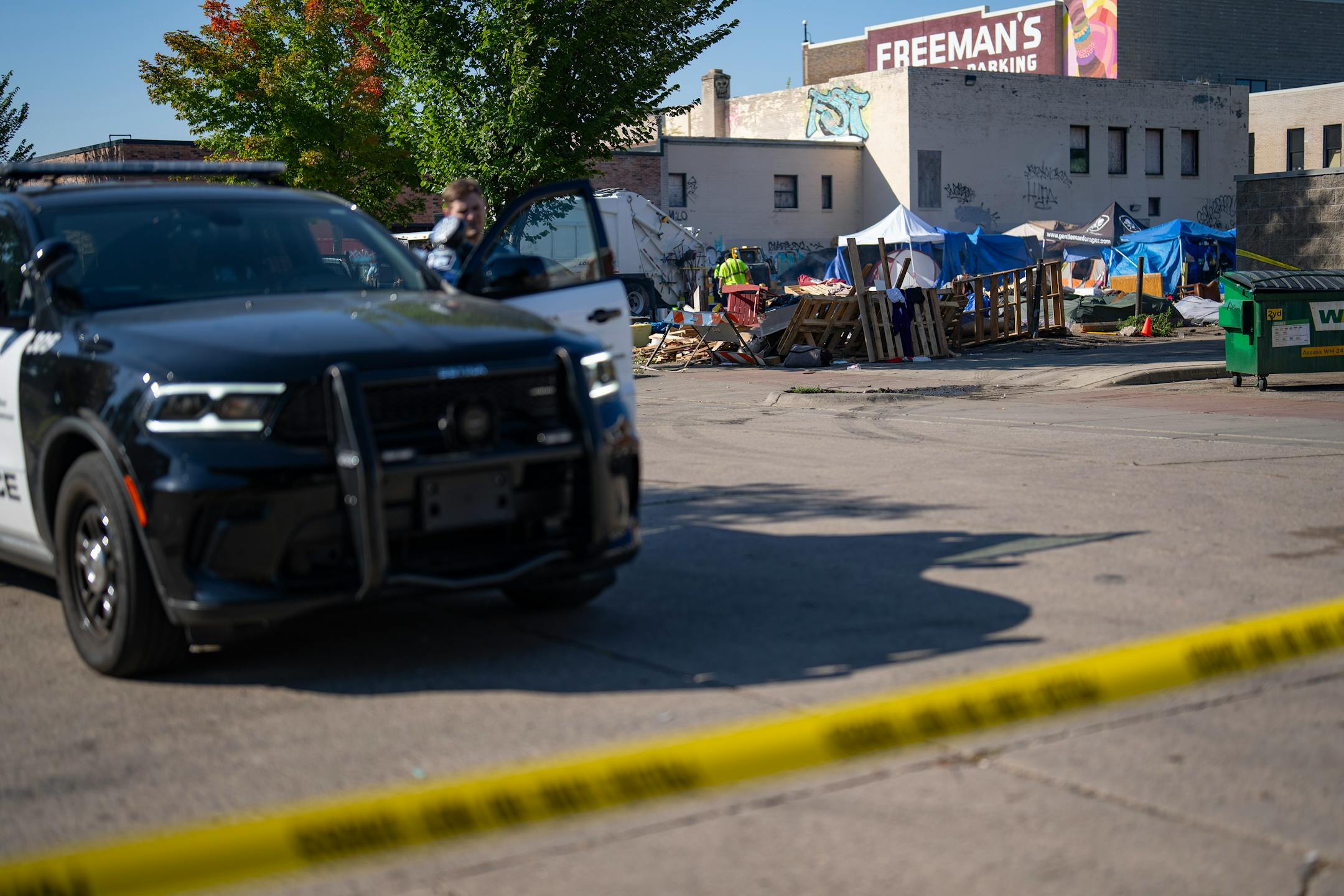
The city of Minneapolis clears a homeless encampment near E. Lake Street and 28th Avenue S. on Tuesday. (Alex Kormann/The Minnesota Star Tribune)

A large Minneapolis homeless encampment on private land was demolished and cleared on Tuesday amid tensions between the landlord and city officials who said the site needed to be cleared due to “urgent safety and health concerns.”

It was cleared following the second mass shooting Monday on the city’s South Side.

The shooting occurred at the private encampment set up by prominent Minneapolis landlord Hamoudi Sabri, a parking lot behind a vacant building he owns on E. Lake Street, city officials said. Sabri has been in a battle with the city for months to keep the encampment open — ignoring $15,000 in citations and daring them to get a court order.

At a Tuesday news conference, Mayor Jacob Frey said the city needed to close the encampment for the safety of those living in it and the surrounding community. Frey listed problems he’s previously linked to other encampments, including vulnerable people being preyed on through drug trafficking, human trafficking and violence.

“We would have liked to close down this encampment months ago,” he said. “It is my goal to prevent these senseless deaths from happening from the very beginning. That’s my responsibility.”

Frey said the cleared site will be controlled by law enforcement until the city can obtain a temporary restraining order from a judge, which the city hopes will happen as early as Wednesday. The mayor additionally took issue with Sabri for resisting the city’s past attempts to clear the site.

Sabri said in a statement Tuesday that his encampment is in response to Lake Street having become “a place avoided by many and blatantly ignored by leadership.”

“Uptown has been abandoned. For years, Phillips and Lake Street have endured shootings, displacement, and trauma without the sustained care or urgency shown to other parts of the city,” he said. “Instead of emergency response, the pattern has been abandonment — and repeated displacement that leaves people more vulnerable to violence."
City officials at the news conference detailed the resources that were offered to encampment residents ahead of the sweep, including shelter. Enrique Velázquez, the city’s director of regulatory services, said there were 70 to 75 people at the encampment before the shooting, and about 30 after it. When the outreach team offered services, only one person was interested in shelter, he said.

“Our neighbors deserve better — our neighbors living in the encampments and neighbors living in the immediate surrounding area around the encampments,” Velázquez said.

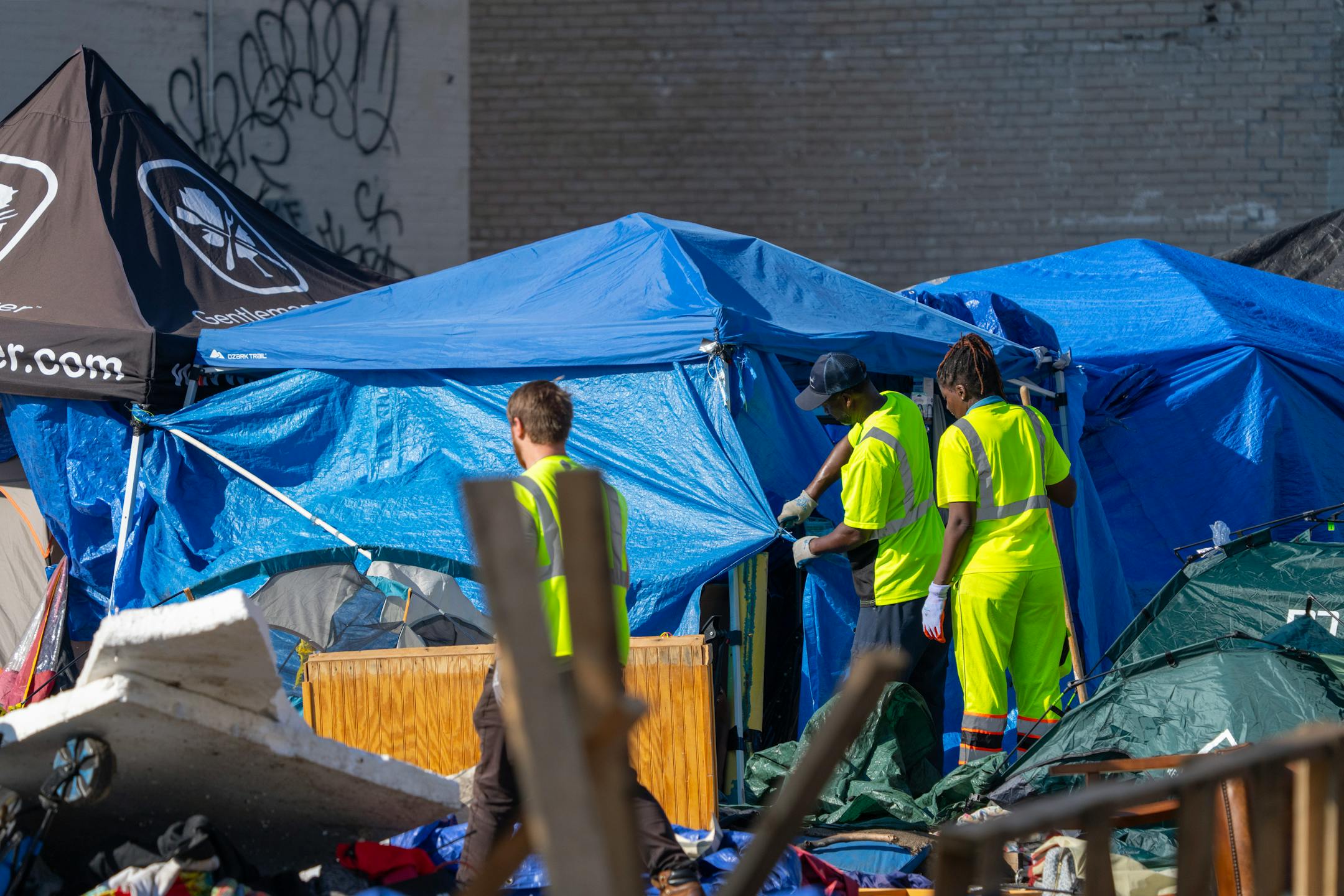
The city of Minneapolis clears a homeless encampment near E. Lake St. and 28th Avenue S. on Tuesday. (Alex Kormann/The Minnesota Star Tribune)

The gunfire erupted around 10 p.m. Monday at the site near Lake Street and 28th Avenue S., drawing a large presence of police, city officials and onlookers to the scene. Less than 12 hours earlier, five people were wounded in a shooting not far from the intersection of Lake Street and Interstate 35W, about 2 miles west.

On Tuesday, Police Chief Brian O’Hara said police believe the encampment shooting was related to a “narcotics dispute,” and the earlier shooting appeared to be “a separate quarrel that escalated to gunfire.”

The scene became tense on Tuesday as former camp residents disputed the closure. A little after 9:30 a.m., a crowd of about 50 former encampment residents and protesters gathered outside police tape as city workers placed bicycles, tents, other belongings and debris in the back of garbage trucks. At least one person was detained after scuffling with officers.

About 10 people argued with officers as the encampment site was cleared, saying they wanted to go back in to retrieve their items and that they were told by police before the sweep that they would be able to.

Several homeless people said they understood the city’s safety rationale of closing it following a mass shooting. But they also said they think it was wrong not to give them time to collect such things as ID cards, clothing and tents before the closure.

“I can’t even get mad at [police] for being here, because what, we’re going to wait until everybody is dead sitting there behind tents?” said former encampment resident Tre Williams. “But I don’t understand why we can’t just get our stuff. That’s all it should have been: ‘Everybody grab your things and get out, it’s the last day.’”

Another former resident, Candy Lake, said she agrees with the closure because of the violence. At the same time she said it’s difficult losing things such as paintings she made and letters she was planning to send to her husband in prison.

“Some of that stuff is irreplaceable,” she said.

Frey later said that the site was an active crime scene, needles were “virtually everywhere” and that it wasn’t safe to allow people to re-enter. He said he would have preferred to work with the property owner on a gradual closure.

Last week, the City Council voted to sue Sabri over creating a public health nuisance at the site.

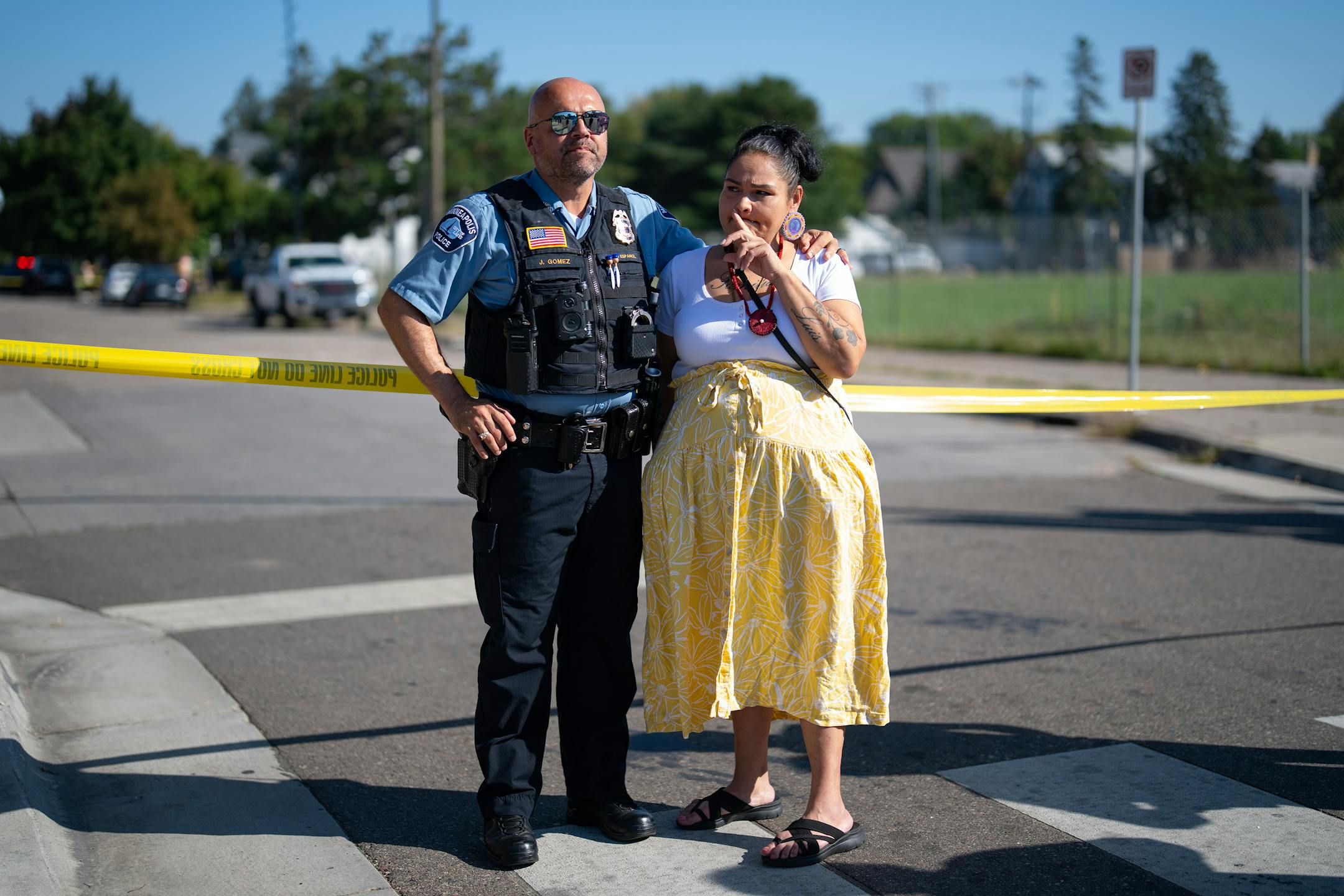
Minneapolis police Inspector Jose Gomez chats with Nicole Mason, Camp Nenookaasi organizer, as a homeless encampment is cleared Tuesday. (Alex Kormann/The Minnesota Star Tribune)

The crowd protesting at the intersection Tuesday included homeless advocates and nearby residents — a mix of people in favor of the camp closure and those against it.

Frey, flanked by Police Chief Brian O’Hara, said he had not talked to Sabri following the shooting. But he vowed to have the encampment cleared as soon as the scene was fully processed by the crime lab Tuesday morning.

“We’re shutting this thing down,” Frey said. “If he wants to sue us, he can.”

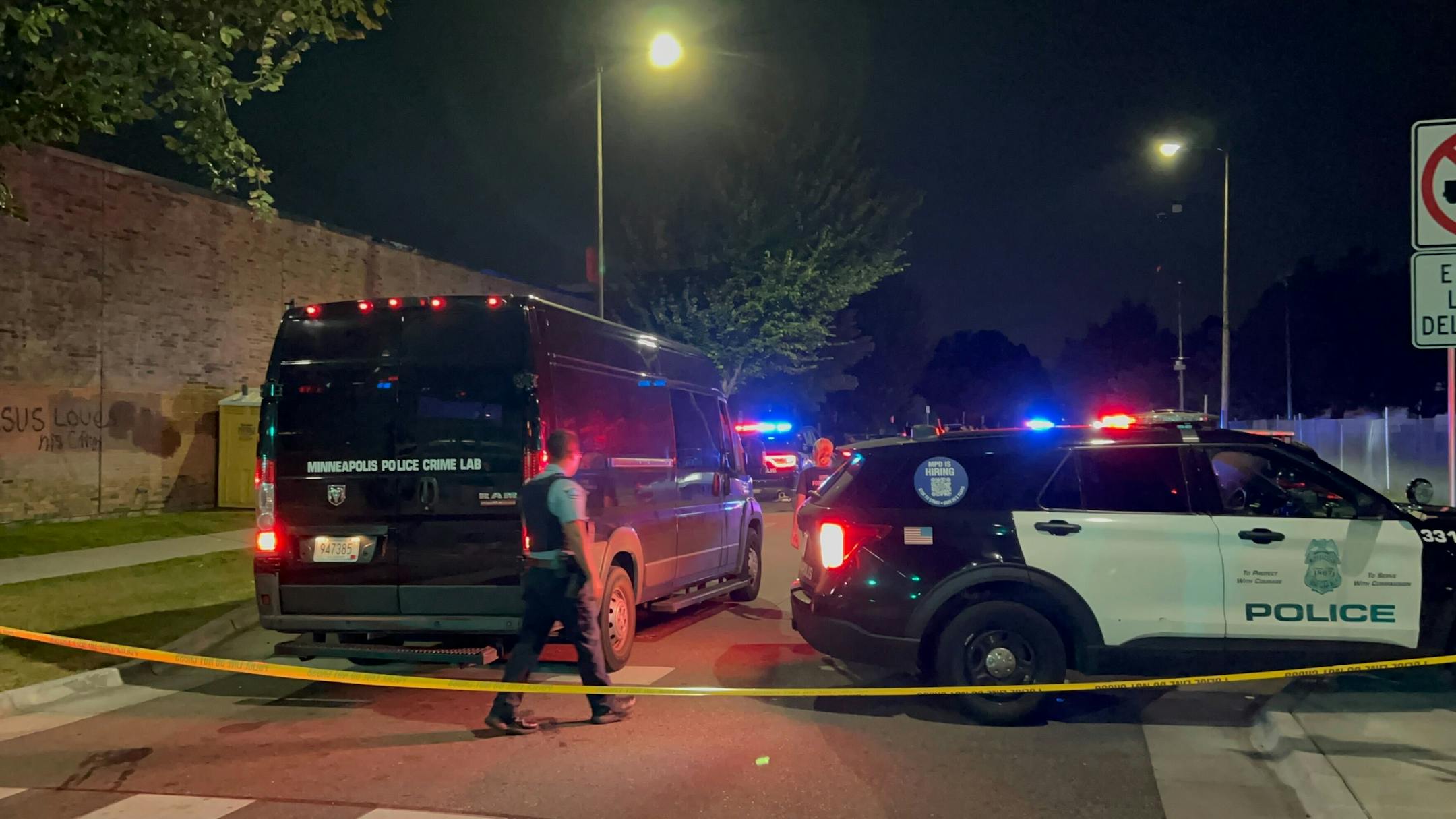
Minneapolis police were on the scene Monday night of a suspected shooting near E. Lake Street and 28th Avenue S. (Liz Sawyer/The Minnesota Star Tribune)

Nicole Mason, an advocate for unhoused people, visited the scene Tuesday morning to check in with people. She said she doesn’t believe the city has provided sufficient resources to respond to homelessness.

“We’ve been talking about what our needs are as the unhoused community, and they don’t listen to us. We always get that pushback,” Mason said. “We’re kindly asking for what we need.”

Mason added that she has helped homeless people at the encampment get documents such as birth certificates that were in the tents cleared away by workers on Tuesday.

Several renters observing the closure said they were in favor of it and previously would see open drug dealing and frequent fentanyl use. They also experienced thefts they believe were committed by encampment residents.

Arlene Escandey, 69, said she has had problems with homeless people defecating in her yard or using drugs. She said she’s glad the camp was closed.

“Why did it take them so long to do this?” Escandey said.

Steve Christen, another nearby resident, said he’s a father of a 10-year-old and has wanted the camp to be cleared out.

“I’ve caught them numerous times in my yard smoking fentanyl, or in my yard trying to break in or break into neighbors’ cars all night long, up and down the alleys,” Christen said.

Sabri opened his own land to the homeless in July after growing frustrated with the city’s homeless dispersal tactics, which he says have driven people struggling with mental illness and addiction from one hideaway to another.

Dozens of people have since moved in, including many struggling with active drug addiction. The parking lot has no running water or toilets, so people are relieving themselves in the entryways of nearby buildings.

Despite repeated interventions by regulatory services workers — and some complaints from neighboring business owners — Sabri refused to clear the property. Earlier this month, he appeared defiant in the face of a pending legal challenge.

“Listen, I’m not scared,” he said. “My crime is I’m helping homeless people who need help.”

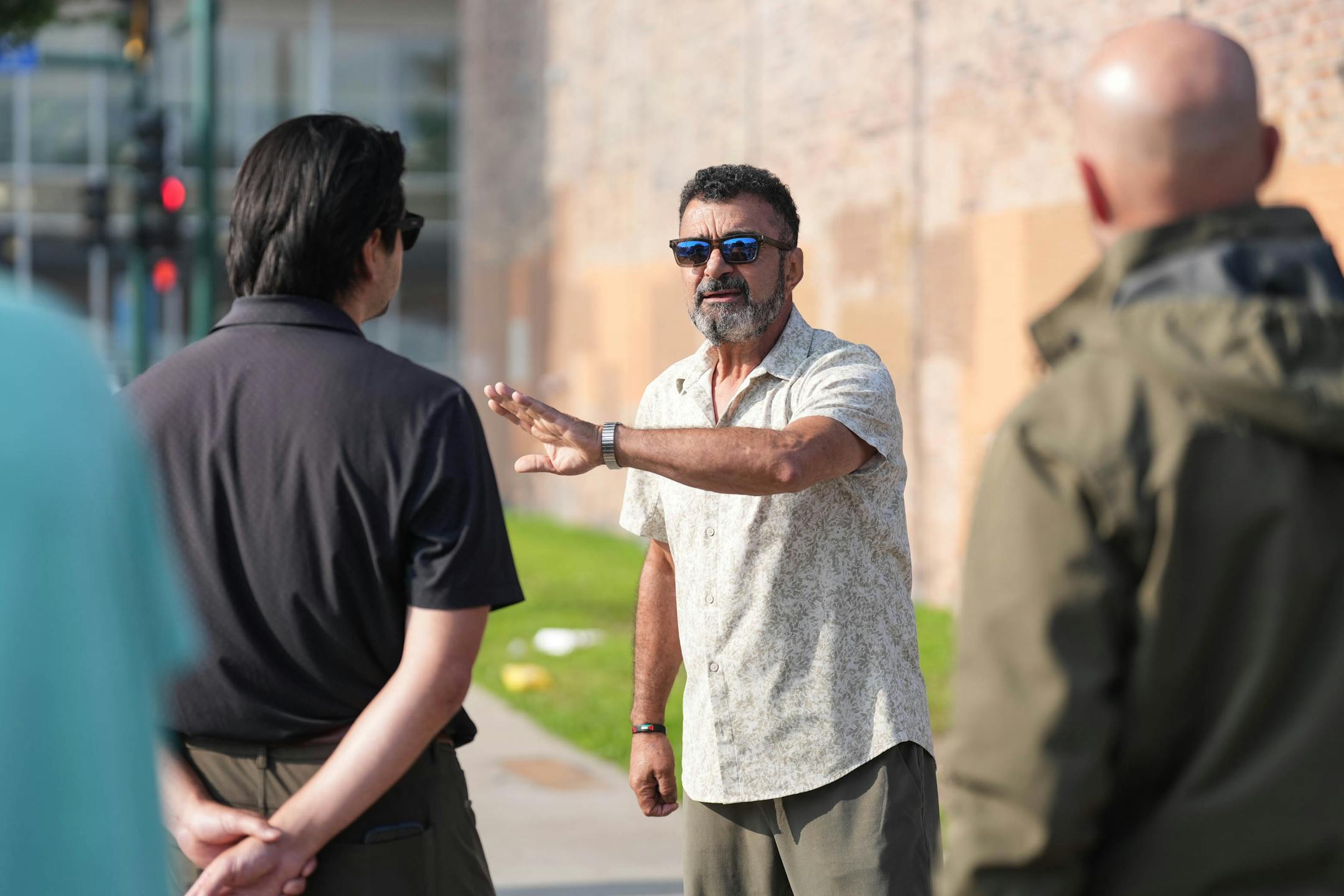
Hamoudi Sabri speaks with a representative from the Minneapolis mayor's office on July 25, saying he will not allow the city to remove tents from his property. (Susan Du/The Minnesota Star Tribune)

Monday’s shooting capped a particularly violent 48-hour stretch in Minneapolis, where gunfire killed two and wounded at least 15 others throughout the city.

An off-duty officer working at a nearby Target store was approached by several people running from a torrent of bullets a few blocks away.

Five victims were found wounded inside the encampment Monday, including a man and a woman gravely wounded in their respective tents from a shot to the head. Another man was struck in the stomach.

Others self-transported to area hospitals, including one man with gunshot wounds to the neck and torso.

Investigators collected approximately 30 shell casings from the crime scene, but noted there might be more hidden amid a dense layer of debris. Evidence suggests there was an exchange of gunfire between at least two people. A fire broke out in one of the tents as police were processing the site, requiring intervention from the Fire Department.

Just after 11 a.m. on Monday morning, five people were shot and injured on Stevens Avenue near the Midtown Greenway and Lake Street transit station.

One victim was rushed to HCMC with serious injuries after he was struck in the head and neck area, police said. Three others were hospitalized with noncritical injuries, and one graze victim declined medical treatment.

Preliminary information indicated shots were fired from near the Greenway, but more gunfire was suspected to have come from the adjacent highway ramp.

Homeless encampments have occasionally cropped up there, with at least three shootings occurring nearby over the last month.

O’Hara had advocated that the city take “immediate action” to close the walkway. Frey later directed city staff to temporarily fence off the area.

It is not clear if the shootings are related. Both incidents appeared to target the homeless — or spots where vulnerable individuals gather — so authorities have yet to rule it out.

No arrests had been made in either case as of late Tuesday afternoon.

State troopers and Hennepin County Sheriff’s Office deputies arrived to help patrol Lake Street on Tuesday at the request of the city.

As midnight drew near Monday, a rotating cast of onlookers approached the yellow crime tape and began livestreaming as forensic analysts combed the street with flashlights for shell casings.

“Didn’t we already do this today?” Christen, the nearby resident, asked no one in particular.

Christen said he was sitting outside when he heard a barrage of about 20 shots pierce the night air. Seconds later, another volley erupted — even closer to his Longfellow neighborhood home.

Christen rushed inside, instructing his family to hide until the bullets stopped. After police swarmed the area, they trekked down the street to assess the scene.

His son watched as dozens of red and blue police lights ricocheted off graffiti-covered buildings.

“He ain’t going to sleep anytime soon,” Christen said.

Susan Du of the Minnesota Star Tribune contributed to this story.

about the writers

about the writers

Louis Krauss

Reporter

Louis Krauss is a general assignment reporter for the Star Tribune.

See Moreicon

Liz Sawyer

Reporter

Liz Sawyer  covers Minneapolis crime and policing at the Star Tribune. Since joining the newspaper in 2014, she has reported extensively on Minnesota law enforcement, state prisons and the youth justice system. 

See Moreicon