Minneapolis fails to take down a private homeless camp. Here’s what happened.

Police and city workers abided by landlord Hamoudi Sabri’s demands that they leave the camp on his property alone.

The Minnesota Star Tribune
July 25, 2025 at 9:24PM
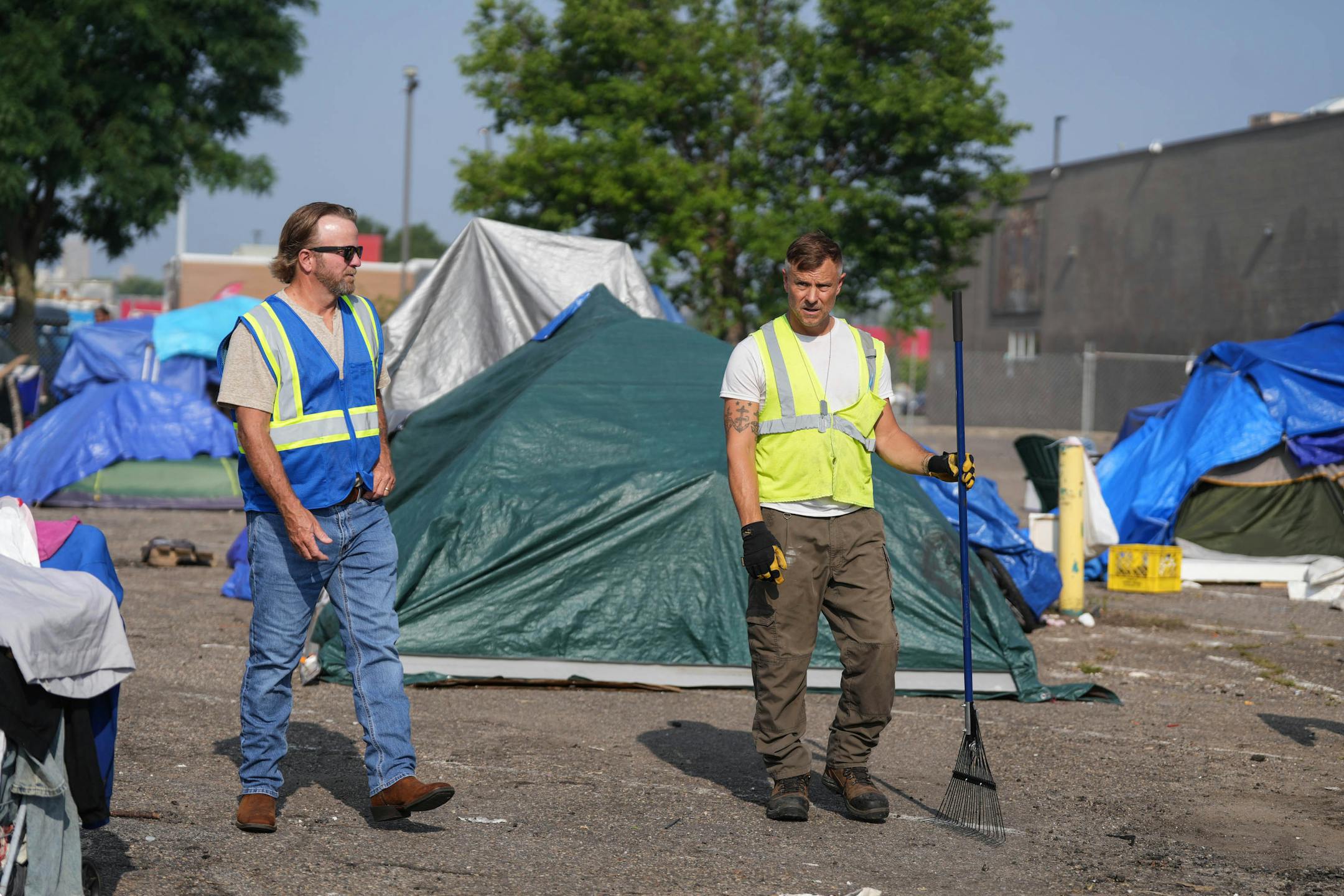
An officer chats with someone in a homeless encampment on private property in Minneapolis Friday. City crews failed to dismantle the camp. (Renée Jones Schneider/The Minnesota Star Tribune)

Minneapolis crews tried — and failed — Friday to take down a growing homeless encampment erected by a prominent property owner hoping to manage the problem himself.

After an hours-long standoff involving police officers, public works personnel and property owner Hamoudi Sabri, the city abandoned its efforts for the day, leaving the situation in south Minneapolis unresolved after clearing some trash and debris.

An estimated 50 people have moved into a tent city in the parking lot behind Sabri’s long-vacant commercial building at 2716 E. Lake St., where he has invited them to stay in defiance of the Minneapolis’ anti-camping ordinance.

On Monday, Minneapolis Health Commissioner Damon Chaplin cited Sabri with a notice of public health nuisance, saying his encampment was unsafe. According to the notice, the camp contained “accumulated solid waste and refuse,” “open fires and uncontrolled combustibles,” and “drug paraphernalia and hazardous sharps,” a term used to refer to syringes with needles.

‘Bring it on’

Police have parked outside the camp off and on ever since the notice, and on Friday morning a caravan of public works trucks arrived to start clearing the site. Sabri soon appeared to intervene, and as he argued with officials about whether the city is authorized to disband an encampment on private property, Public Works staffers heeded the developer’s orders to get off his land.

Hamoudi Sabri tells mayor's aide Michael Ohama he will not allow the city to remove tents from his property. The city ultimately stood down. (Susan Du/The Minnesota Star Tribune)

“Nothing you’re saying is making sense,” Sabri shouted at Michael Ohama, Mayor Jacob Frey’s senior policy aide of community safety. “You want a human being to stand in the sun. You just don’t want the tent?”

“Hamoudi, you know we have an ordinance,” Ohama responded. “I just want to remind you, this won’t end. It will only get more expensive.”

“You know what, money doesn’t scare me,” said Sabri. “Bring it on.”

Shelters have been full

At one point, outreach workers with Hennepin County and nonprofit agencies Avivo and Twin Cities Recovery Project came through with water, clean needles and information about accessing various resources. Members of the city’s Homeless Response Team were barred from entering Sabri’s encampment at first, but they were later permitted to enter and help residents call the shelter reservation hotline.

“The past few days when we were here, a couple of people wanted to go into shelter,” said Homeless Response Team member Maikao Vue. “Unfortunately, they couldn’t get in. It was full. When we called, it was pretty much like all beds for females and males were full.”

Minneapolis police Lt. John Haugland eventually brokered a compromise with Sabri, in which the camp’s occupants would collapse their tents during the day, erect tarps for shade and put the tents back up at night to sleep in.

By noon, the Public Works staff loaded up their skid steer loaders and left. City workers assigned to clean encampments are paid extra for the hazard and are eligible for overtime pay after 3 p.m. as well, they said.

Public Works cleaning crews were allowed to remove building debris and trash from the parking lot in the morning before Sabri insisted they leave. City workers had hours of downtime on Friday, unsure what they were allowed to do. (Susan Du/The Minnesota Star Tribune)

Two hours later, Ohama confirmed that the city was calling off the clearing for the day, having failed to get anyone to leave voluntarily.

“This encampment is the most structured encampment you guys have had,” argued encampment occupant Aeron Bush, whom Sabri deputized to be leader. “We do not tolerate domestic violence, no violence at all. If you do drugs, do them in your tent. Get caught outside, cops catch you, that’s on you.”

Earlier in the day, a man was arrested from the camp after allegedly striking a woman he was sharing a tent with.

Neighbors are anxious

Residents of nearby apartment buildings have been anxious about the encampment since it got going earlier this month, and have been eager to see it removed.

Encampment leader Aeron Bush proposed a "compromise" in which camp occupants would collapse their tents by day and erect them only to sleep in at night. Police Lt. John Haugland accepted, according to Ohama. (Susan Du)

Gary Mitchell, who lives across the street at an apartment for elderly and disabled people, said he’s seen more people panhandling for cigarettes, littering and rummaging through his building’s dumpster since the encampment formed earlier this month. The seniors who used to cut through Sabri’s parking lot to go grocery shopping at the nearby Aldi’s don’t feel comfortable doing that anymore, he said.

Another neighbor, Billy Woodall, said he hasn’t heard of the encampment causing direct problems for his building, but he felt concerned for the people living there with no running water, trash pickup or bathrooms.

“I want to know ... if you got enough money, why don’t you open it back up and then rehab it to make it nice and put them in there with water, [portable toilets] and all that?” Woodall asked of Sabri. “I mean, you got these people on the street. I know some of them might be out there by choice, but still.”

Neighbor Bruce Axelrod shook Sabri’s hand on Friday and asked him why he hadn’t brought in portable toilets and why he was allowing an encampment with drug use to continue next door to Universal Academy Charter School.

“I’m in recovery, I’ve been homeless, I’m 25 years clean and sober.... I feel for these people because I’ve been there,” Axelrod said. “The thing is, there’s a lot of drug use by the school. Would you want your children...? That’s an issue.”

Sabri agreed, saying he ordered portable toilets as soon as the city told him they would not provide them, and that he would try to find a solution before school started again in the fall.

Hennepin County’s shelter hotline is 612-204-8200.

about the writer

about the writer

Susan Du

Reporter

Susan Du covers the city of Minneapolis for the Star Tribune.

See Moreicon