
Opinion | Gov. Walz, don’t opt in to school choice vouchers

How a federal school voucher initiative could harm Minnesota public school systems.

The Minnesota Star Tribune
July 23, 2025 at 10:59AM
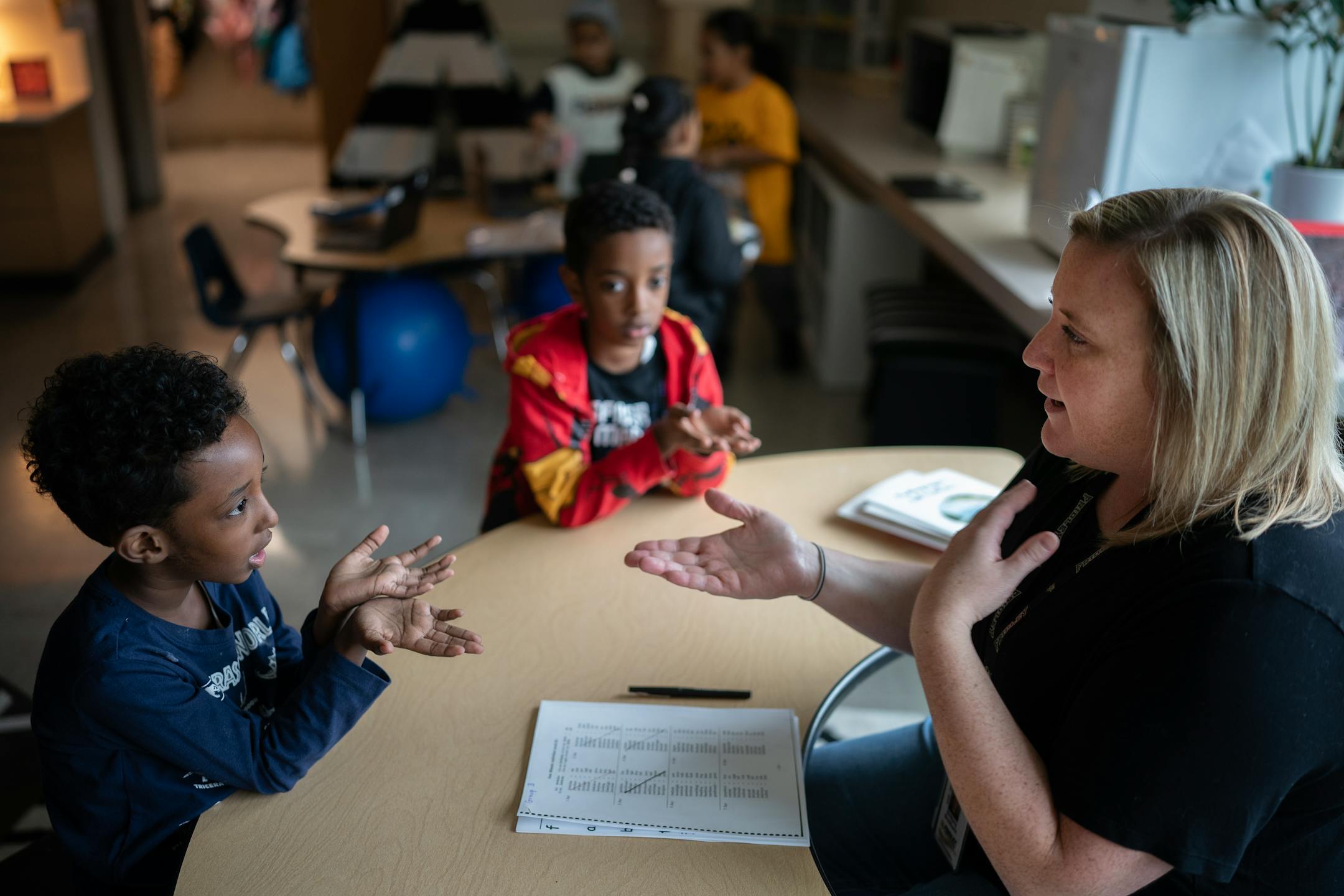
Brit Breitbach teaching reading to her kindergartners twins brothers Hamza Ahmed left and Hudeifa Ahmed, at Stevenson Elementary in Fridley.
A federal initiative to drive more families to private schools would result in less funding and resources for Minnesota's public schools, Caroline Siebels-Lindquist writes. (Jerry Holt/The Minnesota Star Tribune)

Opinion editor’s note: Strib Voices publishes a mix of commentary online and in print each day. To contribute, click here.

•••

If a loon were required by law to give a portion of their hard-earned fish to their government, and that government in turn gave that fish to wealthier loons who then used the fish to send their chicks to an expensive private school that our first loon could not afford to go to, wouldn’t our loon have a right to be upset? Wouldn’t such loons be right to question why their government isn’t using their fish to enrich the local public school just down the lake?

I certainly think that loon would be right, but we’re not actually talking about loons.

We’re talking about Minnesotans, and how a provision in the recently passed federal tax and spending law details a school voucher program to incentivize parents to send or continue sending their children to private education institutions, which ends up driving money away from public school systems.

This almost-national school voucher program, written in the margins of President Donald Trump’s “Big Beautiful Bill,” essentially allows parents to donate to a preapproved scholarship grant organization and then receive upwards of $1,700 on a dollar-for-dollar basis as a tax credit to spend on their child’s private schooling.

The drive by the Trump administration to prioritize private education is a bigger signal of its lack of respect for public education. What the administration is trying to do is divert much-needed funding for K-12 public education and equip for-profit education institutions with ample resources that only those who can pay the tuition can use.

“These voucher schemes playing out around the country [launder] public money through a new kind of nonprofit called scholarship grant organizations,” said Monica Byron, president of Minnesota’s leading teachers’ union, Education Minnesota. “Those dollars will then be sent to private and religious schools … and drain resources from public schools, student loans and other vital resources like our roads and hospitals and other public goods that are funded by the federal government.”

This type of private school voucher initiative is unprecedented at the federal level, but some Republican-led states already have similar voucher programs in place.

In Iowa, for example, a school choice code was enacted in 2023, diverting taxpayer dollars (as a tax credit) to parents already sending their children to private school institutions.

School voucher programs range in style from tax credits to direct appropriation to education savings accounts, but they all have the same purpose: to make public education, a wonderfully long-accepted and well-established practice under which children can learn and grow in the best possible settings, moot.

With the recent approval from the U.S. Supreme Court for the Trump administration to follow through on the firings of roughly 1,400 employees at the Department of Education, Trump’s efforts to privatize education might now have an impact on Minnesota’s highly ranked education reputation.

“My concern lies in how resources are going to get to those that need it, and those are our students and our educators,” Byron said.

One thing that Trump and Education Secretary Linda McMahon keep harping on is their plan to put education back into the hands of the states. Josh Crosson, executive director at EdAllies, a nonprofit education advocacy organization in Minnesota, thinks that their comments don’t add up.

“When I hear ‘bring education back to the States,’ I hear ‘put the sun back into the sky.’ [Education] already is with the states,” said Crosson.

“It’s a hyper-localization of deregulation. It’s, let’s deregulate this education at every single level and just trust that it’s going to be provided fairly, equitably and high quality.”

As if less or eliminated federal protection is a good thing, the push toward private education attempts to sow chaos, confusion and dysfunction into public education.

“We need to trust educators. We need to trust leaders. We also need to verify that our education system is being done equitably … . If we get rid of those regulations, we as a community have very little say in making sure that our education system works,” Crosson said.

Advocates for these voucher programs argue that they assist low-income families in affording private education. However, the only folks who seem likely to benefit from these voucher programs are the parents who already send their children to private institutions.

“When Indiana implemented vouchers statewide in 2017, only half of voucher recipients attended public schools in the first place,” said Byron. “In Florida in 2023, in their statewide voucher program, 69% of the recipients that received vouchers were already attending private schools.”

North Star Policy Action is an independent research group in Minnesota. One of its key conclusions in a February report was that “it seems increasingly clear that the motivation behind these [voucher] programs is not to support the nation’s young people, but to inculcate a religious education at taxpayer expense while providing tax avoidance to the wealthy.”

If the Trump administration’s public education hate train would stop dealing hits, and if the education field were not constantly sidelined in favor of other government sectors, maybe we would see public education systems reach greater heights than they already do with the low funding they’re used to.

“Our public schools have so much to offer, and while families have choice, if they came to our schools and saw all the great things happening, I think they may make a different decision,” Byron said.

While I personally think that kids should experience the same curriculum standards as their peers, even I understand and agree that parents should be able to send their children to whatever school — be it private or religious — that fits their needs. But (and I cannot emphasize this enough) not on the public’s dime. Minnesota kids need the option of well-funded, inclusive and supportive public schools that don’t have the federal government cryptically diverting funds away from them, until there’s no inclusion or support left.

Education Minnesota is under the impression that state governors must decide whether they will impose this federal school-voucher-like program. Neither Byron nor Crosson supposes it’s likely that Minnesota’s governor will entertain the idea of committing to it but, Gov. Tim Walz, in case you were thinking about it, I’m urging you, don’t opt in.

Caroline Siebels-Lindquist, who’ll be a senior this fall at Drake University, is a summer intern for Minnesota Star Tribune Opinion.

about the writer

about the writer

Caroline Siebels-Lindquist

Intern

Caroline Siebels-Lindquist is the intern in the Opinion-Editorial department for the Minnesota Star Tribune.

See Moreicon

More from Columnists

See More
card image
Joel Koyama/The Minnesota Star Tribune

Plus: Minneapolis Chamber embezzlement case, rescuing food waste, SilverSneakers fitness program cuts and more.