
Advertisement

Rash: NYT columnist calls out state ‘terror’ in Minnesota

A court ruling and M. Gessen, a New York Times columnist and expert on authoritarianism, offer unflinching reflections on Operation Metro Surge.

Columnist Icon
The Minnesota Star Tribune
February 21, 2026 at 11:00AM
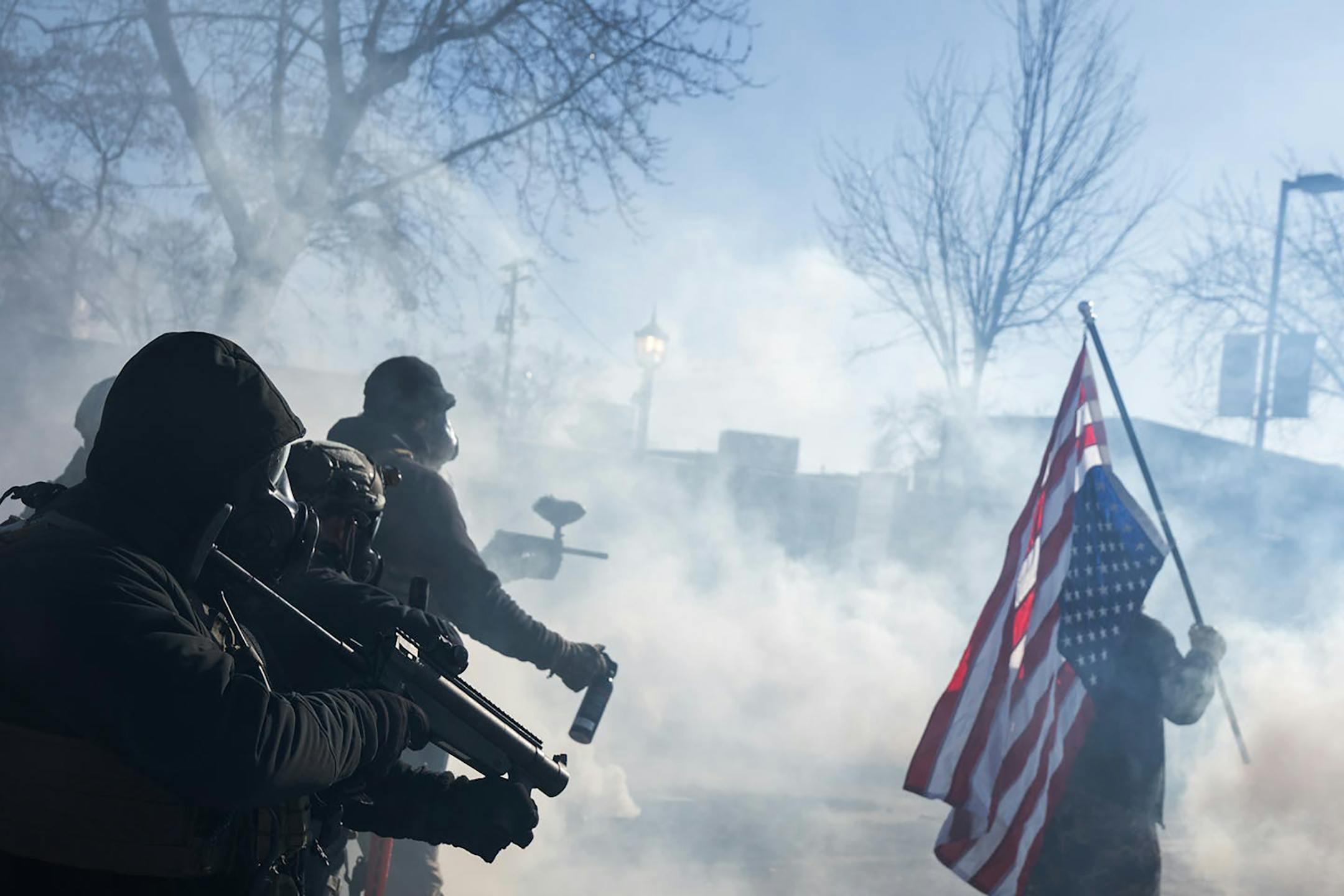
Immigration officers clash with protesters after federal agents fatally shot Alex Pretti in south Minneapolis on Jan. 24. (Richard Tsong-Taatarii/The Minnesota Star Tribune)
Advertisement

Opinion editor’s note: Strib Voices publishes a mix of commentary online and in print each day. To contribute, click here.

•••

For M. Gessen, a New York Times columnist and author of multiple books on authoritarianism, a question from a fellow journalist from Kyiv was key in considering Operation Metro Surge.

“Where is everybody?” Gessen’s fellow Eastern European asked. (Gessen was born and raised in the Soviet Union and reported from Russia for decades.) “Where are all the members of Congress? Why aren’t they flying into Minneapolis? Why aren’t all the celebrities flying into Minneapolis?”

What “a good question,” Gessen told a capacity crowd at the Walker Art Center on Feb. 17. “And how crazy is it that I traveled halfway across the world to hear that question?”

In the end, some politicians and pop stars did arrive, including Bruce Springsteen, appearing concurrently with his instant hit “Streets of Minneapolis.” (U2 also dropped a song about the ICE crisis, “American Obituary.”)

It’s clear that Gessen’s Ukrainian colleague wasn’t referring to the everyday people turned activists — those looking out for their neighbors and looking with understandable anger at the president who had posted, “FEAR NOT, GREAT PEOPLE OF MINNESOTA, THE DAY OF RECKONING AND RETRIBUTION IS COMING!”

Those people were out in numbers — even though there was much to fear from their federal government. Activists, added Gessen, smiling, “who think that everything is their business” — an ethos they (Gessen’s preferred pronoun) said is “the foundation of solidarity,” adding that solidarity “is extraordinarily difficult to practice.”

Advertisement

In fact, Gessen, responding to a question during a discussion with KARE-11 journalist Jana Shortal, said that while examples of truly transformative solidarity are rare, there is one notable exception: the “parallel society” of trade unionists, activists, academics, artists, journalists and others who pushed back on pro-Soviet Poland. Led by Lech Walesa, the group — known, appropriately, as Solidarity — “came to be the country” when Communism collapsed. “So solidarity,” said Gessen, “is the answer, both in the nomenclature and the nature of the thing.”

What solidarity is not, stressed Gessen, are the famous phrases in Martin Niemöller’s poem, “First They Came.” (“First they came for the Communists/And I did not speak out/Because I was not a Communist…”)

“The way [the poem’s] used in this country in particular is to appeal to people’s self-interest,” said Gessen. “If you think about it, it is the opposite of solidarity.”

Instead, said Gessen, “the reason that we should respond to terrible things happening to other people is not because they’re the canary in the coal mine; it’s not because it means they will eventually happen to us. But for the simple reason that they’re happening to other people.”

Gessen expounded by referencing German Ernst Fraenkel’s book “The Dual State: A Contribution to the Theory of Dictatorship.” The author, said Gessen, observed a Nazi-era “normative state” in which “life proceeded as customary for most people; they lived in a law-based society” that ran parallel with a “prerogative state” where for a minority of people things “were no longer the way that they had been.” These people were placed outside the law and could not seek recourse, said Gessen, who was quick to add that the duality is not new to this country, given its history of dual states for Indigenous, enslaved and impoverished peoples.

Today, Gessen said, immigrants are living vulnerably in the prerogative state. In fact, thousands may now be arrested despite committing no crimes, just like some asylum-seekers who were profiled in the Minnesota Star Tribune on Feb. 19.

Advertisement

For many this triggers anxiety, or what Gessen calls “low-level dread.” And “anxiety is the ultimate instrument of state terror, and anxiety is the thing that gets most in the way of solidarity.”

In an interview before the Walker event, Gessen, who in 2017 won the National Book Award for “The Future is History: How Totalitarianism Reclaimed Russia,” told me that “I stand by my characterization of what was happening here as state terror” (a description Gessen used in a recent column). “Terror” was also the adjective used by U.S. District Judge Sunshine Sykes in a Feb. 18 ruling that stated, “Beyond the terror against noncitizens, the executive branch has extended its violence on its own citizens, killing two American citizens — Renee Good and Alex Pretti in Minnesota.”

And beyond Minneapolis, Gessen added, “from what we’re seeing with the construction the [administration] is undertaking and the amount of funding that Trump wants to go to ICE and detention centers being constructed or reconstructed all over the country and just his general rhetorical orientation, this is going to be happening all over the country.”

Most may not be eyewitnesses to what’s happening here and across the country. And many may not see it, said Gessen, who told the Walker audience that “thinking about ‘not seeing’ is really at the heart of a lot of the work that I’ve done in my life.” Particularly with Russian/Soviet and Nazi-era history, but also in present-day Gaza and even with the Epstein files.

“My hypothesis,” said Gessen, “about people who do see when others aren’t seeing is that for them, the burden of not seeing is greater than the burden of seeing. For most people — and I think it’s normal — the anxiety that is produced by seeing is unbearable and not seeing is easier.

“But for a few people, the complicity is unbearable, and they recognize the complicity, and they refuse to live in that complicity. And I think that’s my activist friends, the ones who think that everything is their business. They don’t have easy lives. They have really incredibly harmonious lives, but these are lives that are premised on the fact that you just can’t be complicit. You can’t be one of the people who shore up that border between the normative state and the prerogative state.

Advertisement

“And if you don’t think that it’s unbearable to be conclusive, then you can actually see a lot of things.”

Among the many extraordinary exceptions to how events and the news normally proceed in America, an unusual number of Minnesotans — including Good and Pretti and the thousands who in freezing temperatures protested their killings and the overall prerogative state — chose to see things. And they insisted others do, too.

In the process, millions worldwide now see Minnesota in a profoundly new way.

about the writer

about the writer

John Rash

Editorial Columnist

John Rash is a columnist.

See Moreicon

More from Columnists

See More
card image
Richard Tsong-Taatarii/The Minnesota Star Tribune

A court ruling and M. Gessen, a New York Times columnist and expert on authoritarianism, offer unflinching reflections on Operation Metro Surge.

card image
card image
Advertisement