
Teens’ addictive use of social media affects mental health

Yet social media addiction has not been recognized as a medical disorder.

Saint Paul Academy and Summit School
July 31, 2025 at 11:00AM
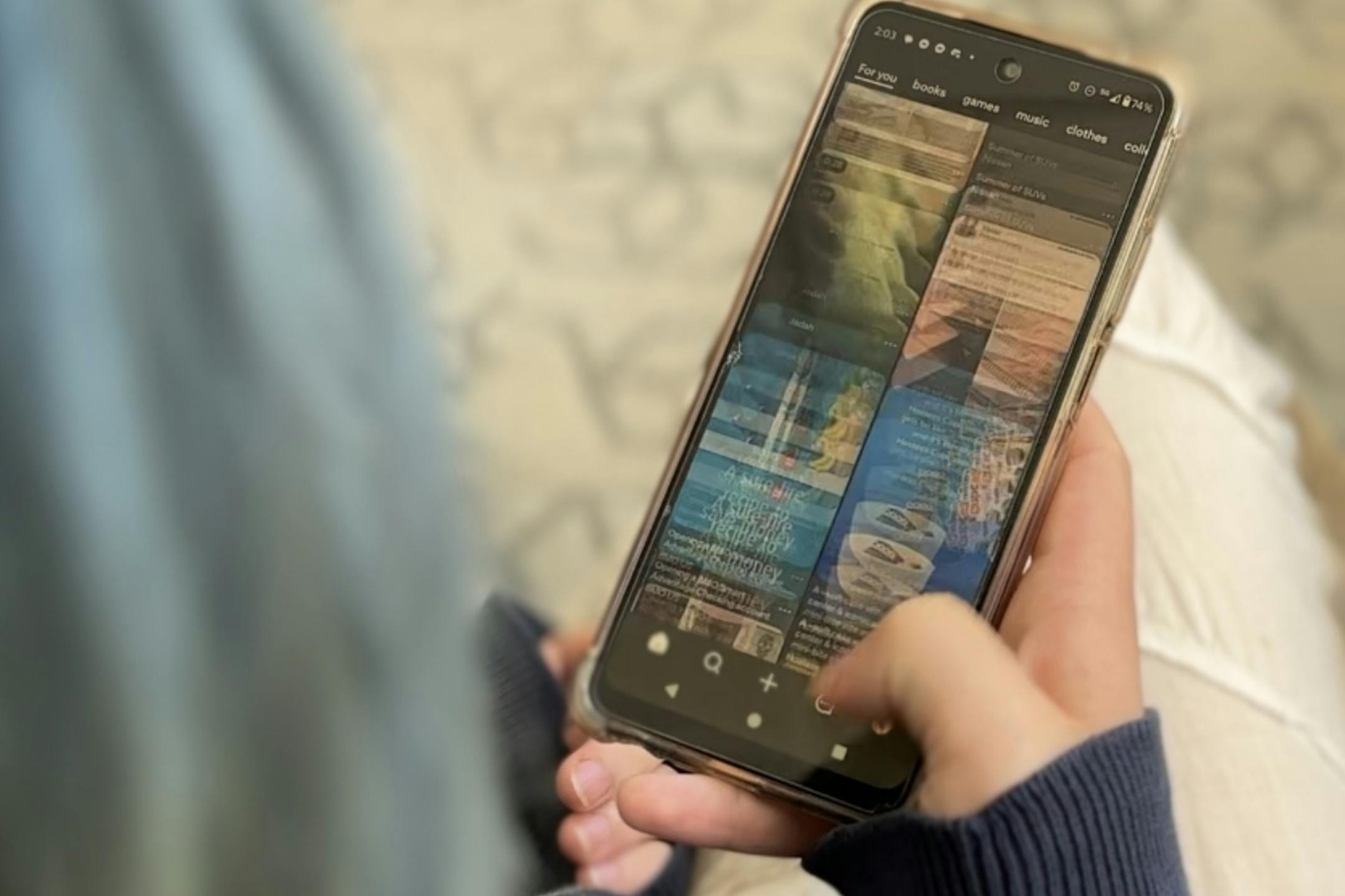
The U.S. Surgeon General released a public advisory warning about social media addiction among teens in 2023 and ongoing research shows the detrimental effects of addictive social media use. (Lani Ngonethong/For the Minnesota Star Tribune)

Most teenagers have 24/7 access to a popular drug. They are high off it for hours a day and carry it in their pockets everywhere they go. The drug? Social media.

From making calls to getting directions, technology has been ingrained into everyday life. According to a 2022 Pew Research study, 95% of U.S. teens have access to a smartphone and 97% say they use social media daily.

Linna Xiong, a high school senior who lives in St. Paul, says she spends three hours a day scrolling on social media.

“We’re currently in the summer right now, so I’m very bored and I have nothing to do,” Xiong said. “I tend to be on social media a lot.”

Ongoing research has linked heavy social media use with health issues. In 2023, the U.S. Surgeon General released a public advisory about social media’s harms to youth mental health, noting that teens who use social media more than three hours a day are twice as likely to have poor mental health. U.S. teens spend, on average, 4.8 hours on social media a day. Forty-one percent of the teens who spent the most time on social media rated their overall mental health as poor.

According to a 2025 study by researchers at Cornell University and Columbia University, 40% of participating children showed addictive use of social media that distracted from important responsibilities like school work or chores. Furthermore, addictive screen use was linked to worse mental health and suicidal behavior.

Joel Frederickson is a psychology professor at Bethel University who follows news on the impacts of social media use on youth mental health. (Joel Frederickson/For the Minnesota Star Tribune)

Teens are susceptible to the addictive qualities of social media because their brains are not fully developed, according to Joel Frederickson, a psychology professor at Bethel University. Features of social media apps, such as follows, likes and comments keep users coming back for more. This reward system makes the brain release a lot of dopamine, similar to how substance addiction works.

“There’s a reason why Wordle has streaks, it’s to get you to go back to Wordle,” said Frederickson. He is cautious of how developers make media addictive. “You’re fighting against some of the best minds in the world, and you don’t even realize it.”

Though studies have shown the adverse effects of addictive use of social media, social media addiction is not recognized as a medical disorder.

“When you think of addiction, you think of something [like substance abuse]. But that’s not how it works with phones or social media. These are a part of our lives,” said Sarah Jerstad, clinical director of psychological services at Children’s Minnesota. “So, how do we work with it?”

Sarah Jerstad is the clinical director of psychological services at Children’s Minnesota. (Sarah Jerstad/For the Minnesota Star Tribune)

Within homes, schools and legislation there is a growing push for more regulations.

Frederickson believes schools are going to have the largest impact in consistently regulating social media usage because that is where students spend more than half their days.

Xiong says parents have an important responsibility here. She has seen it already in her younger Gen Alpha cousins, how they stick to their tablets even at the dinner table. It irks her.

“Whenever I visit, I always see them on their iPads … And they never get off it. No matter how long I stay,” Xiong said.

Jerstad encourages parents to have open conversations with their children about online boundaries instead of dictating barriers, highlighting how social media can have healthy impacts. As the name suggests, it is a place for teens to socialize, connect with others, find entertainment and express themselves.

However, parents often blame social media and technology in response to their teens speaking out about their mental health, and that shuts them down.

“There’s the thought that adults never believe in us, by saying that we don’t understand their struggles. But … everyone goes through something differently,” Xiong said.

In a 2025 national survey on the impact of social media on teen mental health, the Pew Research Center found that many parents believe social media is the primary detriment to teen mental health. Teens say the same, but are more equally divided on other factors such as bullying and pressures and expectations.

“Parents might be minimizing some of [the other experiences] and have a perspective that the world of a teen is their friends and their devices,” Jerstad said.

Xiong believes teens have mental health needs that are often overlooked. “Teenagers should also have a platform to speak on their mental health, their beliefs and have a voice,” she said.

As knowledge on social media addiction grows, states are taking action. The National Conference of State Legislatures reported in 2024 that at least 40 states and Puerto Rico have introduced legislation pertaining to online content and access. In Minnesota, a bill passed in May 2024 required school districts and charter schools to develop policies on cellphone usage.

Phones feel integral to our lives. Xiong remembers when they were not.

“When I didn’t have a phone, I was always outside. Everything was colorful and bright,” she said. “Nowadays, I don’t see that anymore.”

Additional reporting by Maxwell Freeman (Rosemount High School) and Wendy Xiong (Johnson Senior High School).

This story was produced as part of ThreeSixty Journalism’s Multimedia Storytelling Institute for high school students in partnership with Blue Cross and Blue Shield of Minnesota, which financially sponsors the camp and supports story sourcing.

about the writer

about the writer

Lani Ngonethong

Saint Paul Academy and Summit School

More from St. Paul

See More
card image
Sofia Barnett

The City Council will take another week to finalize resolution language. The city will also fund immigrants’ defense and naturalization in 2026 budget.

The setting sun illuminated the St. Paul skyline, with city hall on the left, as seen from Harriet Island Park.
card image