
Rash: Russia’s intensifying test of the West must be met with resolve

European and U.S. unity is essential in responding to incursions.

Columnist Icon
The Minnesota Star Tribune
September 19, 2025 at 6:11PM
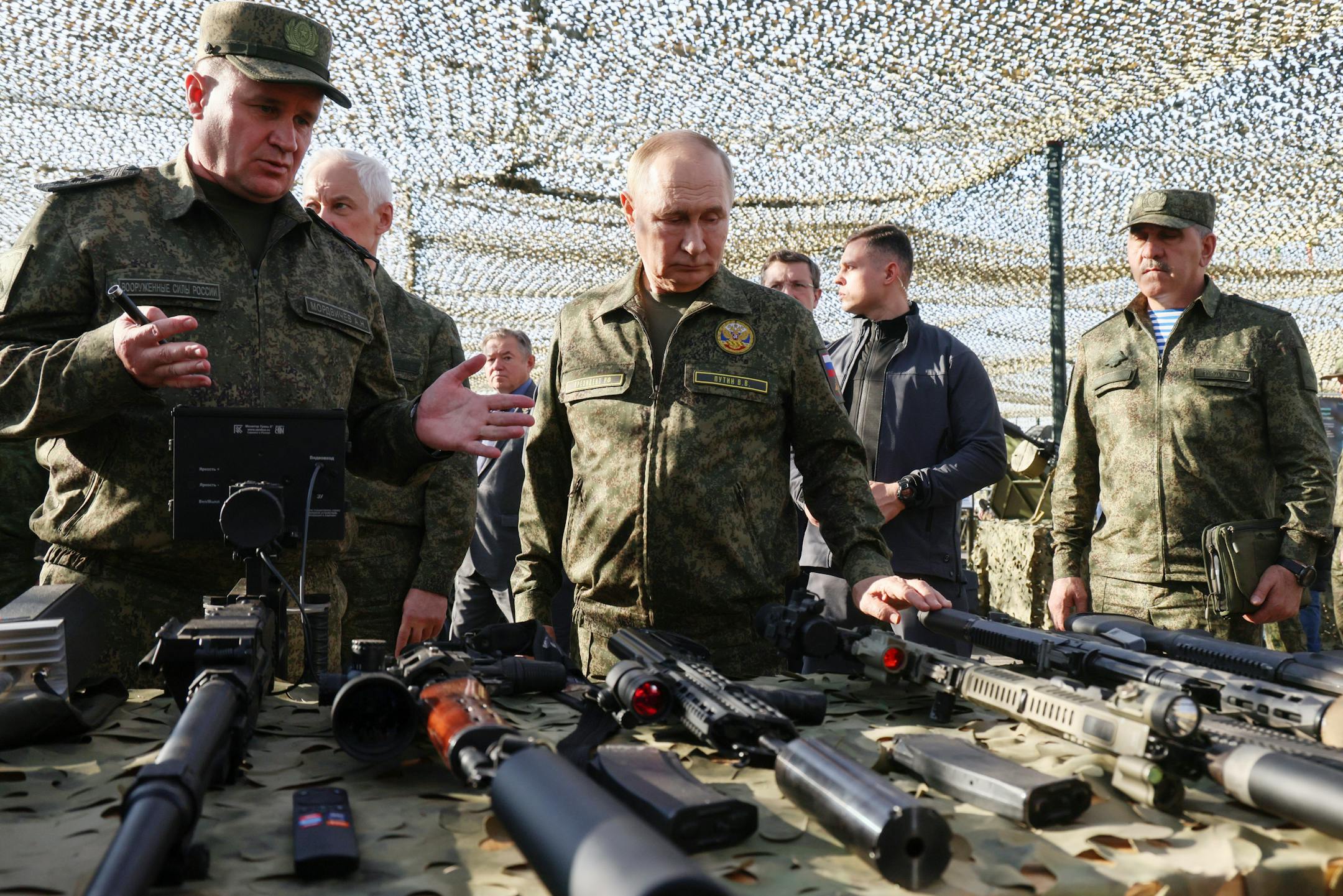
Russian President Vladimir Putin, center, accompanied by Commander-in-Chief of the Russian Ground Forces Andrey Mordvichev, left, inspects Russian weapons and equipment during his visit to the Russian-Belarusian joint military drills "Zapad 2025" (West 2025) at the Mulino training ground in Nizhny Novgorod region, Russia, on Sept. 16. (Mikhail Metzel/The Associated Press)

Opinion editor’s note: Strib Voices publishes a mix of commentary online and in print each day. To contribute, click here.

•••

Russia’s recent drone incursion into Polish airspace may have had a bigger target: NATO’s headspace.

The intent wasn’t to attack. The drones were duds. Instead, it’s likely that the Kremlin wanted to see if the Western response was equally inoperative as it seeks to split Washington from Brussels, home of NATO.

At minimum, Moscow seems to seek to sow disarray among allies. And if not disarray, at least a disconnect, as evidenced in the responses from Polish and U.S. leaders.

“Could have been a mistake,” President Donald Trump said when asked about the incursion.

“We would also wish that the drone attack on Poland was a mistake,” Polish Prime Minister Donald Tusk posted on X. “But it wasn’t. And we know it.”

So does the Institute for the Study of War, which cited a Polish defense analyst who said that Russia’s drones, usually intended for Ukraine, had been outfitted with fuel tanks that doubled their range.

As provocative as the violation was, it shouldn’t be shocking. Drones have already crossed into the three Baltic countries and Romania, and military aircraft have crossed literal and figurative lines in Europe. It’s all part of Russia’s low-grade but high-stakes hybrid war across the continent, which has seen sabotage incidents increase threefold from just 2023 to 2024, according to reporting in the New York Times.

“Russia has been conducting an undeclared and hybrid war against the West for a very long time,” Czech Foreign Minister Jan Lipavsky told a European Security Conference this month. “They regard themselves at war with us.”

Poland, Tusk said after the incursion, was at its “closest to open conflict since the Second World War.”

The drones were “maybe a psychological test more than anything operational,” said Thomas Hanson, diplomat-in-residence at the University of Minnesota Duluth. Hanson, a former Foreign Service officer who chairs the Committee on Foreign Relations Minnesota, said that the “Europeans really are in a nervous state right now, with all the changes happening both vis-à-vis the U.S. and then with Russia making advances in Ukraine.”

Russia, added Hanson, is “looking for signs of daylight between the U.S. and its NATO allies; that’s been clear for quite a while. So it could be kind of testing the waters, testing the reaction.”

Or non-reaction, which itself sends a signal to the Kremlin.

“I think we are currently in an age and a stage where our policies are emboldening our adversaries,” said Philip Breedlove, a former Air Force general who previously served as Supreme Allied Commander Europe of NATO Allied Command Operations.

Breedlove, speaking during a Center for a New American Security virtual event on Monday, added that Vladimir Putin “is very emboldened right now” and that the Russian president came to the recent Ukraine-war summit with Trump “with one message in mind: There will be no ceasefire. And despite the sort of stage-setting by our senior politicians about what it would cost Russia if there wasn’t a ceasefire, we came out of that meeting with no ceasefire and none of the follow-on actions that were promised. And so I truly believe that right now we are in a policy conundrum whereby the actions we are taking — but more importantly the actions we are not taking — are emboldening our enemies.”

Our allies are rallying rhetorically and, belatedly, militarily. Denmark, for instance, just announced that for the first time it will acquire long-range precision weapons in what Prime Minister Mette Frederiksen said was a “paradigm shift in Danish defense policy.”

There was no doubt, the Danish leader said, “that Russia will be a threat to Denmark and Europe for many years to come.” The weapons are for defensive, not offensive, purposes, stressed Frederiksen, who correctly asserted that “we are not the ones attacking; Russia is.”

That ethos has taken hold not just in Copenhagen but in Paris, London and Berlin as well. But despite the pledges from the president of France, prime minister of the United Kingdom and chancellor of Germany, domestic dynamics, including a pan-European populist surge, may create implementation challenges.

“The Russians probably realize that they probably can’t drive a wedge right now as the current leaders are willing to proceed in spite of what’s happening domestically,” said Hanson. “But longer term they are watching this very closely and probably figure that at some point the European leadership will have to take this more into account.”

The American leadership will have to as well. But the administration seemed more focused on putting conditions on allies instead of the adversary when the president indicated that he would impose new sanctions on Russia only if NATO nations did the same, stopped buying Russian oil and imposed steep tariffs on China — requirements unlikely to be met, especially since among the key holdouts is Hungary, whose president, Viktor Orban, is a staunch Trump supporter.

In response to the incursion, NATO announced operation “Eastern Sentry.” But conversely, the Trump administration recently announced an impending end to the Baltic Security Initiative, which annually spent about $200 million to boost Baltic defense.

The move is “illogical,” Zygimantas Pavilionis, Lithuania’s former ambassador to the U.S., told Reuters. “We were first to stop buying Russian gas and have been top spenders on defense and on support to Ukraine.”

In “this region,” he added, “if America goes out, Russia comes in.”

As for Russia going in, America’s commander-in-chief sounded an uncertain trumpet when he posted “What’s with Russia violating Poland’s airspace with drones? Here we go!”

While key administration officials have since offered more reassuring rhetoric, more clarity on “we” — and where indeed we’re going — is called for. And answers should come from not only the White House but Capitol Hill, since Congress can and should assert itself more. Because unity — here at home and among our allies — is essential as Russia tests Western resolve.

about the writer

about the writer

John Rash

Editorial Columnist

John Rash is an editorial writer and columnist. His Rash Report column analyzes media and politics, and his focus on foreign policy has taken him on international reporting trips to China, Japan, Rwanda, Kazakhstan, Turkey, Lithuania, Kuwait and Canada.

See Moreicon