
Advertisement

Brown: What a 1921 Ford Model T can teach us about today’s tech

It helps explain why everything, and everyone, seems off these days.

Columnist Icon
The Minnesota Star Tribune
February 19, 2026 at 11:00AM
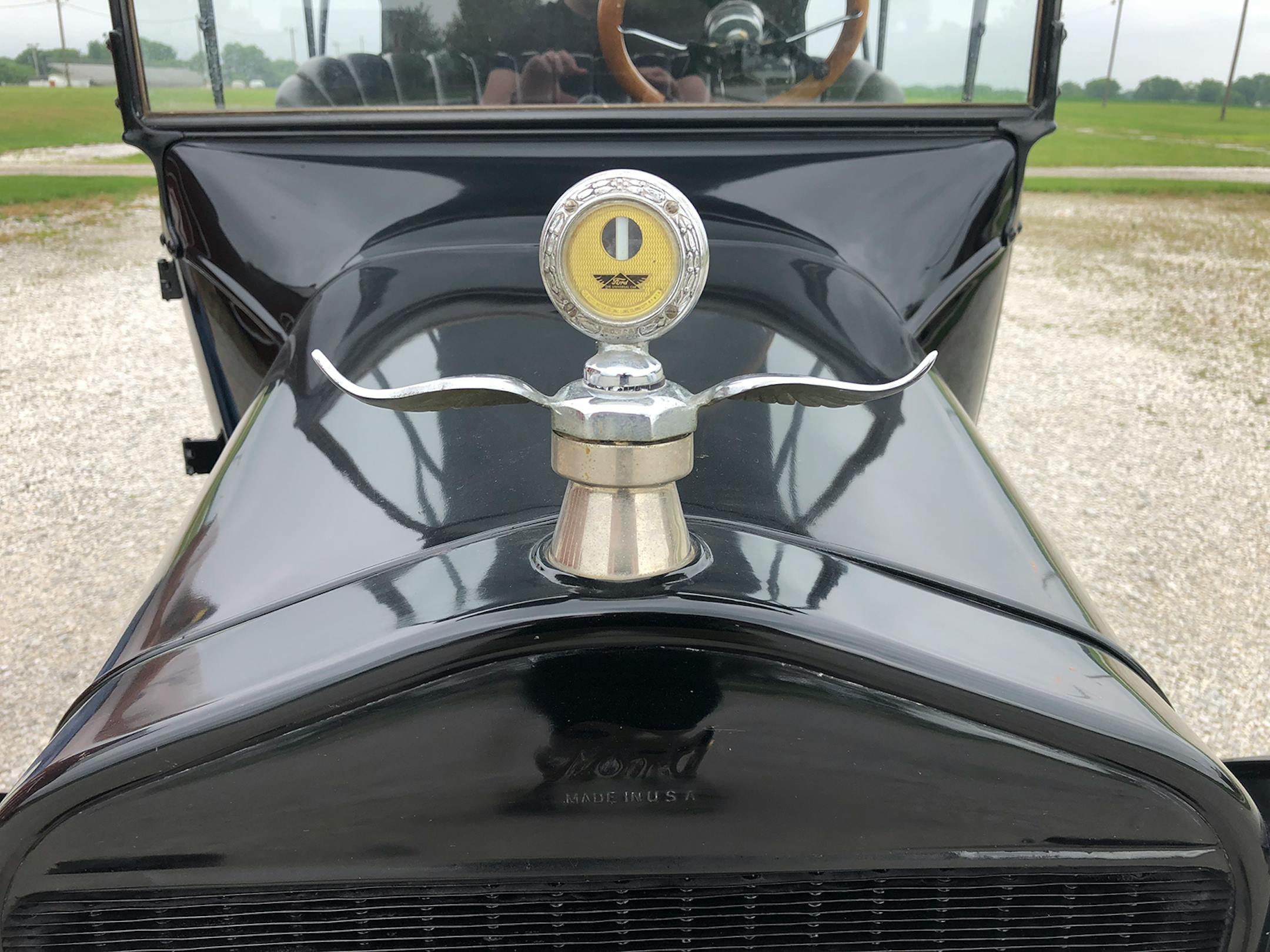
The hood ornament on a 1920 Ford Model T. (Casey Williams)
Advertisement

Opinion editor’s note: Strib Voices publishes a mix of commentary online and in print each day. To contribute, click here.

•••

Several years ago, I started the minivan, smiled at my wife over in her car, told our preschoolers to wave at Mommy and then backed into the unopened garage door. It was an absent-minded mistake that lives forever in family lore.

This was, as they say, a teachable moment. And yet, nowadays, I think even less behind the wheel. I push a button to start everything. A map pops up on a screen telling me how to get to where it predicts I’m going. A sensor array quickly informs me if the garage door is still closed, so we don’t have that to worry about.

This phenomenon isn’t just limited to automation of machines but also the automation of our minds. Humans are in the process of delegating our work to artificial intelligence. In just the first few weeks of 2026, engineers have announced AI capable of training itself and collaborating with other AIs. Until we hit the metaphorical garage door, we don’t really know what could go wrong.

Here’s an example. My 91-year-old grandfather, a lifelong junk aficionado, recently picked up a 1921 Ford Model T through his endless wheeling and dealing.

When the Model T came on the scene in 1908, it famously changed everything. Affordable personal vehicles shaped American families, cities and public policies. But have you ever tried starting one of those old contraptions?

There’s no key. You lift one lever to open the throttle and another to “advance the spark,” which creates an electrical circuit that manually controls the engine’s timing sequence. Then, you shift the transmission into neutral, open the battery terminal and crank the engine to get it started.

Advertisement

Pops, who drove mining and semi trucks for decades, told me that his new machine “scares the hell out of me.” This, coming from a guy who once piloted an out-of-control tractor-trailer down from the Rocky Mountains.

See, you can backfire the engine while cranking, which would not only wake up the neighborhood but possibly break your arm or crack your skull. Once underway, the driver must manipulate levers constantly as the vehicle sputters and spurts along the road.

This experience became the knowledge that developed today’s cars, which increasingly drive themselves. And it helps explain why everything, and everyone, seems off these days. We’re unbound from our understanding of how the world works or how “progress” benefits us.

Humans build our lives upon layers of generational knowledge piled so deep we don’t even know where it all came from. It’s our species’ most important trait.

In 1921, the same year as my grandpa’s Model T, Polish American philosopher Alfred Korzybski described this human quality as “time-binding.” He contrasted it with the “space-binding” attributes of animals, whose prime focus is survival and defending limited territory. Humans too often fall into these animalistic habits, he said, and the evidence was as clear a century ago as it is today.

“Life progresses faster than our ideas, and so medieval ideas, methods and judgments are constantly applied to the conditions and problems of modern life,” wrote Korzybski. “This discrepancy between facts and ideas is greatly responsible for the dividing of modern society into different warring classes, which do not understand each other.”

Advertisement

In the wake of World War I, an event that reordered everything in Korzybski’s time, the writer sought to provide a universal theory of human nature. This was a stretch, but his theories on the gap between progress and generational knowledge proved prophetic. In fact, it almost seems like he was talking about today’s debate over artificial intelligence.

A Feb. 3 study by Judy Hanwen Shen and Alex Tamkin, published by the AI company Anthropic, shows that artificial intelligence is a valuable tool for experienced workers. However, it creates negligible results for novice workers, who become slower to learn new skills that would help them use AI more effectively. Thus, the human “skills gap” could become massive in no time. Arguably, it already has.

On Feb. 9, a top Anthropic safety engineer quit the company, saying that exponential growth in AI capabilities just this month puts the world “in peril.” The model apparently taught itself how to lie.

Korzybski might suggest that human progress is again outpacing human institutions. We’re not ready for the change, so people react with anger, fear, distrust and authoritarian instincts. Institutions of stability suddenly become unreliable. The author saw this happening during the brief lull between the world wars.

“The so-called sciences of ethics and jurisprudence and economics and politics and government have not kept pace with the rapid progress made in the other great affairs,” wrote Korzybski. “It is because of their lagging that the world has come to be in so great distress; and it is because of their lagging that they have not now the needed wisdom to effect a cure.”

Greed, the gap between rich and poor and systems built on “survival of the fittest” all conspired to prevent humans from doing what they were meant to do, Korzybski said. We exist, he said, to build upon the knowledge given to us by all those who came before, a phenomenon Korzybski poetically calls the “living powers of dead men.”

Advertisement

These powers are great; they are the sum of eons of experimentation and sacrifice. We don’t have to die of measles, close hospitals or create a police state. These are choices borne of our worser instincts.

The implementation of change must remember the most basic human goals, the author suggests. Those with knowledge must engineer a world where humans make progress together.

But the future comes all the same. Humanity’s complex machinery is always ready to run — dangerously, if we prefer.

Mind the backfire. It sounds just like a gunshot.

Maybe it is a gunshot.

about the writer

about the writer

Aaron Brown

Editorial Columnist

Aaron Brown is a columnist for the Minnesota Star Tribune Editorial Board. He’s based on the Iron Range but focuses on the affairs of the entire state.

See Moreicon
Advertisement