
‘History in the making’: Ojibwe-language hockey announcers bring new cultural life to the sport

It takes more than words to describe a hockey game in Ojibwe. To hear the game in “the language of the people” is a fully immersive experience.

Columnist Icon
The Minnesota Star Tribune
February 3, 2026 at 11:00AM
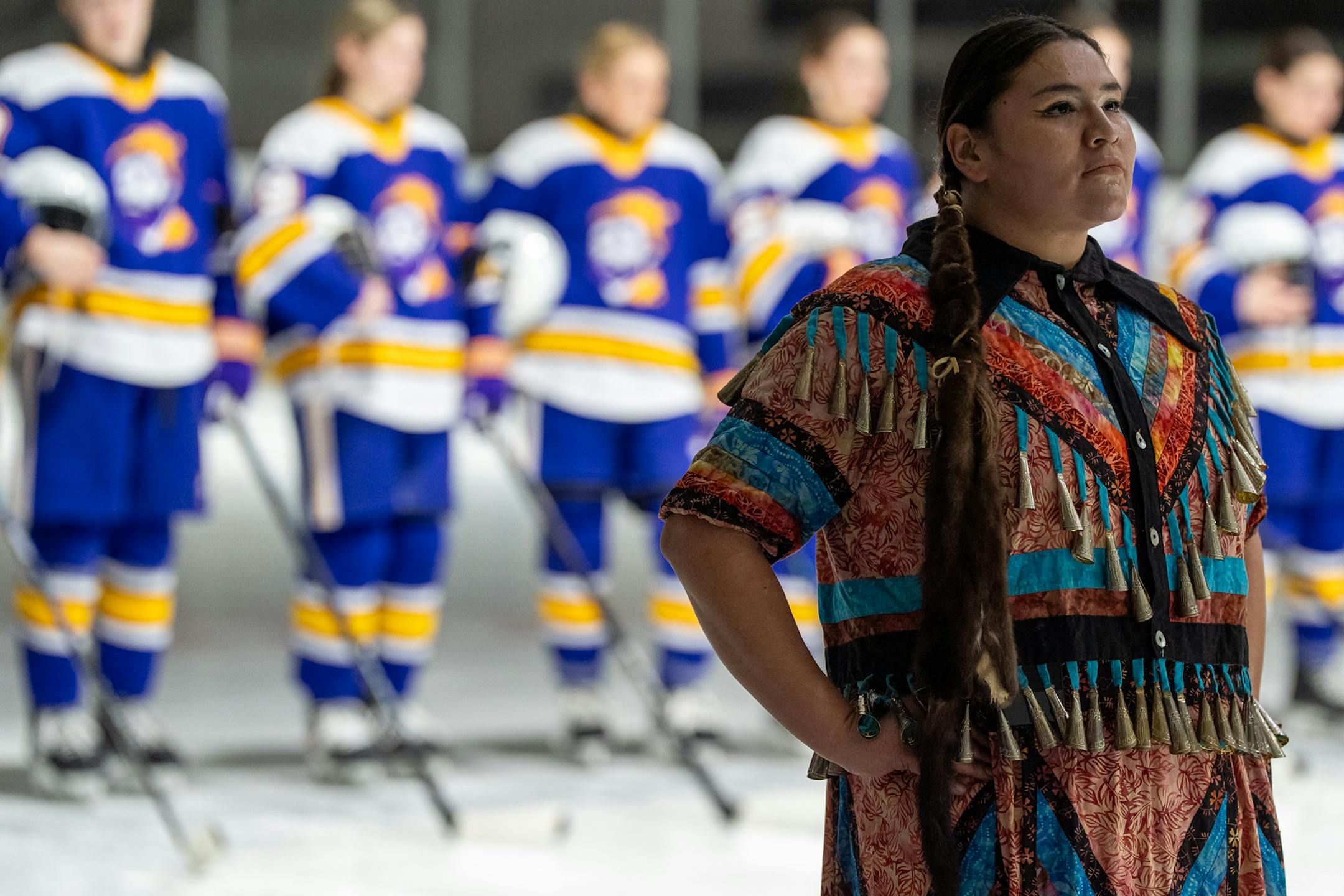
Meredith Two Crow pauses and listens to the Ojibwe drum circle during the Jan. 20 pregame ceremony.
Meredith Two Crow pauses and listens to the Ojibwe drum circle during the Jan. 20 pregame ceremony. (Jerry Burnes/Iron Range Today)

Opinion editor’s note: Strib Voices publishes a mix of commentary online and in print each day. To contribute, click here.

•••

Biinjweba’ige!

Score! No other word lights up a hockey game the same way, whether players skate at Grand Casino Arena in St. Paul or on a pond somewhere up north.

But it takes more than words to describe a hockey game in Ojibwe, according to educator Dr. Gordon “Maajiigoneyaash” Jourdain. To hear the game in Anishinaabemowin, “the language of the people,” is a fully immersive experience.

“My voice is elevated,” said Jourdain. “Intonation is fluctuating all the time. My body is moving, my hands, my whole body is involved in describing what that is.”

Last November, Jourdain made history as the play-by-play announcer on the first Ojibwe-language broadcast crew for a Minnesota Wild hockey game.

On Jan. 20, he became the first Ojibwe-language announcer for a Minnesota high school hockey game when he called a girls matchup between Rock Ridge and Cloquet/Esko/Carlton in Virginia, Minn. Then, on Friday, Jan. 30, he announced a boys game between Rock Ridge and Grand Rapids.

Each of these northern Minnesota communities are located near an Anishinaabe nation. Both games included traditional drumming and dances inside Iron Trail Motors arena as part of the first Native American Heritage Hockey Nights on the Mesabi Iron Range.

“This is history in the making,” said Maria Poderzay, Indigenous Education Director for Rock Ridge Schools. “We are the first school to ever do this in the nation. We really hope to see this take off and maybe other schools will start following our lead and start bringing our culture into sports.”

If you’re a native English speaker, you grew up learning a language built on structure. There’s a long list of rules and an even longer list of exceptions to those rules. The Ojibwe language doesn’t work like that.

In Anishinaabemowin, action words propel speaker and listener through a vivid description of the players, the condition of the ice and the flow of a game. That’s one reason Jourdain said the language pairs well with hockey. The other is that a version of hockey has been a part of native life for centuries.

When Jourdain grew up, hockey and the Ojibwe language were intertwined. He comes from the Gakijiwanong Anishinaabe Nation, formerly known as Lac La Croix First Nation, along the Quetico Provincial Park in Ontario, Canada. His mother came from just over the border at the Bois Forte reservation in northern Minnesota.

Jourdain’s first language is Ojibwe; he learned English at school and from broadcasts of Hockey Night in Canada. He played hockey with his friends, and some of his relatives went on to play professionally. In Canada, he said, native people feel a sense of belonging within the sport of hockey.

“It’s different here in America,” said Jourdain. “The narrative is told not from an Indigenous perspective.”

Here in Minnesota, native kids participate less frequently in hockey, in part because of cultural and economic barriers. Famous Minnesota Ojibwe hockey stars like Henry Boucha and T.J. Oshie came from the border town of Warroad, Minn., but Ojibwe communities farther south produce relatively few hockey players.

Meredith Two Crow is the president of the Rock Ridge American Indian Parent Advisory Council. Her daughter plays youth hockey in the Rock Ridge organization. She said restoring Ojibwe cultural traditions does so much for native kids.

“When you bring the knowledge behind the history ... you also bring back the ancestral wisdom that is embedded in our DNA,” said Two Crow.

Two Crow said her mother was born during the era of forced assimilation and boarding schools. Even growing up in the 2000s, she had friends whose parents wouldn’t let them visit because she lived on the reservation.

To her, it’s not surprising that few Ojibwe kids play hockey. It’s too expensive and requires far too much travel for people who often lack reliable transportation. A cultural divide between white and native communities formed over many generations, and it’s still there. As the drums and songs filled the Iron Range arena these last few weeks, she sensed tension in the crowd, but also the possibility of change.

“I can feel some of the feelings of like, well, why is this going on? Why is this happening?” she said. “But at the same time, I had a white elder come up to me and say this is something that should have been done 50 years ago and I’m proud of you for doing something like this. It brought tears to my eyes because, you know, he wasn’t wrong. This is something that should have been celebrated a very long time ago given the history of the Iron Range and hockey.”

So, perhaps some would see hockey as just a game, and Ojibwe as just another language.

But for those who speak Ojibwe, including young people learning their ancestral language for the first time, an Anishinaabemowin broadcast of a local hockey game is like a much-needed power play to rally cultural traditions.

After all, every player carried a stick that was first designed by native people, just a few miles from the “World’s Largest Free Standing Hockey Stick” in Eveleth, Minn.

“We always had hockey,” said Jourdain. And that’s something all Minnesotans can share.

about the writer

about the writer

Aaron Brown

Editorial Columnist

Aaron Brown is a columnist for the Minnesota Star Tribune Editorial Board. He’s based on the Iron Range but focuses on the affairs of the entire state.

See Moreicon

More from Columnists

See More
Meredith Two Crow pauses and listens to the Ojibwe drum circle during the Jan. 20 pregame ceremony.
Jerry Burnes/Iron Range Today

It takes more than words to describe a hockey game in Ojibwe. To hear the game in “the language of the people” is a fully immersive experience.

card image
card image