
Rash: They fled torture in their home countries. Now they’ve been held by ICE.

Six clients of the Center for Victims of Torture, all legally living in Minnesota, were detained as part of Operation Metro Surge.

Columnist Icon
The Minnesota Star Tribune
February 2, 2026 at 10:59AM
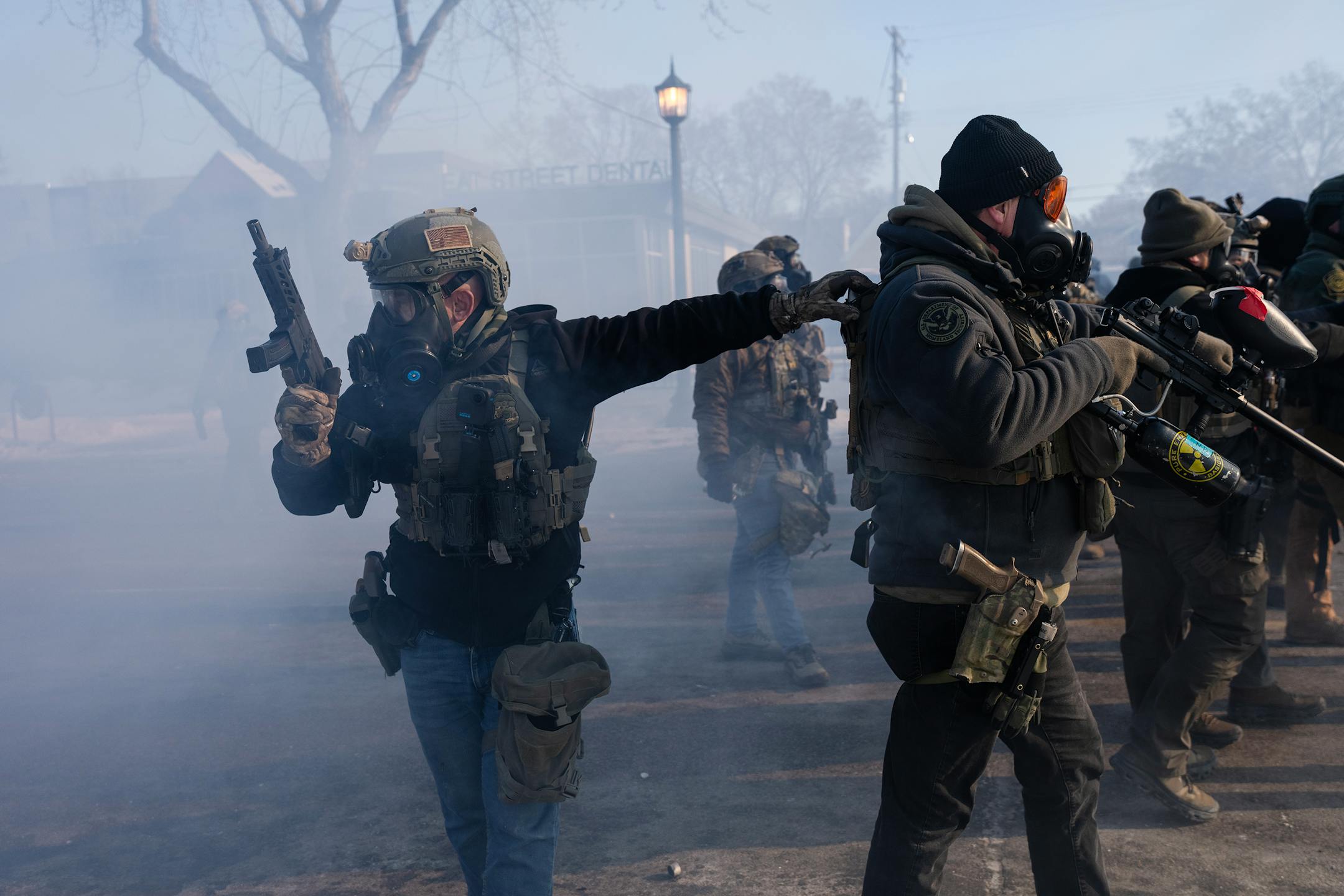
Immigration officers clash with protesters after federal agents fatally shot Alex Pretti in south Minneapolis on Jan. 24. (Richard Tsong-Taatarii/The Minnesota Star Tribune)

Opinion editor’s note: Strib Voices publishes a mix of commentary online and in print each day. To contribute, click here.

•••

Immigration hearings in recent years often sounded similar, said Scott Roehm, senior director of global justice and accountability at the St. Paul-based Center for Victims of Torture.

“You probably wouldn’t be surprised to hear an asylum-seeker explaining they were abducted at gunpoint by mass security forces, then dumped into some sprawling detention complex that’s rife with abuse without remotely any credible allegation — if there’s any allegation at all — about what they’ve done wrong. You’d assume that they’re asylum-seekers from Syria under Assad, or Afghanistan under the Taliban — pick your oppressive regime around the world.

“The same story is what’s happening to our clients in Minnesota.”

In fact, for six CVT clients — all here legally, seeking asylum, with work permits — their Orwellian ordeals reoccurred after they were swept up by Immigration and Customs Enforcement agents as part of the Department of Homeland Security’s Operation Metro Surge, which was falsely predicated on arresting the state’s “worst of the worst.”

To protect privacy and safety of its clients and their families, CVT is not releasing the names of their clients, as well as a staffer who’s also been detained. (Accordingly, they can’t be journalistically confirmed by contacting federal authorities.) But through a statement and interviews, CVT said that five of the torture survivors are from four different sub-Saharan African countries and one is from Central America and that the center was able to share specifics on three of them.

One of them, detained after leaving a local mosque, “fled his country after surviving a terrorist attack and multiple assassination attempts that resulted in physical injury and ongoing psychological trauma.”

Another was “living amid a civil war in his home country and was falsely accused of being a spy for the rebel forces; he was imprisoned and beaten and only escaped because his family paid a bribe for his release.”

The third had “fled her home country after she was arrested and detained for several days during which she was beaten and raped as part of her torture for attending a rally in support of democratic elections.” Here in Minnesota, she was detained while entering her workplace.

Men and women in their 30s or 40s. At least one with children remaining in their homeland. None were arrested for, or accused of, any specific crimes in this country, but four are still being held in a Texas detention center, one is in a New Mexico facility and one has been returned and released in Minnesota. Fortunately, each already had legal counsel for their asylum cases, and those attorneys are now tasked with getting them back to Minnesota.

Getting them back to any semblance of normalcy will be another thing, however.

“One of the keys to the healing process is feeling safe,” said Roehm. Normally, many CVT clients “feel safe, particularly in the environment of working with our clinicians, or they’re in the process of getting there on the road that is their healing journey. Now they’re terrified.” It’s “causing all kinds of new trauma on top of the trauma that they’ve experienced previously.”

And it’s not just these six. Other CVT clients still here are retraumatized, too.

“A lot of these people can’t, and frankly shouldn’t, leave their house,” said Roehm.

The immediate impact on the affected community has been “devastating,” said Sara Nelson, program manager of CVT’s St. Paul clinic. “The majority of our clients are essentially under house arrest, not leaving their homes for any reason — not to work, not to go to school, certainly not to come to a place like CVT, where they would be in a group with other immigrants.”

A crucial component of recovery is reconnecting to your community, Nelson said. Instead of clients calling and saying, “‘I need some therapy or support to help cope with these past experiences in my home country,’ what we’re hearing from people is, ‘I need therapy and support to cope with my current situation, which is triggering memories of my past situation.’”

Making them fearful of being sent back to their torturers isn’t only immoral, it’s illegal under the international principle of non-refoulement, “which means that it is against international law and practice to return people to a place of persecution,” said Ellen Kennedy, the executive director of Minnesota-based World Without Genocide.

Asylum-seekers “have every right to safety and security here” because they’ve been through a thorough vetting process, said Kennedy. Nonetheless, she said, “this is setting up a climate of fear, and the climate of fear is what is being desired; the climate of fear is sending people into hiding. They are unable to work, they are losing their livelihoods, they are unable to function.

“And this climate of fear is empowering the oppressors.”

The U.S. used to not just be a beacon to those oppressed but also pressed, however inconsistently, for human rights in other countries. The Statue of Liberty was called the “Mother of Exiles” by Emma Lazarus in her immortal poem “The New Colossus,” with one stanza stating: “From her beacon-hand/Glows world-wide welcome; her mild eyes command/The air-bridged harbor that twin cities frame.”

The twin cities in Lazarus’ line were New York and Brooklyn. Injustices in the modern meaning of the Twin Cities, ironically and tragically, are showing the world a dimming of that beacon.

“We have utterly lost whatever moral standing we might have had,” said Kennedy, “to an extent that I don’t know when or how it can be reclaimed.”

CVT’s overseas operations had already faced federal funding reductions. Now the Minnesota-based work is imperiled.

The cuts were “devastating, primarily to our international programs, and I would say this has now been a blow to our domestic programs,” said Nelson. “We’re still here, we’re still doing the work, we’re still helping clients, but the kind of foundation on which we build our work, which is called ‘safety and stabilization’” can’t be assumed anymore. “Our whole work has just been turned on its head.”

Nelson said, “I always believe in human capacity to heal and to grow,” but acknowledged that “this is going to be a long road for people.”

Fortunately for them, they’re accompanied down that long road with the Center for Victims of Torture, which represents Minnesota’s best of the best.

about the writer

about the writer

John Rash

Editorial Columnist

John Rash is a columnist.

See Moreicon

More from Columnists

See More
card image
Richard Tsong-Taatarii/The Minnesota Star Tribune

Six clients of the Center for Victims of Torture, all legally living in Minnesota, were detained as part of Operation Metro Surge.

card image