
Brown: As freedom is tested in Minnesota, the world watches

For some in Russia, the authoritarianism beginning to rear its head in the U.S. seems all too familiar.

Columnist Icon
The Minnesota Star Tribune
January 27, 2026 at 10:58AM
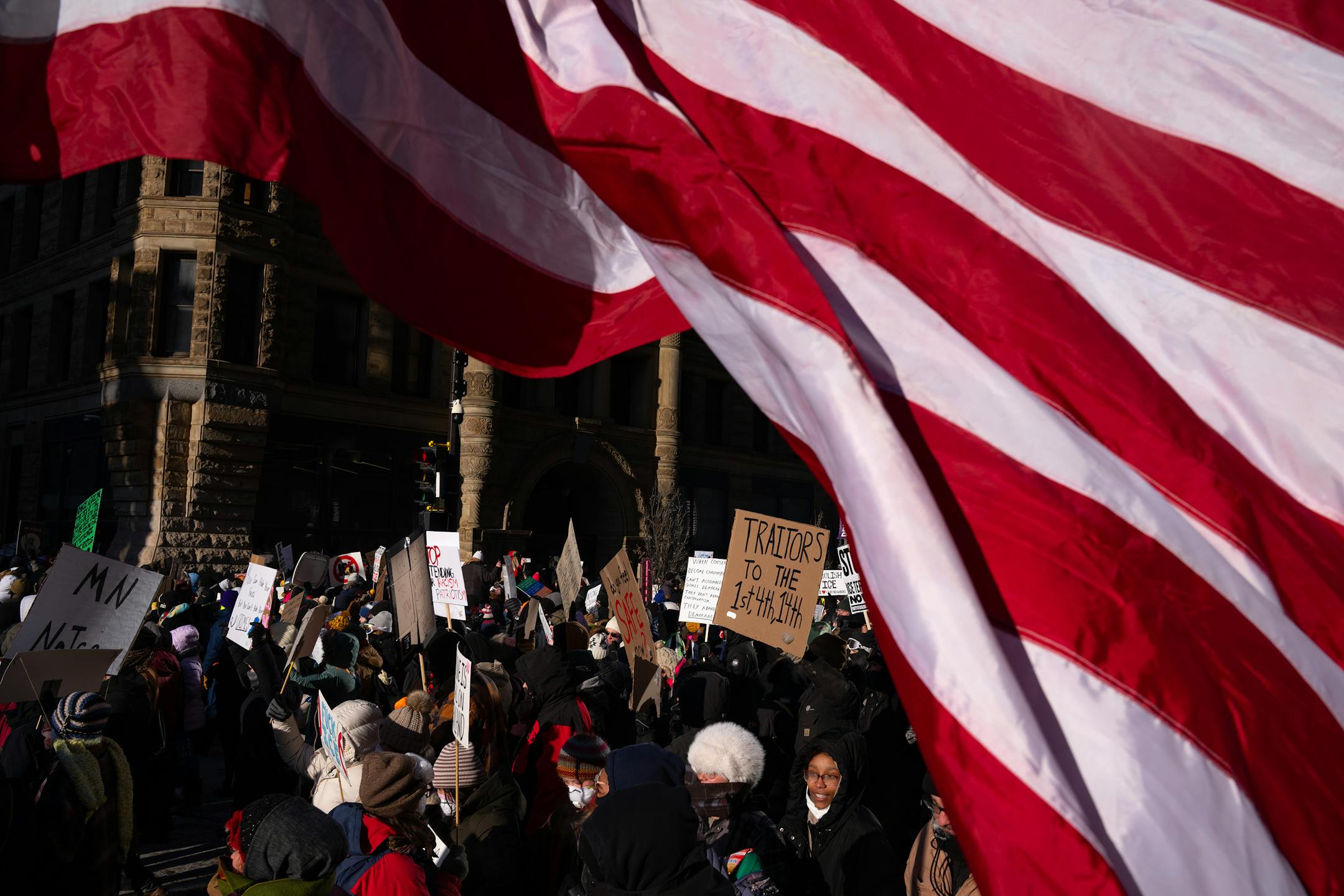
Thousands of people protest ICE and Operation Metro Surge by marching through downtown Minneapolis on Jan. 23. Temperatures hovered around -10°F with a windchill of around -20°F. (Alex Kormann/The Minnesota Star Tribune)

Opinion editor’s note: Strib Voices publishes a mix of commentary online and in print each day. To contribute, click here.

•••

For as long as I can remember, the word “Russia” was shorthand for “oppression.” I grew up at the end of the Cold War and celebrated the unraveling of the Soviet Union, easily conflating the nightly news with Rocky IV.

But I learned that the world isn’t as black-and-white as Cold War propaganda suggested. Oppression can be found anywhere it’s allowed to stomp. Meantime, the hope of freedom endures everywhere, even in the darkest times.

As federal forces ignore due process and embrace violent tactics in Minnesota today, we see that America isn’t always the land of the free. At the same time, some Russians yearn for the same freedoms many Americans now take for granted.

One of them is Igor Yakovlev. A Moscow communication officer for the pro-democracy political party Yabloko, Yakovlev and I have corresponded over the last few years with help from ever-improving translation software.

We share an interest in history. Both of us descended from laborers who built small parts of these competing empires. And we also agree that one can be a patriot while also criticizing a government and its policies.

“There is the state and the government, and there is the country,” said Yakovlev. “For me, these are different things. I love my country and my people and wish them only the best. That is why I criticize what, in my view, the state does to the detriment of my country and my people.”

Yakovlev watched the cellphone videos showing immigration agent Jonathan Ross shooting Renee Good on Jan. 7. He and his colleagues have been closely watching the situation in Minnesota ever since. For him, it is all too familiar.

“I believe that the most important aspect of this story is precisely the government’s reaction to the actions of law enforcement,” said Yakovlev. “This reaction gives them a free hand and is fraught with new cases of violence. Police officers begin to feel immune from punishment, which leads to an escalation of violence.”

Yakovlev’s words were tragically prophetic. In the short time since I talked to him, federal agents killed Minneapolis VA Hospital ICU nurse Alex Pretti as he attempted to help a woman they had violently shoved.

“In Russia,” said Yakovlev, “law enforcement agencies are virtually unrestricted in their use of force against protesters, while protesters themselves risk receiving long prison sentences for the slightest resistance to such violence. All of this leads to people being afraid to participate in protests and being deprived of their constitutional right to influence the authorities.”

I first connected with Yakovlev while researching Duluth’s Russian sister city, Petrozavodsk, where a Yabloko-backed independent mayor was removed by loyalists to Vladimir Putin’s United Russia party.

Yakovlev told me that this kind of political oppression is common. The fear of arrests or state-sponsored retribution prevents reformers from seeking office. The ones who do risk arrest on outlandish charges.

The Yabloko party faces this challenge every day. It’s the only Russian political party that supports a permanent ceasefire in Ukraine. That’s tricky, because it’s illegal to speak against military strategy in Russia. Yakovlev and his colleagues spend considerable time defending legal challenges and party members arrested by the state.

“The pressure on Yabloko’s leadership is relentless,” wrote Marie Struthers, Amnesty International’s Eastern Europe and Central Asia director, in a statement last month.

Last year, party officials were convicted of sharing information from sources that the government labels as being “foreign agents,” though that distinction is often applied to any group that criticizes the Putin government. Other party leaders were charged with the nebulous accusation of “extremism.”

As the U.S. government arrests and indicts American protesters, activists and public officials, we should not think ourselves so far removed from these practices.

Different histories and influences explain why Russia and the United States felt like such different places during the Cold War, but new forces in the 21st century seem to be making them more similar. To this, Yakovlev sees a shared cure.

“What I also see in common is that in Russia, in the United States, in Europe, and in many other countries, the human being is ceasing to be the center of politics,” said Yakovlev. “Money, some abstract notion of greatness, and state power are placed at the forefront. Such a policy is fraught with the advance of authoritarianism, totalitarianism and their extreme forms, such as fascism. We need to return the human being to the center of politics.”

I had to ask my Russian colleague, what do we do when we face oppression? How do we speak up when authority wants people to stay quiet?

Yakovlev said he couldn’t give advice to Americans on this topic but that he always chooses nonviolence. He said when a government no longer follows laws in favor of a political regime, everyone pays the price.

“In that case, the human being — their life, dignity, rights and freedoms — becomes not a goal but a means for the state,” said Yakovlev. “Human life then becomes worthless: The life of any person can easily be destroyed for the sake of abstract goals, because nothing protects it. Ultimately, this is bad for the state itself as well, because it becomes drawn into various adventures that, in the long run, only weaken it.”

As the world struggles with these questions, pro-democracy Russians maintain their optimism despite their systemic disadvantages. Yakovlev said that Americans have enviable tools at their disposal, including “street demonstrations, the press, representative institutions, elections and the courts.”

“Unlike Russia, where these institutions essentially never existed, in the United States they have existed for centuries,” said Yakovlev. “Cherish them. Above all, do not be indifferent to them and do not assume that someone else will protect them for you.”

about the writer

about the writer

Aaron Brown

Editorial Columnist

Aaron Brown is a columnist for the Minnesota Star Tribune Editorial Board. He’s based on the Iron Range but focuses on the affairs of the entire state.

See Moreicon

More from Columnists

See More
card image
Alex Kormann/The Minnesota Star Tribune

For some in Russia, the authoritarianism beginning to rear its head in the U.S. seems all too familiar.