
Brown: Betsy-Tacy books show the humanity in our immigration story

Maud Hart Lovelace’s books extolled curiosity and kindness, two traits we could use a little more of today.

Columnist Icon
The Minnesota Star Tribune
February 12, 2026 at 10:59AM
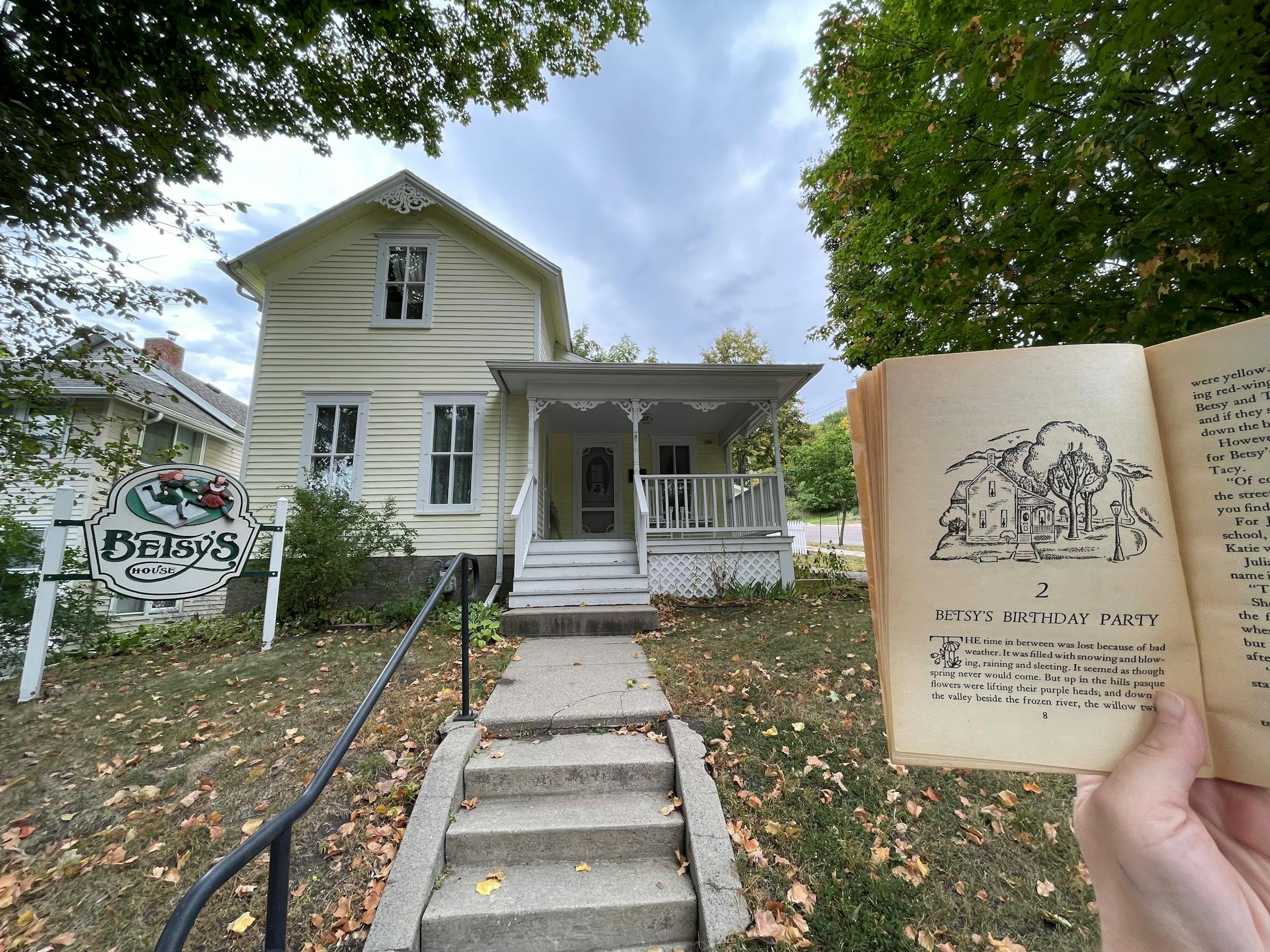
The childhood home of Maud Hart Lovelace, the author of the Betsy-Tacy book series, in Mankato, Minn., pictured with chapter 2 of the first book.
The childhood home of Maud Hart Lovelace, the author of the Betsy-Tacy book series, in Mankato, Minn., pictured with chapter 2 of the first book. This house was the inspiration for main character Betsy's home. (Betsy-Tacy Society)

Opinion editor’s note: Strib Voices publishes a mix of commentary online and in print each day. To contribute, click here.

•••

When author Maud Hart Lovelace wrote her beloved Betsy-Tacy stories in the 1940s, storytelling was her only agenda. She renamed her family and childhood friends, sending them on adventures in Deep Valley, a fictionalized version of the place and time she grew up: Mankato, Minn., in 1901.

But the imaginative escapades of Betsy, her steadfast friend Tacy and many new friends made over the span of 12 books, quietly reveal an important part of Minnesota’s story. Lovelace’s literary world describes a time when dynamic change wove immigration into the fabric of our state. Today, the stitches still hold, despite the tragic toxicity of modern immigration politics.

First, if you haven’t heard of the Betsy-Tacy books, you’re not alone. I only came to them recently after some friends wouldn’t stop talking about them. If you were born in the previous century, children’s literature was dominated by another author with Minnesota roots, Laura Ingalls Wilder, and more recently by “Walter the Farting Dog.”

In this context, “Betsy and Tacy Go Over the Big Hill” is like a carefully preserved original pressing of the Velvet Underground, slid under your bedroom door by a cool older sibling. You don’t know what you want; you want this.

That’s certainly the vibe when you talk to the members of the Betsy-Tacy Society, a coalition of thousands of Lovelace fans from around the world founded in 1990. The group conducts tours of Lovelace’s childhood home in Mankato and holds events to discuss the books. For many women, especially writers, Betsy was an early hero. Celebrity fans include Bette Midler and author Anna Quindlen.

“Maud Hart Lovelace wrote about strong little girls who grew into strong women,” said Minnesota author Lorna Landvik. “In the Betsy-Tacy books, I felt a special affinity with Betsy with whom I shared the goal of wanting to be a writer. I do remember when she wrote about Syrian immigrants; it cracked open your world a little.”

That’s what recently drew me to the books. Writing in the 1940s, about the early 1900s, Lovelace introduced immigrant story lines to her readers. In that era, Syrian immigrants from modern-day Lebanon were settling in the Mankato area. Though their customs and appearance surprised people at first, Betsy, Tacy and their friends welcomed children from the new community, learning much along the way.

“Betsy is such a curious, compassionate, friendly and outgoing character,” said Jennifer Davis-Kay, executive director of the Betsy-Tacy Society. “She greets these new communities with all of those attributes.”

What stands out today is the enormous power of curiosity over fear. Of course, not all parents in Betsy’s era would let girls wander the town, spend whole days at the library or obsessively enter writing contests, but Betsy’s did. The lesson is in demonstration, not preaching.

“It’s not in a heavy-handed way at all,” said Davis-Kay. “There’s no moralizing in these books. You don’t come out of all this with, hey, be nice to people who are different from me. It’s subtle. She just tells the story and engages you in it.”

Because many of the stories in Lovelace’s books are based on reality, traces of Betsy’s world survive the author, who died in 1980. For instance, the Lebanese American community of “Little Syria” along James Avenue became a vibrant part of Mankato culture. Mocol’s Supermarket on North Broad Street has been family-owned for more than a century.

Traveling salesman Joe Mocol Sr., born in the Beqaa Valley of Lebanon, founded the store at its current location in 1917, passing it off to his sons. One of those sons, Herb Mocol, would become a longtime mayor of Mankato in the 1970s and ‘80s. Today, Herb’s son Greg runs the store with his brothers.

“Some of the clientele that would come in here maybe didn’t have a lot of money, but he always treated every person that walked in here with respect,” said Greg Mocol of his father. “My grandfather was the same. I think he learned that from my grandfather. Just treat everybody with respect and dignity. You know we’re all stuck here together.”

I grew up on the Mesabi Iron Range in northern Minnesota. At the time Lovelace was growing up in Mankato, my birthplace of Hibbing was 50% foreign born, with 43 nationalities comprising a rapidly changing local culture. By the time I came along three generations later, we were a Nordic family with an English last name and a deep affinity for Italian food.

Communities need risk-takers to start businesses, take on difficult jobs like nursing or law enforcement and to serve in the military and in public office. Minnesota immigrants have done this so well that we have the luxury of forgetting how it happened. The adventures of Betsy and Tacy, Tib and Naifa might be lighthearted, but they remind us how Minnesota became a successful state.

“We are all more alike than we are different,” said Davis-Kay, contemplating Lovelace’s stories. “If there is some way that we can talk and listen more to each other, we have so much to offer each other, that part of our gorgeous country’s richness is from its immigrants.”

With a little imagination, patience and kindness, we might create communities that produce good Americans, rather than enforcing some unforgiving version of Americanism.

about the writer

about the writer

Aaron Brown

Editorial Columnist

Aaron Brown is a columnist for the Minnesota Star Tribune Editorial Board. He’s based on the Iron Range but focuses on the affairs of the entire state.

See Moreicon

More from Columnists

See More
The childhood home of Maud Hart Lovelace, the author of the Betsy-Tacy book series, in Mankato, Minn., pictured with chapter 2 of the first book.
Betsy-Tacy Society

Maud Hart Lovelace’s books extolled curiosity and kindness, two traits we could use a little more of today.

card image
card image