
Rash: ‘Department of War’ sends the wrong signal

Trump’s bellicose branding may alienate ally and adversary alike.

Columnist Icon
The Minnesota Star Tribune
September 16, 2025 at 11:00AM
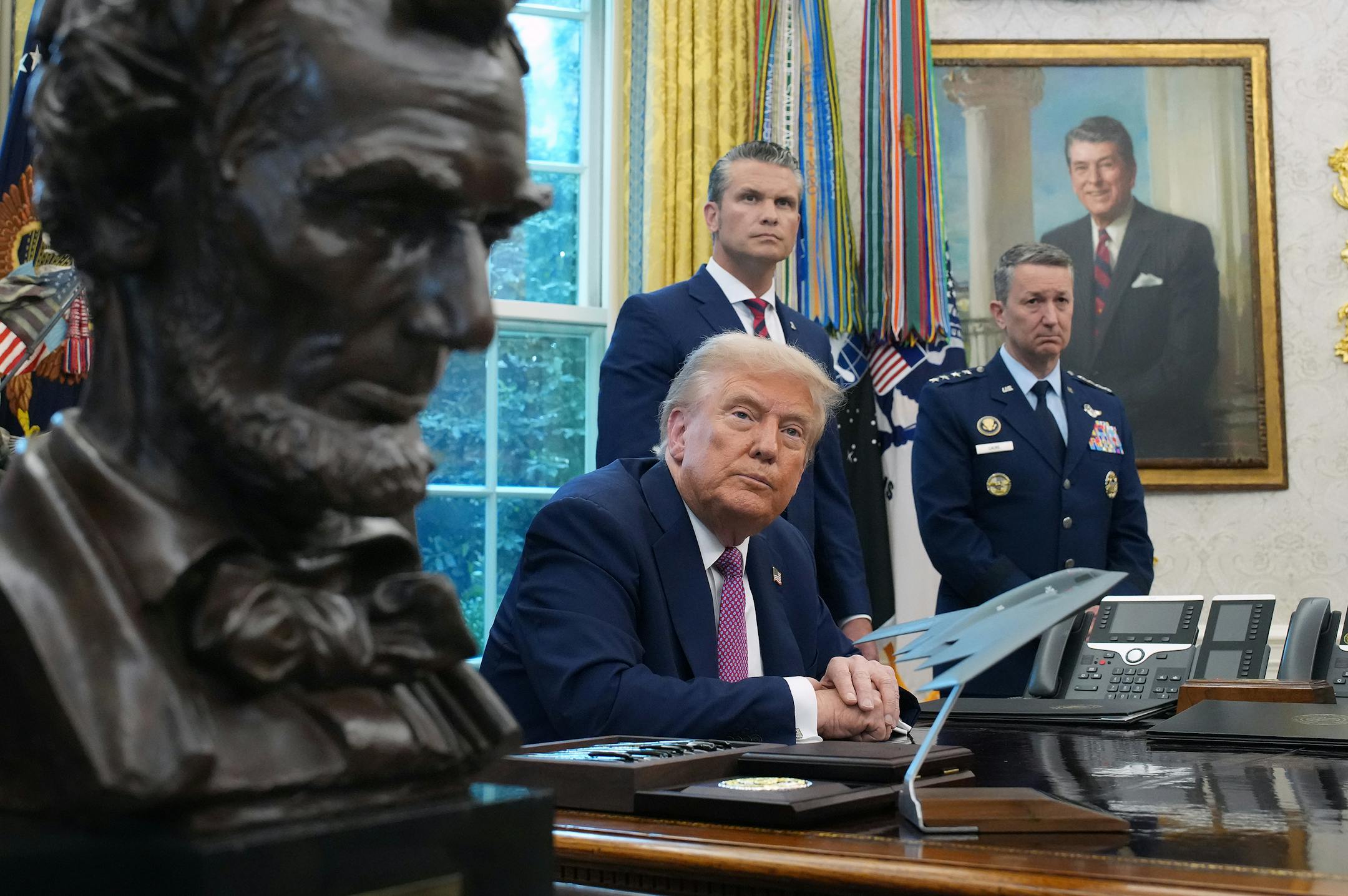
President Donald Trump speaks to media prior to signing an executive order renaming the Department of Defense as the Department of War as U.S. Defense Secretary Pete Hegseth and Chairman of the Joint Chiefs of Staff Air Force Gen. Dan Caine look on in the Oval Office of the White House on Sept. 5. (Kevin Dietsch/Tribune News Service)

Opinion editor’s note: Strib Voices publishes a mix of commentary online and in print each day. To contribute, click here.

•••

“We think words and names and titles matter,” Pete Hegseth recently told Fox News when discussing President Donald Trump’s executive order renaming the Department of Defense to the Department of War.

They sure do.

For relatively mundane matters, like Trump now referring to the Forest Lake native as secretary of war, not secretary of defense.

But more profoundly, as a signal to adversaries and allies alike, let alone U.S. citizens, on what the administration values.

“When I survey the threats we confront as Americans, changing the name of the Department of Defense is not something I would put on my top-10 list of priorities for the Pentagon — not even close,” said Bradley Bowman, senior director of the Center on Military and Political Power at the Foundation for Defense of Democracies.

Bowman, who previously served as a national security adviser to members of the Senate Armed Services and Foreign Relations Committees, as well as an active-duty U.S. Army officer, Black Hawk helicopter pilot and an assistant professor at West Point, pointed to the recent gathering of authoritarian leaders who paraded around Beijing.

“We are confronting an axis of aggressors consisting of China, Russia, Iran and North Korea,” Bowman said. “They’re unified by their antipathy for Americans, our allies, our interests and our democratic principles. Their cooperation is making each of them more formidable, reducing the margin of safety of Americans.”

Cooperation used to be a decisive U.S. advantage. NATO nations banded together to prevail over an isolated Soviet Union in the Cold War and then rallied around the U.S. after 9/11 — 24 years ago last week.

More recently, Asian-Pacific pacts, including the so-called Quad (the U.S., Australia, Japan and India) have been formed to counter challenges from China. But last week, in a pique over the diplomatic drift with Washington, Indian Prime Minister Narendra Modi figuratively (and even literally) held hands with despots America’s desperately trying to contain.

The linguistic shift from “Defense” to “War” risks repelling allies even more than adversaries.

At a minimum, it is “a very interesting performance art on the part of the administration,” said Jon Olson, a retired commander who spent 21 years in U.S. naval intelligence who now teaches at Carleton College and the University of Minnesota’s Humphrey School.

“What we as a nation have always stood for, at least since World War II, is a beacon of hope and freedom around the world and aspirational goals for ourselves.” One of the main postwar objectives, Olson said, “was to make sure that our friends and allies around the world could defend themselves against the kind of tyranny that we saw leading up to World War II, and that’s the framing why we became the Department of Defense.”

But now, Olson said, our commitment is in doubt. “When we had the Department of Defense we worked collaboratively with our allies and friends around the world. And now we have the Department of War, and we’re abandoning all of those friends and allies.”

Today’s turbulent world “is real-world war and peace, life-and-death stuff,” said Bowman. “Our adversaries understand the value of partners [being] more formidable because of their cooperation.”

Every country will react differently to the more bellicose branding. Europe in particular, Bowman suspects, “might just see this as more evidence of what is a unique moment in Washington.”

Bowman was speaking figuratively, but the nation’s capital is literally having a unique moment with Trump’s deployment of the National Guard. Memphis is next, and then maybe Chicago — a possibility the president posted (and boasted) about on social media via a meme poster of “Apocalypse Now.”

Retitled “Chipocalypse Now,” the faux poster, replete with military imagery, features his face on Robert Duvall’s Lt. Col. Kilgore character. The social-media post came with these comments from the commander in chief: “I love the smell of deportations in the morning” (changing the original, legendary line “I love the smell of napalm in the morning”) and “Chicago about to find out why it’s called the Department of WAR.”

Bowman, reflecting on the use of troops in such situations, said that “we have to be very, very careful how we use the U.S. military domestically, because the civil-military relationship is precious and at times fragile and we need a military that is seen as servants of the Constitution, not a party or a person.”

More caution seems warranted on another recent extraordinary — and perhaps extralegal — use of the military: the sinking of a Venezuelan vessel allegedly carrying gang members ferrying drugs. Normally, the U.S. Navy or Coast Guard would board the boat in a law-enforcement action. Instead, all 11 on board were killed in a military strike — even though, according to recent reporting by the New York Times, the boat may have already turned around. (On Monday, Trump announced a second strike, which killed three people, against a Venezuelan craft he said was carrying drugs.)

“That’s another fundamental change in what the U.S. has always stood for,” said Olson. “As the leader of the free world, we care about law and order and making sure that people’s rights are afforded to them. We don’t just go kill people.”

Hegseth’s statement on words mattering was in response to renaming his department, which seems to be just the latest change spurred in the service of conservatism.

Referring to broader political dynamics and important American norms, mores and institutions, Bowman said:

“The essential conservative impulse is an appreciation for the fact that it is easier to destroy than build. So before you destroy an institution you better think twice because you’re probably standing on decades, or more likely centuries, of informal and formal institution building, and you won’t appreciate how good you had it until that institution is gone.

“So I think real conservatives are people who when they see a problem want to reform rather than destroy. I think the impulse to destroy institutions is the antithesis of conservatism.”

about the writer

about the writer

John Rash

Editorial Columnist

John Rash is an editorial writer and columnist. His Rash Report column analyzes media and politics, and his focus on foreign policy has taken him on international reporting trips to China, Japan, Rwanda, Kazakhstan, Turkey, Lithuania, Kuwait and Canada.

See Moreicon