
Rash: As brutal war endures, Ukraine needs good neighbors

Western unity is essential in reversing Russian aggression.

Columnist Icon
The Minnesota Star Tribune
August 20, 2025 at 11:00AM
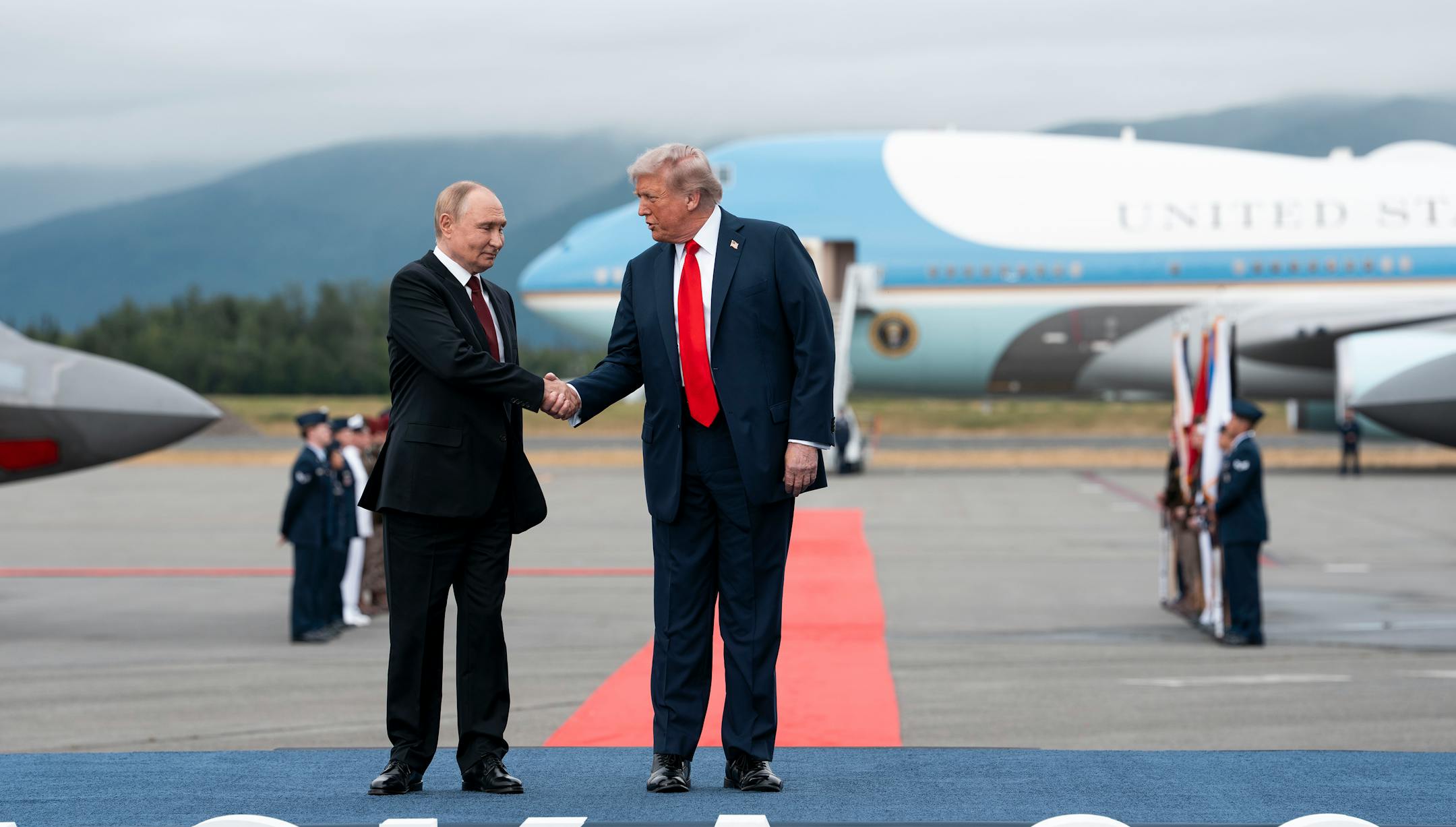
President Donald Trump greets Russian President Vladimir Putin as they meet at Joint Base Elmendorf-Richardson in Anchorage, Alaska, on Aug. 15.
President Donald Trump greets Russian President Vladimir Putin as they meet at Joint Base Elmendorf-Richardson in Anchorage, Alaska, on Aug. 15. (DOUG MILLS/The New York Times)

Opinion editor’s note: Strib Voices publishes a mix of commentary online and in print each day. To contribute, click here.

•••

“Good afternoon, dear neighbor, very good to see you in good health and to see you live,” President Vladimir Putin greeted President Donald Trump in Anchorage last Friday. The Russian leader, who emphasized to the press that our two nations are only separated by the Bering Strait, said, “I think [my greeting] is very neighborly.”

Ukraine is also Russia’s neighbor. But Russia hasn’t been “very neighborly.”

Instead, since its cleaving of Crimea in 2014, through its full-scale invasion in February 2022, all the way up to and through the Alaska summit and the extraordinary gathering of transatlantic allies at the White House on Monday, Russia has killed and kidnapped Ukrainians, including thousands of children, for which Putin faces war-crimes charges.

Belarus is also a Russian neighbor. But unlike Ukraine’s vital, albeit imperfect, democracy, it’s an authoritarian country, run by Alexander Lukashenko, Putin’s closest continental ally. Before the summit Trump called Lukashenko for the right reason — releasing political prisoners — but wrongly referred to him as “the highly respected president of Belarus.” He is neither: Instead, he’s often referred to as “Europe’s last dictator” (Putin evidently qualifies as Eurasia’s) — and Trump’s first-term State Department didn’t recognize Lukashenko as legitimately elected after a sham election.

There are, of course, scores of highly respected European leaders, and eight of them met Trump in Washington on Monday, including Ukrainian President Volodymyr Zelenskyy, who was berated in an infamous Oval Office meeting in February. This time he and the others were warmly greeted by Trump, and in turn they took turns thanking the U.S. president for pursuing peace (all while working around the edges of a diplomatic divide over how to go about it).

The unified European view that a ceasefire is required before negotiations evidently was embraced by Trump before he met Putin. But within days Trump had seemingly cribbed the Kremlin’s perspective on how to proceed. While Monday’s meeting didn’t restore the ceasefire condition (Europeans have rhetorically pivoted to “truce”), it came closer to the cohesion needed to blunt Russia’s aggression.

“Security guarantees” were openly considered during the televised portion of the meeting and afterward as the leaders of Finland, France, Germany, Italy, the United Kingdom, the European Commission and NATO joined Zelenskyy and Trump in private afterward. The leaders discussed “security guarantees for Ukraine, which Guarantees would be provided by the various European countries, with a coordination with the United States,” Trump posted on social media.

On Tuesday, Trump told Fox News that no American boots would be on the ground but that the U.S. would offer help in other ways, including potentially air support, because “there’s nobody who has the kind of stuff we have.” (Ukraine may soon have more U.S. “stuff” as Europeans prepare to purchase $90 billion worth of materiel to help defend the country). Other European countries could station troops in Ukraine as part of a security guarantee, which would be acceptable to Putin, Trump said. But that idea was deemed “demonstrably unviable” by Russia on Tuesday, underscoring the chasm between Moscow’s maximalist position and the newfound allied unity.

Trump appears to want to build upon the Anchorage and Washington summits by arranging one between Putin and Zelenskyy, and in fact interrupted his Monday meeting to call the Kremlin to discuss it. But by Tuesday, Russian Foreign Minister Sergey Lavrov seemed to downplay that prospect, referring to Zelenskyy, who the Kremlin considers illegitimate, as “that character.” (Lavrov had disgracefully donned a “CCCP,” Cyrillic for “USSR,” sweatshirt before the Alaska summit, reflecting what this war is really about: Putin’s contention that the dissolution of the Soviet Union was “the greatest catastrophe of the [20th] century.”) Trump has even mentioned the prospect of a trilateral summit, which is laudable but unlikely at this point if Putin won’t negotiate.

“Diplomacy is good and necessary, and keeping the focus on what the Russians are doing and how we figure this out, is needed,” Eric Ciaramella, senior fellow and Ukraine Initiative Director at the Carnegie Endowment for International Peace, said during a media call on Tuesday. He hopes administration officials in effect say: “Everyone is focused on us now, and we have a huge amount of say with all the parties.” But now, “we need to organize our work in a way that makes sense, so that we actually nail down some of these details and then bring it back to the leaders.”

Ciaramella’s Carnegie colleague Andrew Weiss, who oversees research on Russia and Eurasia as vice president for studies, cautions that despite Monday’s momentum, much depends on Moscow.

“If Putin’s irreducible minimum is full control of Ukraine, a puppet regime, no European or Western independent security activities that aren’t under Moscow supervision, no armed forces for Ukraine except for something very token” and if they’re “brotherly nations, as he said in Anchorage, and that Ukraine is just a historical fiction, this war will go on for a very long time.

“Because this is a genocidal war for Ukraine’s very existence, and the people of Ukraine who’ve endured this for more than a decade aren’t going to submit to those Russian maximalist demands; it’s just a total negation of their existence. And there’s plenty of blood now that validates that this isn’t just talk or hot bravado on the part of the Russians — they are actually working to grind Ukraine down and get those things.”

For the future of Ukraine, Putin cannot be allowed to succeed. So now more than ever, Ukraine needs good neighbors — like the ones in the West who gathered in the West Wing on Monday.

about the writer

about the writer

John Rash

Editorial Columnist

John Rash is an editorial writer and columnist. His Rash Report column analyzes media and politics, and his focus on foreign policy has taken him on international reporting trips to China, Japan, Rwanda, Kazakhstan, Turkey, Lithuania, Kuwait and Canada.

See Moreicon