
Rash: For Ukraine and Europe, a high-stakes Trump-Putin summit

America’s president must advocate for our European allies.

Columnist Icon
The Minnesota Star Tribune
August 13, 2025 at 11:00AM
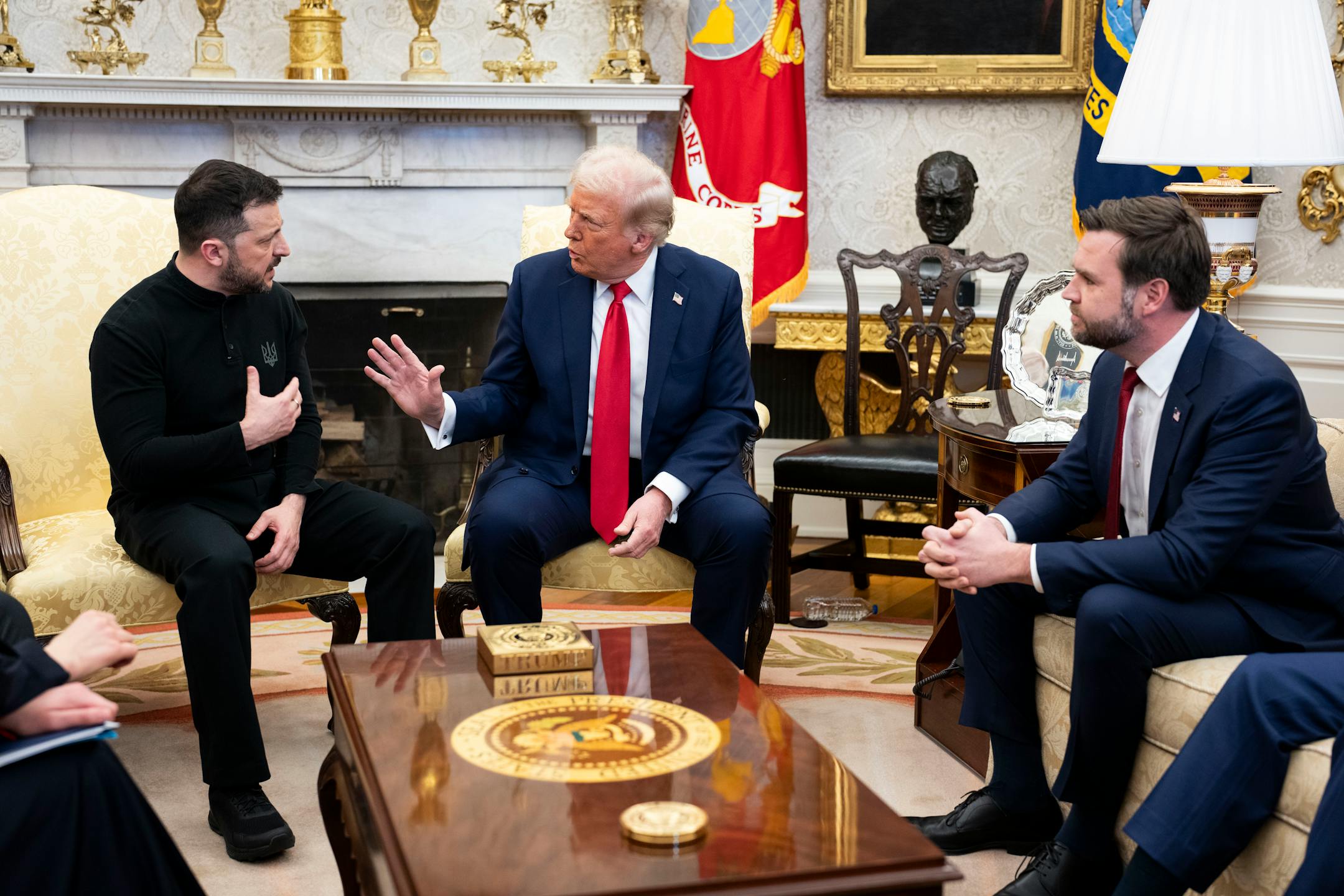
President Donald Trump, center, and Vice President JD Vance during a contentious meeting with Ukrainian President Volodymyr Zelenskyy, left, on Feb. 28 in the Oval Office in Washington, D.C.
President Donald Trump, center, and Vice President JD Vance during a contentious meeting with Ukrainian President Volodymyr Zelenskyy, left, on Feb. 28 in the Oval Office in Washington, D.C. Trump has agreed to a meeting with Russian President Vladimir Putin in Alaska on Friday to discuss ending the war in Ukraine. (DOUG MILLS/The New York Times)

Opinion editor’s note: Strib Voices publishes a mix of commentary online and in print each day. To contribute, click here.

•••

The world will turn its attention to Alaska on Friday for the summit between President Donald Trump and Russian President Vladimir Putin to discuss the war in Ukraine.

But first another meeting with great consequence — for the continent of Europe and in particular the country of Ukraine — takes place virtually on Wednesday, with Trump joining Ukrainian President Volodymyr Zelenskyy and key European and European Union leaders.

The meeting is necessary because, remarkably, a summit that may change the fate of Ukraine and by extension Europe won’t include their leaders.

Justifiably concerned, Zelenskyy warned Ukrainians that “we understand the Russians’ intention to try to deceive America” — perhaps with the Russian president presenting Ukraine as the obstacle to peace when of course it’s Russia that invaded Ukraine.

Trump, who humiliated Zelenskyy in an infamous White House meeting by berating the beleaguered leader, already seems to be pivoting away from his recent criticism of Putin to turn his eye (and often ire) back on his Ukrainian counterpart.

Regarding Zelenskyy’s comments that a national referendum would be necessary to take part in any “land swapping” of the sort Trump had suggested in announcing the summit last week, Trump said on Monday that “I was a little bit bothered by the fact that Zelenskyy was saying ‘I have to get constitutional approval’ [when] he’s got approval to go into a war and kill everybody, but he needs approval to do a land swap?”

Zelenskyy and Ukraine did not “go into a war.” They were forced into it by Russia.

“This is existential for Ukrainians; it’s not for the Russians,” said William B. Taylor, who was twice America’s top envoy to Ukraine, serving during portions of the George W. Bush, Obama and Trump administrations.

Taylor, now a distinguished fellow at the Atlantic Council, added in an interview that Trump is in a much stronger position than the last time he met with Putin in 2019. “He has the ability, the capability, the opportunity to press Putin for a ceasefire; that should be the goal.”

But that doesn’t appear to be Putin’s objective. His rhetoric and reality on the ground (and in the air and sea) suggest maximalist demands.

He may be emboldened because Trump opted to announce a summit instead of the punishing sanctions he threatened by Aug. 8, said John Herbst, who like Taylor was once U.S. ambassador to Ukraine. Now senior director of the Atlantic Council’s Eurasia Center, Herbst said in an interview that “it’s Putin’s unwillingness to actually accept a ceasefire which explains why the war continues, and nothing since Friday [Trump’s deadline] is moving Putin to the idea he has to compromise.”

Herbst said that not only do Zelenskyy’s and Europeans’ views need to be taken into account, it’s also ultimately in America’s interest “to not make it easy for Putin to take control of Ukraine, and that’s clearly what Putin has in mind for the summit.”

An unflinching analysis issued on Sunday from the Institute for the Study of War was clear on the diplomatic realities when it stated that “European and Ukrainian officials, including [Zelenskyy], have consistently demonstrated their willingness to promote and engage in good faith negotiations and impose substantive ceasefire agreements to progress the peace initiative, which Russia has consistently rejected in pursuit of incremental battlefield gains and additional concessions from Ukraine and the West.”

The Kremlin, it continued, “has long attempted to weaken cohesion between the United States, Europe, and Ukraine as part of a wider campaign to deter further Western support to Ukraine and distract from Russia’s intransigence regarding the peace process and unwillingness to compromise on Putin’s original war demands.”

These demands, the think tank concludes, would eventually “ensure Ukraine’s full capitulation — and that Russia will very likely violate and weaponize any future ceasefire agreements in Ukraine while blaming Ukraine for the violations as it repeatedly did in spring 2025.”

Trump, who harangued his Ukrainian counterpart during his Oval Office tirade that Zelenskyy didn’t “have the cards” to end the war without compromise is in a position to say the same to Putin. That is if the West is unified, a point underscored by the E.U.’s top diplomat, Kaja Kallas, who said in a statement that “transatlantic unity, support to Ukraine and pressure on Russia is how we will end this war and prevent future Russian aggression in Europe.”

Channeling the continental resolve, a joint statement on Saturday from the leaders of France, Germany, Italy, Poland, the U.K., Finland and the European Commission said that “the path in Ukraine cannot be decided without Ukraine.”

Accordingly, Friday’s summit should be multilateral. But unfortunately, Trump has decided it will be bilateral — a diplomatic coup for Putin, who faces war-crimes charges, but a setback for Western friends.

While he’ll be going it alone, Trump should remember that he is representing brave Ukrainians who have saved their country from once again living under Russian/Soviet domination, as well as European allies who may be the next targets of Russian aggression.

NATO Secretary-General Mark Rutte explained the stark stakes on Sunday when he told ABC that the summit will be “about security guarantees, but also about the absolute need to acknowledge that Ukraine decides on its own future, that Ukraine has to be a sovereign nation, deciding on its own geopolitical future — of course having no limitations to its own military troop levels. And for NATO to have no limitations on our presence on the eastern flank.”

For his part, Trump didn’t go into such certitudes when addressing reporters on Monday. He did say, “I make deals.”

Trump “knows that a bad deal is not a victory,” said Taylor, “understands they don’t give out prizes for appeasement” and “knows that if he is outplayed, outmaneuvered, out negotiated by the Russians, by Putin, he has lost.”

Trump, concluded Taylor, “wants to be seen as the person who brought a just and lasting peace, not just a handshake. You can get a handshake by appeasement, and President Trump knows that appeasement has been tried and failed.”

about the writer

about the writer

John Rash

Editorial Columnist

John Rash is an editorial writer and columnist. His Rash Report column analyzes media and politics, and his focus on foreign policy has taken him on international reporting trips to China, Japan, Rwanda, Kazakhstan, Turkey, Lithuania, Kuwait and Canada.

See Moreicon