
Advertisement

Banks: I’m fed up and I’m moving to the other chair

Which means I’m likely to stay in Minnesota after retirement, whenever that arrives.

Columnist Icon
The Minnesota Star Tribune
February 22, 2026 at 11:00AM
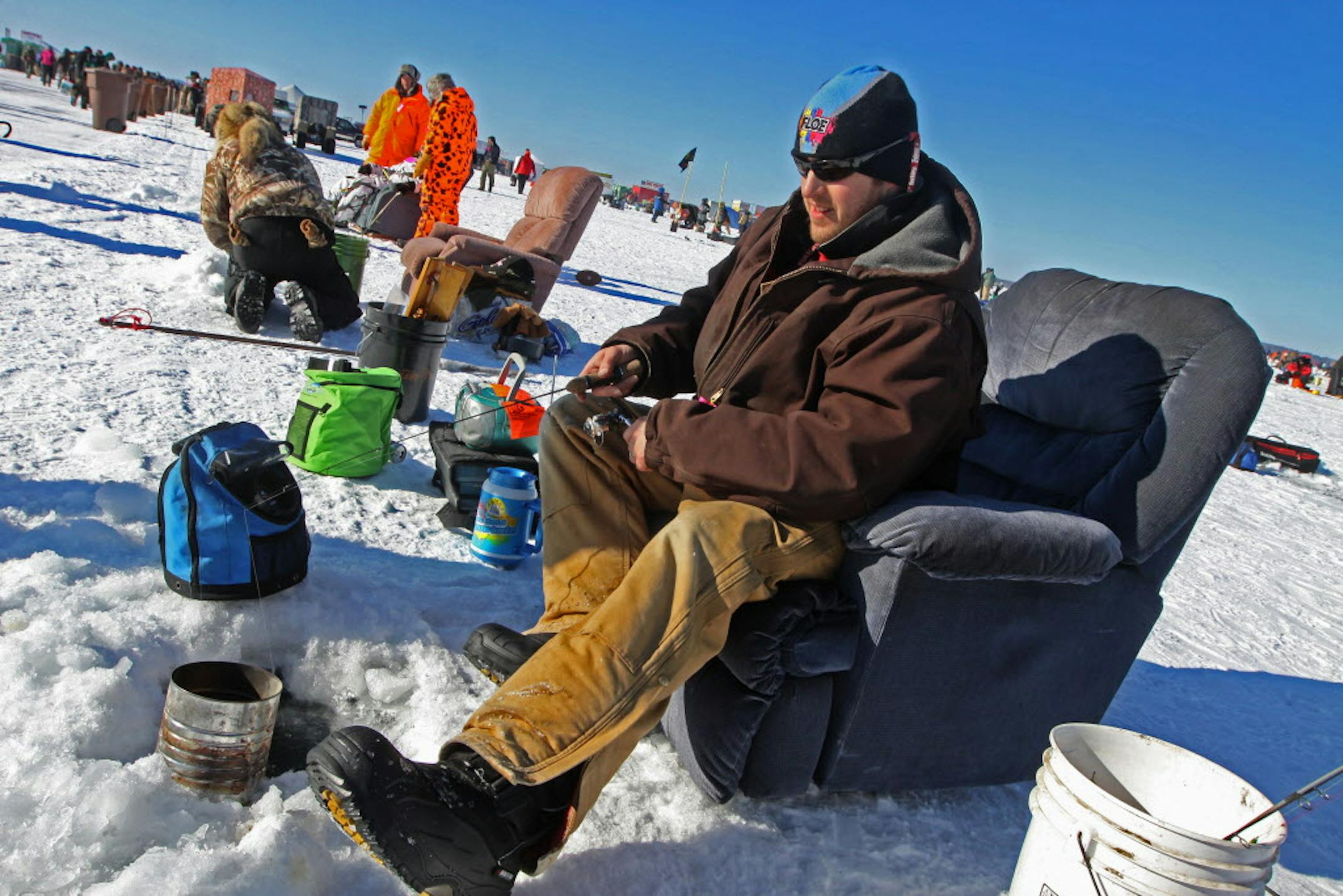
People ice fish from recliners in February 2012 on Gull Lake in Brainerd. (Bruce Bisping/The Minnesota Star Tribune)
Advertisement

Opinion editor’s note: Strib Voices publishes a mix of commentary online and in print each day. To contribute, click here.

•••

Somewhere in Minnesota there’s a wealthy individual, perhaps a retired executive, who’s fed up with how this state is run and intends to move away for good, or at least half the year plus a day. That person is formulating a commentary that will say as much. It’s still winter here, after all. Brrr. But the article will focus on taxes and governance, not the weather.

I don’t know this for sure. But I suspect it, because such commentaries are submitted to us on a semi-frequent basis. Some we’ve published. They perform quite well in terms of audience. That could be because articles our progressive readers hate the most often do the best.

But we’re not just chasing numbers. We like numbers; they contribute to our survival. But we don’t chase them. Instead, when we publish material at odds with the conventional wisdom in Minnesota it is because we think there should be discussion of matters that are important to a state. Taxes, government efficacy and resident well-being are relevant. Even if a commentary on these subjects has been flavored in a reduction sauce of the author’s ideology, it can be food for thought.

If someone wants to move to, say, Florida, because they like it there and by their calculation it suits their circumstances, then I have no criticism. People deserve to be happy.

Myself, I sometimes dream about living elsewhere in retirement, but that’s mostly for the novelty. When I game it out, it’s clear I’m already in the right place. So what follows is my story and my sauce.

I got on this subject recently as I read an article in Barron’s magazine about the 2025 version of the United Health Foundation “America’s Health Rankings” report, in which Minnesota was sixth-best (tinyurl.com/uhf-2025). Noting that health care consumes 12% of a typical retiree’s income, the Barron’s article suggested that our state, along with Washington and Vermont, may be a better choice than Florida or Arizona.

Advertisement

And because I read online comments and other such communiqués, I could imagine how some people would respond. “But the taxes! The anarchy! Minnesota is burning!” (It’s not.)

Health care is going to be a consideration in my retirement. Much of my time from the pandemic onward was consumed by providing and seeking the proper care for my nonagenarian parents. After my mom died a year ago and it was all over, someone told me to watch out for myself. Your responsibilities held your own potential health issues at bay, that person said. Now’s when they’ll surface.

Sure enough, on Labor Day weekend I had a stroke.

I’m pretty fortunate. There was no lasting damage except for some numbness in one hand. But I am no longer a youthfully carefree person — one without regular pills and appointments.

Can a ranking provide guidance?

The United Health Foundation’s ranking takes a lot into account, ranging from air and water quality to access to care to how many people have bad habits. But does the state government deserve credit or blame for those things?

Advertisement

Some, not all. Minnesota was middle-of-the-road, for instance, on public health funding. It did well on premature deaths, with a lower prevalence than in most states. Yet on that same measure, adding in racial disparities, it was horrible.

Essentially, the ranking offers a satellite view showing which states have which shine. It doesn’t tell you what probably matters more — whether you get good care for what you pay. But if you do the research for your scenario, the Barron’s article suggested, you might discover that what you’d save by moving to a lower-tax state could be erased by what you’d pay for health care there. There’s an abstract thought to add that the equation would properly include some things, like premiums, that are measurable and others, such as a strong tradition of volunteerism (in which Minnesota ranks third), that are intangible.

But purely in taxes, how much might you save? There are various methods for gauging this, but one is state and local tax revenue as a percentage of personal income. It balances the ways states get their money.

The Tax Policy Center provides that information in a spreadsheet (tinyurl.com/tpc-percentages). Two things are striking about it. One is that Minnesota’s recent percentage is about the same as half a century ago. There are wobbles over the years, but the range is tight. The other is that the variation among the states overall is a few percentage points — with most huddled around 9 and 10%. (Within the years cited, Minnesota was at a low of 10.32% in 2004 and a high of 12.03% in 1977. Florida has been as high as 10.09% in 2008 and as low as 7.05% in 2021.)

For rich people, the difference may be enough to buy a whole Bitcoin or a Tesla truck. For typical people, it’s probably a couple thousand dollars or less.

That’s not nothing, but the impact depends on what you think you’re getting in return. Which is subjective. You could try to measure it against external costs and quality in education, housing, poverty and so on, but I doubt that for most people policy really outweighs preference.

Advertisement

You can easily find people catastrophizing challenges. You can find data that suggests the need for calibration. But mostly, you could accept that Minnesota has a good reputation. Keep watch and you’ll see an unrelenting stream of reports about the state’s broad qualities, most of them illustrated by a photo of a canoe on the shore of an empty, peaceful lake in the Boundary Waters, and none by a gripping image of the windswept tundra where I grew up. Reality is complex.

However you measure it, you get to vote — every few years at your polling place or anytime with your feet if you’re so motivated.

Whether or not you’re feeling ambulatory, the biggest choice about a location is what really appeals to you.

Think about it that way and you’ll hardly go wrong.

about the writer

about the writer

David Banks

Commentary Editor

David Banks has been involved with various aspects of the opinion pages and their online counterparts since 2005. Before that, he was primarily involved with the editing and production of local coverage. He joined the Star Tribune in 1994.

See Moreicon

More from Columnists

See More
card image
Bruce Bisping/The Minnesota Star Tribune

Which means I’m likely to stay in Minnesota after retirement, whenever that arrives.

card image
card image
Advertisement