
Banks: We resisted ICE. It should worry us that we had to.

And might need to again. The defense of democracy never ends, whether it’s protesting Operation Metro Surge or other dangers to our rights.

Columnist Icon
The Minnesota Star Tribune
February 15, 2026 at 11:00AM
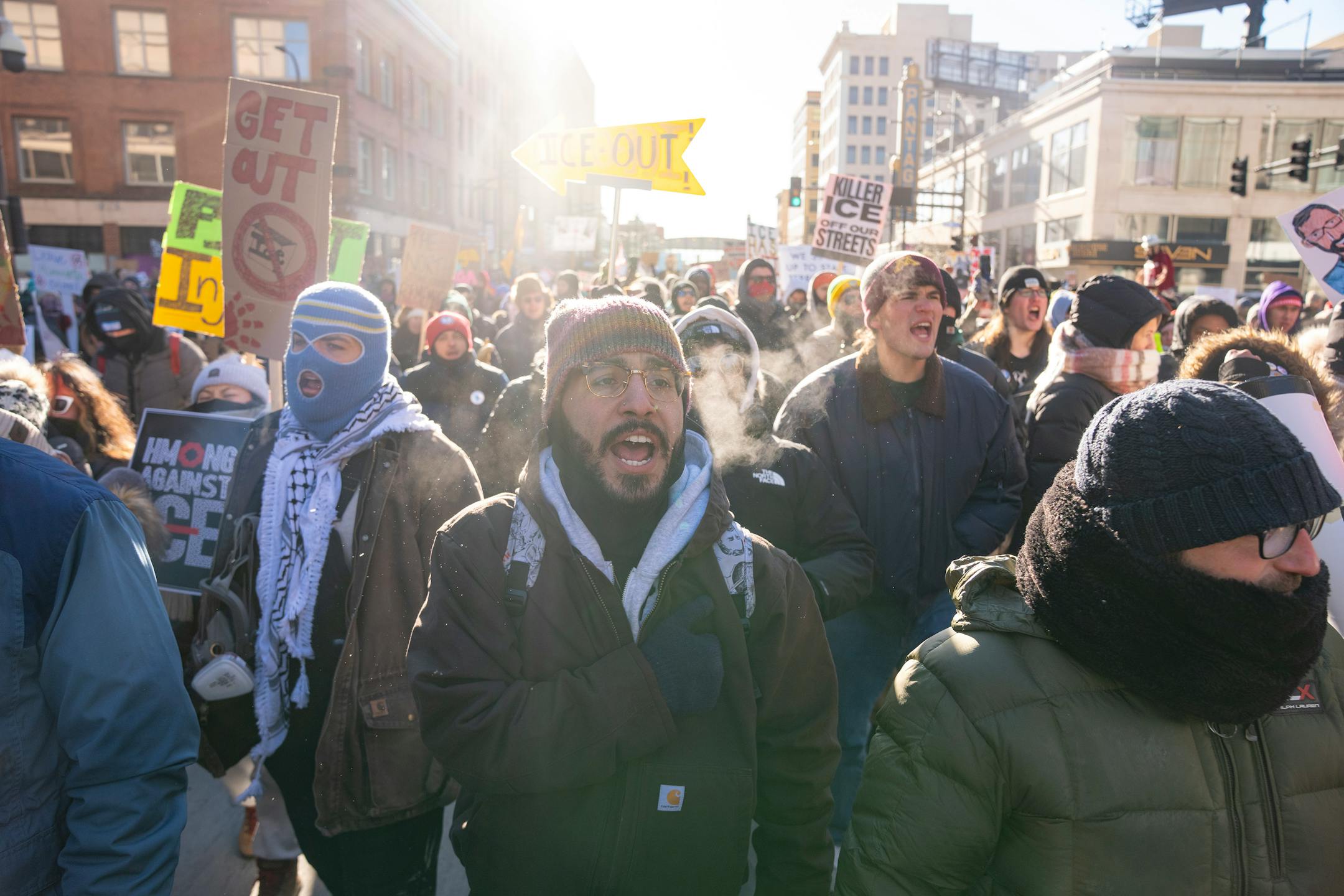
Thousands of protesters march through the streets during an anti-ICE protest in downtown Minneapolis on Jan. 30. (Alex Kormann/The Minnesota Star Tribune)

Opinion editor’s note: Strib Voices publishes a mix of commentary online and in print each day. To contribute, click here.

•••

There are a few types of people who make me madder than other types do. For instance, those who lazily punish the many for the offenses of a few. Or those who change things without taking the time to understand how the things came to be.

Also, people who punch down.

I’m inclined to think I’m not alone in these sensitivities. Life outside a social contract may be brutish, as the philosopher Thomas Hobbes famously put it (only to be parroted by uncounted dabbling Hobbesians since, plus now me), but contrary to Hobbes we can do something about the nastiness without piling on the monarchical horrors.

And we all know it.

Because in America we’ve sometimes done it.

I think that’s why two-thirds of Minnesotans responding to a recent poll believe the actions of federal agents under Operation Metro Surge went too far. The immigration enforcement initiative modeled the worst qualities I’ve mentioned in this column so far, all in pursuit of a kind of order the poll respondents couldn’t embrace.

Depending how easily you’re able to take things on faith, the brunt of the tempest here has passed. On Thursday, Feb. 12, border czar Tom Homan announced that a significant drawdown of the 3,000 agents who had been sent to the state under federal orders is underway.

Now we peer out to see what kind of mess was left behind.

That’s what Gov. Tim Walz is doing, too, by vowing Thursday to focus state policies and legislation on economic recovery from the impacts of the disruption to normal life. At least one of these ideas would be borrowed from the pandemic. There’s perhaps a little danger there, but the help is needed. The state’s legislative session begins Feb. 17.

Yet of all the things people should be wary of, in this state and beyond, foremost is the Trump administration’s strategy on immigration enforcement and the fear that the end of the surge here will simply lead to the escalation of another elsewhere. As the publication Wired reported earlier this week, federal records show that Immigration and Customs Enforcement and the Department of Homeland Security have worked in recent months to expand ICE’s physical presence across the U.S., with more than 150 leases and office expansions, touching nearly every state.

And there remain unresolved questions about the events that have transpired in Minnesota this winter, including the deaths of Renee Good and Alex Pretti in shootings by federal agents. These were homicides — the term used when one person or group of people kills another, intentionally or otherwise — and homicides in this country are to be investigated. Some within the federal government, including Vice President JD Vance, have asserted that immigration enforcement agents have immunity. Dropping this belief, and holding specific agents accountable if they are shown to have acted abusively, would go a long way toward building public confidence in ICE and Customs and Border Protection as a whole. That, by the way, means losing the masks.

Other lingering concerns:

  • That top Minnesota political leaders who are allied with the Trump administration could not be bothered to speak out against even its obvious excesses on behalf of their own citizens. No constituency is served well by one-party dominance, and it is a reality that Minnesota is a collection of constituencies. Leaders must walk a careful line between reflecting their voters and serving the greater good. Some appear not to even recognize the path.
    • That some in this country may be willing to consider constitutional requirements too onerous for effective public control — a blundering thought that could easily be expanded to any federal agenda. As University of Minnesota Prof. Richard Painter and former Law School Dean Thomas Sullivan wrote in a recent article in The Contrarian, the First, Second, Fourth, Fifth, 10th and 14th Amendments all were in tension with the activities of the surge, which they take pains to point out was not met with anything approaching the definition of an insurrection.
      • That the value of Operation Metro Surge remains unclear. Homan said Thursday that it had yielded “successful results” in the Twin Cities, including the arrests of 4,000 people, and that the operation will have left Minnesota safer. The public, however, will need much more detailed information about those arrests and their ultimate outcomes before it can reach that conclusion. In any case, safety has not been the abiding aura of recent weeks. There must — and eventually will — be an accounting of the federal policy’s reasoning and methods.
        • That discrepancies remain between local and federal goals on immigration enforcement. Homan touted collaboration with state and local officials, including more cooperation with sheriff’s offices for access to county jails. It’s never a good thing when various levels of government operate at odds, but so-called sanctuary policies and their variants did not arise unbidden.
          • That ultimately it is the nation’s broad immigration policy, not just enforcement, that must be updated and aligned with needs. A tremendous opportunity for doing so was missed in Washington leading up to President Donald Trump’s 2024 election victory, for political reasons primarily, and it brought upon the nation unnecessary pain, felt acutely in our state.

            Trump’s promise to us citizens has always been to make America great again, and the heck if he might not just succeed — by forcing us to remember how we approach greatness at all.

            Meanwhile, the many Minnesotans who dedicated themselves to peaceful resistance against aggressive policy can be proud. They didn’t, in fact, take shelter from the storm. There have been times in the nation’s history — and this is one, and it’s ongoing — when federal authority seeks to slip the bounds of its constitutional restraints. Quiet acquiescence at such times is not an option. Neither is violence. Our system, as we have seen, offers many means for citizens to strike the balance.

            about the writer

            about the writer

            David Banks

            Commentary Editor

            David Banks has been involved with various aspects of the opinion pages and their online counterparts since 2005. Before that, he was primarily involved with the editing and production of local coverage. He joined the Star Tribune in 1994.

            See Moreicon

            More from Columnists

            See More
            card image
            Alex Kormann/The Minnesota Star Tribune

            And might need to again. The defense of democracy never ends, whether it’s protesting Operation Metro Surge or other dangers to our rights.

            card image
            The childhood home of Maud Hart Lovelace, the author of the Betsy-Tacy book series, in Mankato, Minn., pictured with chapter 2 of the first book.