


Ramstad: In Minnesota, our constraints don’t have to block economic prosperity

Creativity is born of limitation, necessity the mother of invention.

Columnist Icon
The Minnesota Star Tribune
January 3, 2026 at 1:01PM
Limits on capital and labor don't have to be entirely negative. Minnesota's history is shaped by people who overcame constraints on its location and resources. (iStock)

Minnesota has the chance to solve a key riddle: how to stay rich with very little population or economic growth.

The entire world will eventually confront this conundrum, but as I wrote in my first column three years ago, Minnesota will face it sooner than most places.

To do it, we’ll first have to wait out Donald Trump’s presidency. His administration’s restrictions on immigration are making the problem of flat population growth much more difficult for Minnesota and other states that are facing it. His campaign to arrest and deport undocumented immigrants is cruel to boot.

Second, we’ll sort out the fights in Minnesota over taxes, incentives and regulations to try to attract more businesses and people to move here. As I wrote a couple of times in December, the defrauding of state programs in human services and education has eroded the social trust on which they rely.

But let’s focus today on a third point that is more optimistic. Limits on labor and capital don’t have to be entirely negative, I’ve had more and more Minnesotans tell me. And much of the history of Minnesota and the Midwest involves overcoming such limits.

“There is something to this idea that creativity is born of constraint,” said Eric Dayton, a descendant of the Dayton retail family who has openly discussed his business successes and failures.

In the first century of statehood, Minnesota’s remoteness from centers of commerce and industry proved surmountable for the people who moved to the state. They tamed the prairie, chopped forests, mined sand and iron and turned it all into food, windows, glass and cars and bridges.

It’s easy to still find that drive today in all corners of Minnesota.
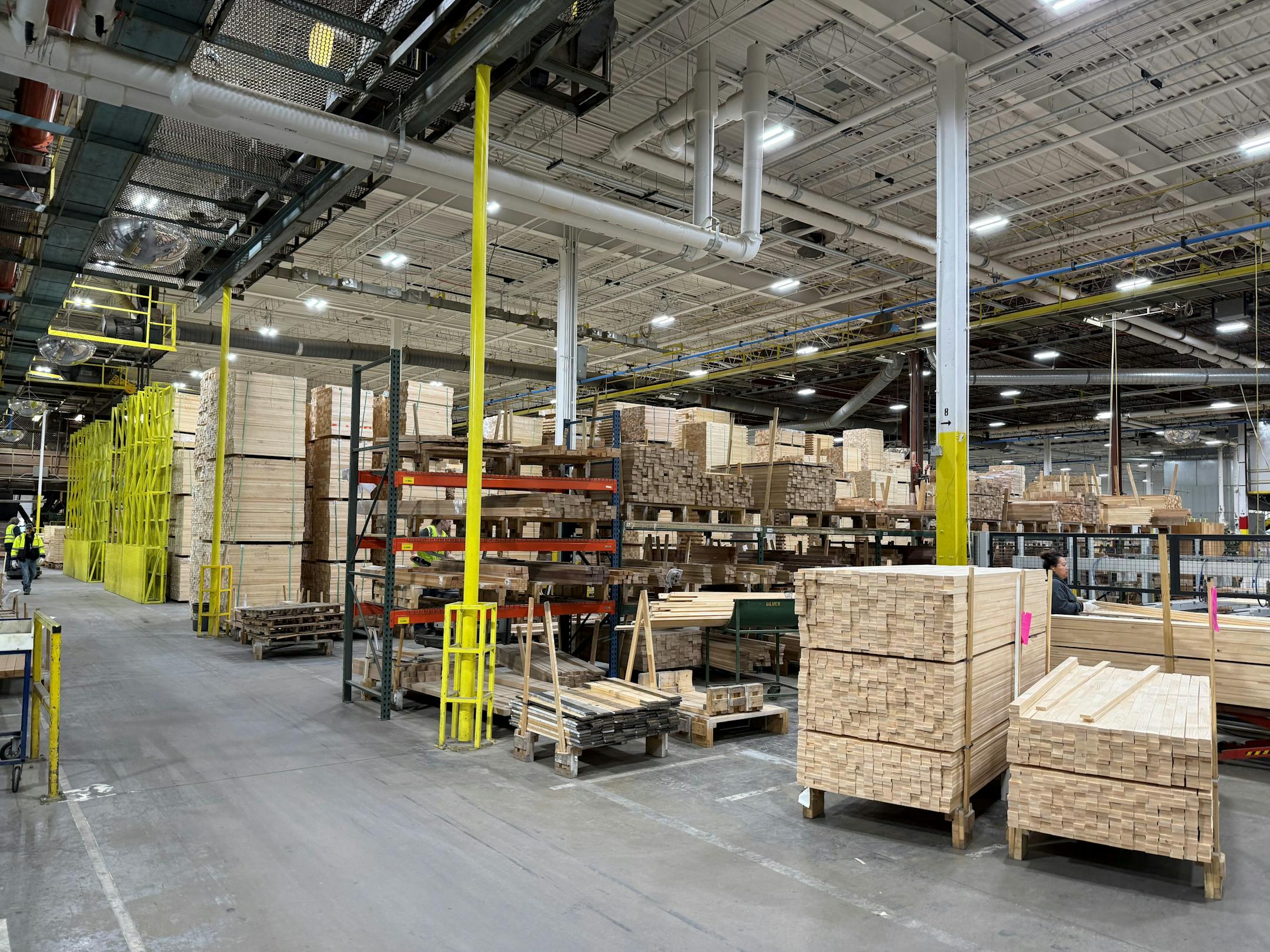
On my visit last month to window and door maker Marvin in Warroad, a town of 2,000 just a couple of miles from the Canadian border, I saw how a just-completed remodel of the oldest part of the plant, shaped in large part by employees’ ideas, had allowed the company to double its productivity. Company leaders expect similar gains as they update the rest of the plant in coming years.

The oldest part of the Marvin plant in Warroad, Minn., was recently remodeled with higher ceilings, brighter lights and greater automation. (Evan Ramstad)

And at DigiKey, the giant electronics distributor in Thief River Falls, CEO Dave Doherty conveyed story after story about inventiveness of not just the company’s employees but people in the community.

At one point a decade ago, word got around town that the company needed more warehouse space, so people offered barns and garages. And once after a bad winter storm left the airport runway too icy for cargo planes, volunteers drove to Minneapolis-St. Paul International Airport to fetch some of the solution it uses on slippery runways. The city sent out its street sweepers, which had been mothballed for the winter, to help break up some of the ice patches.

“Do you remember when they thought we were going to have that conveyor down for three or four days because we needed to replace all those joints? And they had it fixed overnight,” Doherty said to Chris Lauer, the company’s vice president of logistics, and some of their colleagues as I listened.

“They developed some tooling, some custom-made tooling, just to support that conveyor. These guys are incredible,” Doherty said. “It was just like an Indy [500] pit crew.”

Necessity is the mother of invention, particularly in the small towns of the Midwest — it dates back to the days of “farm equipment, no doubt,” Doherty said — and was something I experienced growing up in a town of 8,000 people in Iowa.

And then, shortly after I’d moved away for college, the writer Tom Wolfe in 1983 wrote an essay that showed the nation why Midwesterners meant so much to America’s prosperity.

Wolfe profiled Robert Noyce — who grew up in my hometown in the 1930s and 1940s and invented the computer chip in 1959 — for the 50th anniversary issue of Esquire magazine. Noyce wasn’t a household name, but he was a pioneering figure in Silicon Valley and co-founder of Intel.

“Just why was it that small-town boys from the Middle West dominated the engineering frontiers?” Wolfe asked in that essay. “Noyce concluded it was because in a small town you became a technician, a tinker, an engineer, and an inventor, by necessity. ‘In a small town,’ Noyce liked to say, ‘when something breaks down, you don’t wait around for the new part, because it’s not coming. You make it yourself.’”

No one has written a textbook about how to manage a society as its population flattens out or declines.

Places like Japan, South Korea, Italy, Nova Scotia or Maine are facing the challenge more quickly. But Minnesotans can’t wait for them to show us how to build a future constrained by population and capital.

Now as ever, we must make it ourselves.

about the writer

about the writer

Evan Ramstad

Columnist

Evan Ramstad is a Star Tribune business columnist.

See Moreicon

More from Business

See More
SBA loans are up over 10% this year.
Cathy Roberts — Getty Images/iStockphoto/The Minnesota Star Tribune

The Minnesota Star Tribune has previously reported on pandemic-era fraudsters stealing from the Small Business Administration.