Ramstad: Even in 2025, you could put your money where your mouth is or heart lies

President Trump hates DEI and environmentalist goals, but most people in business expect companies to think further ahead.

Columnist Icon
The Minnesota Star Tribune
December 26, 2025 at 12:00PM
A protester outside an appearance by President Donald Trump in Warren, Mich., in April 2025. (Dominic Gwinn)

The most opined-about moment of the year on Minnesota’s business scene happened in January, when Target Corp. during Donald Trump’s inauguration week said it was ending some of its programs for improving diversity and inclusion.

I wrote at the time Target’s leaders were reading the zeitgeist, and Trump’s re-election had ended the virtue signaling that followed the police murder of George Floyd in 2020.

As this year ends, however, I no longer believe the zeitgeist changed much.

Corporate America and investors didn’t turn away from creating more equitable opportunities and healthier workplaces, despite Trump’s words and manic actions. Data from the Investment Company Institute (ICI), an industry researcher, shows investors continue to pour money into values-oriented investments.

“It’s out of favor to say I have an ESG fund, or I have a DEI-responsible investing viewpoint, but it’s there,” Roger Sit, CEO of Sit Investment Associates, said during the Minnesota Star Tribune’s annual Investor Roundtable earlier this month.

In some ways, this is a difficult opinion to substantiate. There’s always been an air of theatricality around corporate do-gooding, whether it involves philanthropy, social expression, environmentalism or the race-related goals of recent years. The extreme positives or negatives of corporate actions get more attention than the middling reality of them.

On top of that, Trump binged on what I call “old white man’s revenge” this year, lashing out at whatever he doesn’t like about people and life in the 2020s.

But he has not and cannot change markets and demographics. In Minnesota and much of the country, economic growth is driven by the rising number and growing wealth of people of color, a reality that no business executive, owner or investor can ignore.


“If you invest in quality, and you’re investing for the intermediate to longer term, you’re going to find managements that are going to do the right thing,” Sit said. “They’re going to do what makes sense environmentally, management-wise and for their people.”

Americans have been putting their money where their values lie for more than two centuries, dating to investing clubs formed in churches and groups that helped slaves escape the South or start colleges in the Midwest.

The modern-day ethical investing movement traces to 1971, when a mutual fund called the Pax Fund was sold to investors who didn’t want to put money into businesses that were making money from the Vietnam War.

Values-oriented investing vehicles emerged in waves since then. And the labels given to these waves could make an alphabet soup: CSR for corporate social responsibility, ESG for environmental, social and governance factors, DEI for diversity, equity and inclusion.

“In the old days, they called it socially responsible investing. It’s been rebranded, but I’ve always felt that it was a slippery slope because it means something different to everyone,” said Ben Marks, chief investment officer of Marks Group Wealth Management.

“Someone can buy an ESG fund, and you know, all those companies may or may not be consistent with one’s values,” he said during the roundtable.

David Royal, chief investment officer of Thrivent, a Minneapolis investment firm with roots in Lutheran churches, said he thinks investors need to do a lot of work to be certain that a values-oriented investment delivers what it promises.

“Formulaic screens are a very blunt instrument,” Royal said. “I think it’s important to invest with someone you trust, whether at the adviser level or the institutional level.”

At the Minneapolis-based McKnight Foundation, one of the largest philanthropies in Minnesota with about $2.5 billion in assets, over half of its investments align with its mission goals around arts, food systems, neuroscience, climate and community development, said Elizabeth McGeveran, McKnight’s vice president of investments.

“Fund managers that do not consider good governance or responsible management of environmental risks, or the opportunities that come from investing in the broadest possible pool of talent for their human capital, we’re just not interested in,” McGeveran said.

In his new book, “The Art of Spending Money,” financial journalist Morgan Housel observes, “The amount of attention a problem gets is often the inverse of its importance.”

So it has been with the Trump attacks on DEI and corporate behavior or the environment. His threats to wield the power of the government, particularly the Justice Department, against companies are real. But he hasn’t changed the forces driving American businesses to better practices on hiring or the environment.

And that brings me back to Target, which like other companies, law firms and universities across the country, made a show of appeasing Trump that now looks unnecessary.

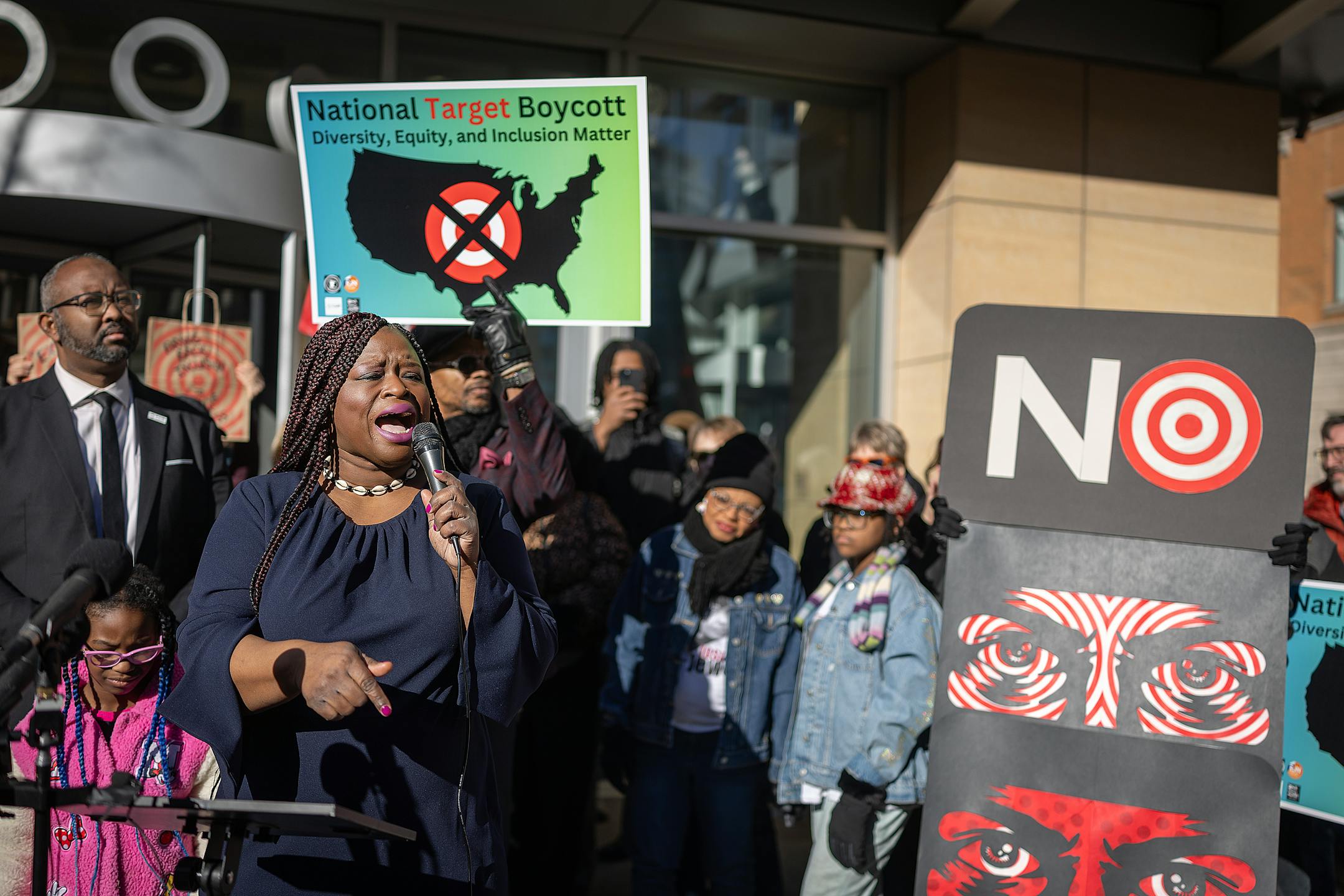
Nekima Valdez Levy Armstrong, a Minneapolis attorney and civil rights activist, called for a boycott of Target at an event on Jan. 30, 2025, days after the company modified its diversity and inclusion program. (Elizabeth Flores/The Minnesota Star Tribune)

Target has been blasted for that again and again. Other commentators were more critical of the company than I was; and some local Black leaders organized a consumer boycott that hurt the company’s results.

However, I found no commentary when Target published its annual Sustainability and Governance report this fall.

Over 111 pages, plus a detailed appendix, the company described the strides it made in 2024 on environmental goals, like consuming 1.5% less energy than in 2023. It revealed it wouldn’t reach its 2025 goal for making all the plastic on its owned brands recyclable or compostable, citing a lack of recycling facilities, vendor constraints and costs.

And for a company criticized for turning its back on diversity, its report showed 58% of its 440,000 employees and 48% of its managers in 2024 were people of color. Fifty-six percent of its employees and 55% of managers were women. Target reported pay equity on gender and racial lines, as it has since 2018.

We’ll see next fall how Target’s 2025 employment numbers look, but I would be shocked if they’re significantly different.

about the writer

about the writer

Evan Ramstad

Columnist

Evan Ramstad is a Star Tribune business columnist.

See Moreicon

More from Business

See More
card image
Jeff Wheeler/The Minnesota Star Tribune

The 8,200-square-foot St. Paul property has been a single residence, shared living space and event center in its nearly 150-year history.

card image
card image