
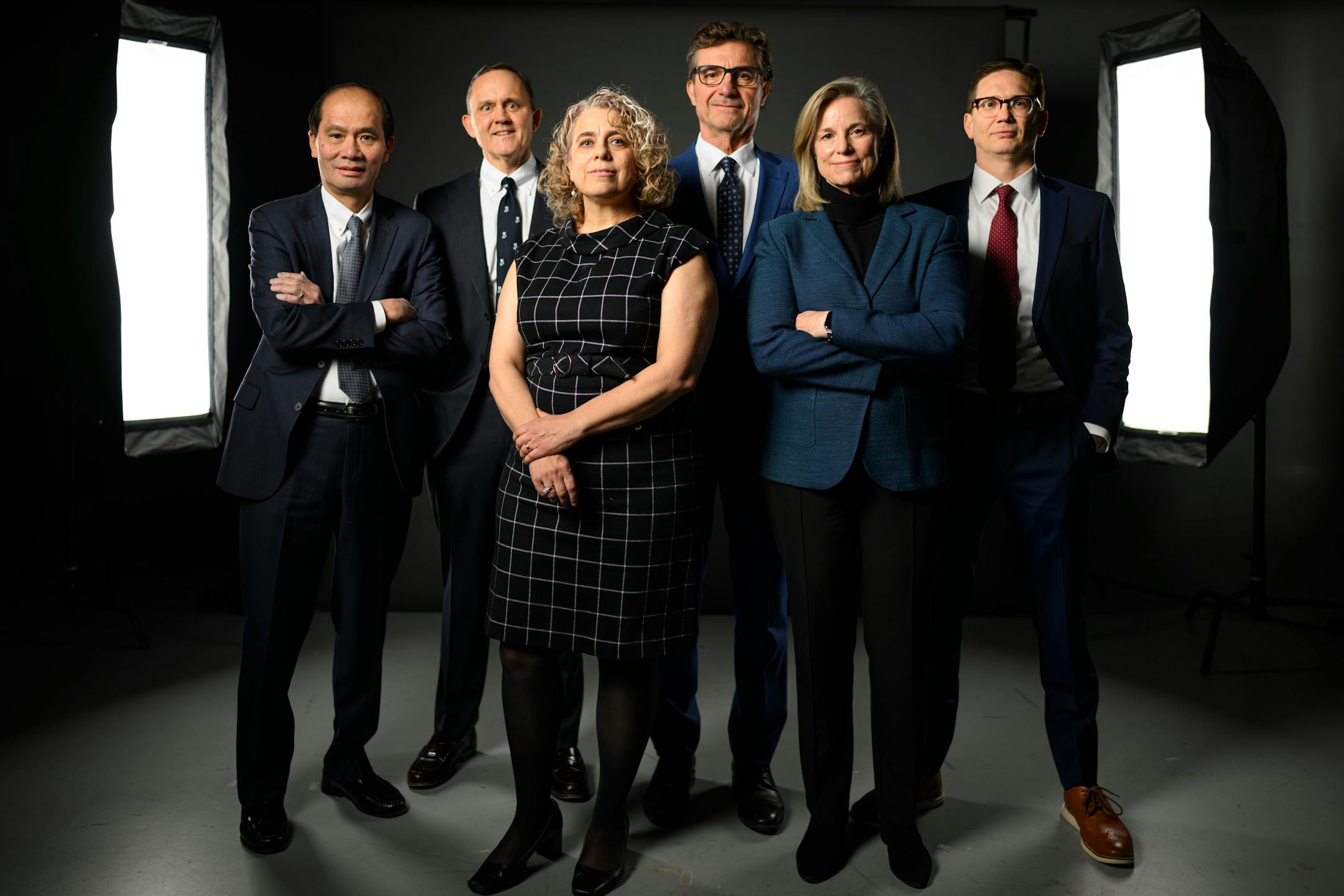
Expect a turbulent stock market in 2026 as K-shaped economy takes hold

December 26, 2025
(Aaron Lavinsky/The Minnesota Star Tribune)

Participants in the Star Tribune Investors Roundtable predict the stock market will grow between 6% and 14% in 2026, but it won’t be a smooth ride.

S&P 500 in 2025

Volatility was the name of the game for the stock market this year, and it will continue next year.

That’s the message from participants in the Star Tribune’s Investors Roundtable, our annual talk with investment officers from some of the largest organizations in Minnesota.

All six predicted the S&P 500 index will end up on the positive side and agreed government credits and incentives, as well as tax cuts and interest rate reductions, create the fuel.

The short-term positives could end up hurting markets in the long run, though, if the government stimulus does not spur economic growth.

All of them expressed concern about the growing K-shaped economy, where those at the top are doing much better than the rest of the population.

The hourlong discussion on Dec. 8 — two days before the Federal Reserve lowered interest rates another quarter point — covered topics from artificial intelligence, China trade expectations, which industries are ripe for growth and the upcoming changes at the Federal Reserve.

The participants: Elizabeth McGeveran, vice president at McKnight Foundation; Ben Marks, chief investment officer of Marks Group Wealth Management; Bill Merz, head of capital markets research for U.S. Bank’s Asset Management Group; David Royal, chief investment and chief financial officer of Thrivent; Jill Schurtz, chief investment officer for the Minnesota State Board of Investments; and Roger Sit, chief executive and investment officer for Sit Investments.

A year ago, roundtable participants made S&P 500 estimates that ranged from 6,450 to 7,300. Ten days before the end of the year the S&P 500 closed Dec. 22 at 6,878.

The winner from last year’s roundtable was Carol Schleif, chief market strategist at BMO Private Wealth, who had predicted S&P 500 6,900.

The following are excerpts from this year’s discussion, edited for length and clarity.

Meet our Roundtable participants

What about 2025 met your expectations and what surprised you?

Ben Marks: As we’ve indicated here, on April 8, we had maximum tariff uncertainty, and since then, any tariff news has been thought to be less worse than April 8, and so things have been moving up on that news, and it’s become clear that the Trump administration is using tariffs or tariff threats as really a negotiation tool that’s become transactional.

Bill Merz: What wasn’t surprising was that investors who remained invested and remained diversified [were] paid off — and panic was punished — again. This is a recurring theme in capital markets. This is a recurring theme in investing, and so staying off the sidelines amid that volatility rewarded investors.

Roger Sit: The magnitude of the strength in terms of AI spending was a lot stronger than even I had anticipated. And that’s what really drove the markets up on top of the fact that now we believe there’s going to be rate cuts.

Jill Schurtz: From a market perspective, not a political perspective, we actually did see a pretty strong move on deregulation, market friendly legislation and tax cuts [from the Trump administration]. We saw a strong move on reshoring policies, national security policies. Telling Europe that they needed to start contributing more to national defense. All of that they told us ahead of time what they were going to do, and they did. And actually markets let us know they were in favor of those policies.

David Royal: One surprise would be the stubbornness and persistency of inflation, particularly core inflation. I think that surprised the Fed, it scared the Fed and I think it has surprised a lot of folks. Some of that may be tariffs, some of that may be supply-chain shifting, but we’re seeing that stubbornness, both in goods and services inflation.

Elizabeth McGeveran: I had hoped that this would not be the case, but the continuation of this K-shaped economy, I think is really notable. We have a certain group of people that are participating in equity markets and participating in that incredible wealth building, but yet 40 percent of Americans don’t participate in equity markets.

It’s becoming difficult for people to afford their own lives. Housing costs are up, health care costs went up tremendously. Those of us who are institutional investors are doing well, but I don’t know how healthy the economy is.

What companies or industries stand to benefit from AI’s next wave?

Merz: First off, AI is a macroeconomic story. We know that it’s a macroeconomic story. It’s not going to be limited to one specific sector or one small set of companies. It’s going to permeate everything.

Schurtz: If you believe that this is an enduring infrastructure play, it’s power and it’s the picks and shovels, the infrastructure behind all of this.

And quite frankly, our infrastructure across the country is nowhere in the shape it needs to be to handle AI or to handle renewables coming online.

Sit: I think the next stage, in terms of AI beneficiaries, [are] everyday companies that can take advantage of reducing their workforce, reducing their cost, improving their margins, because then it should help earnings. And earnings, as we believe, drives stock price appreciation, and that will drive the market higher.

McGeveran: I’m really interested in AI in the venture capital space, actually. So I’m not talking about investing in AI companies, but it’s increasingly becoming a lot cheaper to start a new company with fewer people and with less money.

Venture [investing] is really spearfishing, and I think what’s interesting in an AI world, is venture going to become more like casting a net on early entrepreneurs.

Royal: I think active management is going to be more important in figuring out who those winners and losers are, particularly the winners.

I was just thinking of one name that we own. It’s a budget hotel chain. They have a disproportionate number of rooms in areas where they’re building AI data centers. Those are second and third order implications you wouldn’t necessarily think of if you don’t have an active manager thinking about these things. I don’t think a retail investor would ever come up with that idea.

The Federal Reserve could see big changes in 2026, what are the implications for the market?

Schurtz: The Federal Reserve is one of our most understated but most important institutions. It’s the guardian of our monetary policy. Not only do we around the table rely on it to be a trusted, independent actor, but debt markets rely on it. And I think what’s really interesting right now, over the last year, is that the 10-year Treasury bond has been the megaphone for the market’s view on how the Federal Reserve is being treated.

To the extent right now that there’s a view that perhaps there won’t be as independent of a Fed chair, the 10-year is speaking quite loudly.

Merz: I would agree that the 10-year will be an important gauge of the perception of market credibility of the new Fed regime.

I think there’s an important interplay both between the rhetoric that you hear from certain current and future Fed members around affordability and how to address it, as well as the potential for whether that’s effective for helping that lower end of the K-shaped economy get out of their slump.

Smaller companies and low income individuals, they’re the ones that feel tight policy the most.

Sit: We all know even though you cut short rates, that doesn’t mean mortgage rates are going to come down. It’s really tied closer to the 10-year. I certainly think the independence of the Fed has something to do with where the 10-year rates are falling, but there’s also other items, including our huge debt level.

The short rate might come down, but the curve is going to just steepen. And the question is, is the 10-year going to come down, and I’m very wary of it for that reason as well.

I think Fed interest rates are going lower, not higher. I think through the first half of next year, we’ll see another 50 basis point down.

Royal: I would also remind people that we’ve had a period of a fair amount of conformity in Fed voting, but multiple dissents are not unusual. Historically, we’ve had decades where two and three dissents were the norm. So the fact that we have some dissents from the Fed doesn’t mean the system is broken down.

Will the midterm elections influence the markets or investors?

Marks: I don’t believe that the outcome of the midterm elections will change the trajectory of the market. And I think for individual investors to let their political views drive their investment decisionmaking is a huge mistake. They should try to ignore politics as much as possible. And the reality is historically the market likes a split government.

Royal: Elections are important for a lot of other reasons, but they generally don’t move markets that much overall. If you look at the data over the very long term, one party isn’t clearly better than the other.

Merz: I’ll add that, historically, since 1982 midterm election years are a little bit more volatile and a little bit lower return than other years on average. Is that [a] signal? Probably not.

Where are U.S.-China relations headed and will it affect markets?

Sit: The U.S. is playing nice with China in the negotiations, because China has two things that we don’t have right now. One is rare-earth minerals and the second is on the health technology front, a lot of the pharmaceutical processing and drug manufacturing. Other than that, they’re in terrible shape. The China economy is lousy, and they’ve been a drain on the global economy.

McGeveran: We have maybe not emphasized enough how important those rare-earth minerals, are, and China currently processes 90 percent of them. We have deposits elsewhere, but the processing infrastructure is not anywhere but China.

Schurtz: In the future, we’re going to continue to fight the battle for who’s the reserve currency of the world, and that’s going to play out over, I hope, a very long time. Right now we are and that confers to us enormous benefits. China obviously would very much like to change that, and they are making significant efforts trying to build the yuan into that. We’re seeing more of it. They’re not there yet, but that’ll be one of the next great frontiers for us.

Merz: It seems as though the tensions have eased a bit in the last nine months, and are on that trajectory for the time being. But I completely agree with the points made. China needs to find a way to stimulate domestic demand, and they have not been able to do that yet.

Marks: As China typically does, they’re playing the long game, and they’re taking advantage of the more isolationist America these days by building alliances and building trade agreements. Brazil [soybeans] is a good example of that, and there are long-term implications of that. We don’t know exactly what they are, but one would tend to believe that those long-term implications are not necessarily in the U.S.’ best interest.

How should everyday investors think of private equity opportunities?

Royal: I wouldn’t open it up like the Wild West for retail investors, but I think there are some areas, like defined contribution plans, where I think it’s a real opportunity for investors to dampen volatility and have greater returns.

I think it’s important to invest, whether at the adviser level or the institutional level, with someone you trust and judgment you trust.

McGeveran: I’m a little less sanguine, I would say that I think these opportunities are set up for people who have money to lose, or people that will never need to lay their hands on [the funds].

Marks: I started as a retail stockbroker in 1982 at E.F. Hutton, and every time I’ve witnessed a sexy investment product being delivered to the retail investor, it always ends badly, and the institutions that are packaging and distributing the product are going to be the winners here.

Sit: If you’re going to do it, you better have a big educational push. Meaning, make sure they understand it’s illiquid, and you’re not necessarily going to have the same transparency that you have with public companies and public securities.

You better educate the retail investor and the financial planner that’s advising that retail investor, because there’s a lot of minefields you’re going to be walking through.

What asset classes or industries do you think will perform well in 2026?

Merz: We see continued opportunities in growth orientation and portfolios. Rates are coming down, the consumer is still spending despite the K-shaped economy. Policy is conducive to that growth orientation. So globally diversified stocks, not necessarily a narrow allocation and certain subset — we continue to see opportunities there. High valuations are not a good reason to not own stocks.

Schurtz: One is emerging markets. They’ve been on a tear for the last six-plus months. But the big tailwind for them is just dollar depreciation, weaker dollar, which the administration is supportive of. A weaker dollar helps emerging markets who historically have most of their debt and their trade spend denominated in dollar.

Marks: I would say U.S. equities will continue to do well, as they historically have. I’ve been in business 43 years — there’s only been seven of those years where the market’s been down. So I think that’s a good bet. U.S. equities will continue to do well.

McGeveran: I think there’s a lot of talk about the AI level, and I can’t really comment on what will happen. You know, I don’t think it’ll burst, but maybe it’ll deflate a little bit.

Royal: I wouldn’t sleep on small caps. I probably look to the higher-quality end of small caps, but I think they could outperform.

What is your prediction for where the S&P 500 will finish 2026 and how did you get there?

Schurtz: It sort of hurts me not to be more bullish about where I think we’re going to end up. But I think we’ve heard it here a number of times. I think it will be a wildly volatile year, lots of ups and downs, and I think that those ups and downs could be fairly dramatic. I think we rest about 7% return for the year, that puts me at 7,300.

Merz: We’re at 7,625 that’s 25 times earnings of 305. So that multiple is about where we are right now. 305 is little bit lower than street consensus. So about 12 percent earnings growth, companies have been delivering. For all the reasons that we’ve talked about today, lower rates, stimulative fiscal policy in the front end of the new legislation and a consumer that continues to spend, and we’ll get some of that fiscal boost early in the year. We think that companies can continue delivering.

Marks: 14 percent growth puts us at 7,800. Since 1950, the S&P 500 has been up double digits 68 percent of the time. If there’s no recession this year, I think that’s a good bet. There will be volatility. Seems logical that the AI trade will lose steam in the first quarter.

We do have to get this market to broaden out and some of these stocks that are negative, they do have to perform better.

McGeveran: 7,500. It’s kind of right down the middle. I think there’s a lot of opportunity, and I agree that the volatility is going to be a pretty major feature. I think U.S. equities still have steam.

Sit: We’re putting the S&P 500 at about 7,400, which is about 8 percent up. Coming at it from two different angles. One is, if you look at consensus earnings for 2026 it’s 307 right now. But I think we’d see multiple contraction again, because we’re even longer than two to four years in terms of recovery. And so I think 8 percent is reasonable from that front.

And also, if you take today’s multiple, which is about 25 times, and say, OK, next year on 307 — which is the earnings forecast, something less than that multiple would probably be appropriate.

Royal: We’ve had three strong years. Expectations are high. So are multiples. So I’m going to come in a little bit lower. You know, we rarely, if ever it seems, have a single-digit year. You’re either up double digits or you’re down. I’m at 7,275.

I think we’ll see some volatility. It’s not going to feel like a 6 percent or 7 percent year, even if that’s where it ends up.

Prediction for the S&P in 2026

about the writers

about the writers

Patrick Kennedy

Reporter

Business reporter Patrick Kennedy covers executive compensation and public companies. He has reported on the Minnesota business community for more than 25 years.

See Moreicon

Aaron Lavinsky

Photographer

Aaron Lavinsky is a staff photographer for the Minnesota Star Tribune covering news, sports and everything in between. He joined the visuals staff in 2014.

See Moreicon

More from Business

See More
card image
Anthony Soufflé/The Minnesota Star Tribune

City boosters have targeted Grand Casino Arena and surrounding areas as the center of post-pandemic revitalization efforts, including a potential $488 million renovation.

card image
card image