
Polaris records another loss as outdoor vehicle industry continues to struggle

Sales fell 6% as the Medina-based company continues to discount vehicles to get them off lots. At the same time, because of the “global macroeconomic environment,” the company’s costs were up.

The Minnesota Star Tribune
July 29, 2025 at 11:56AM
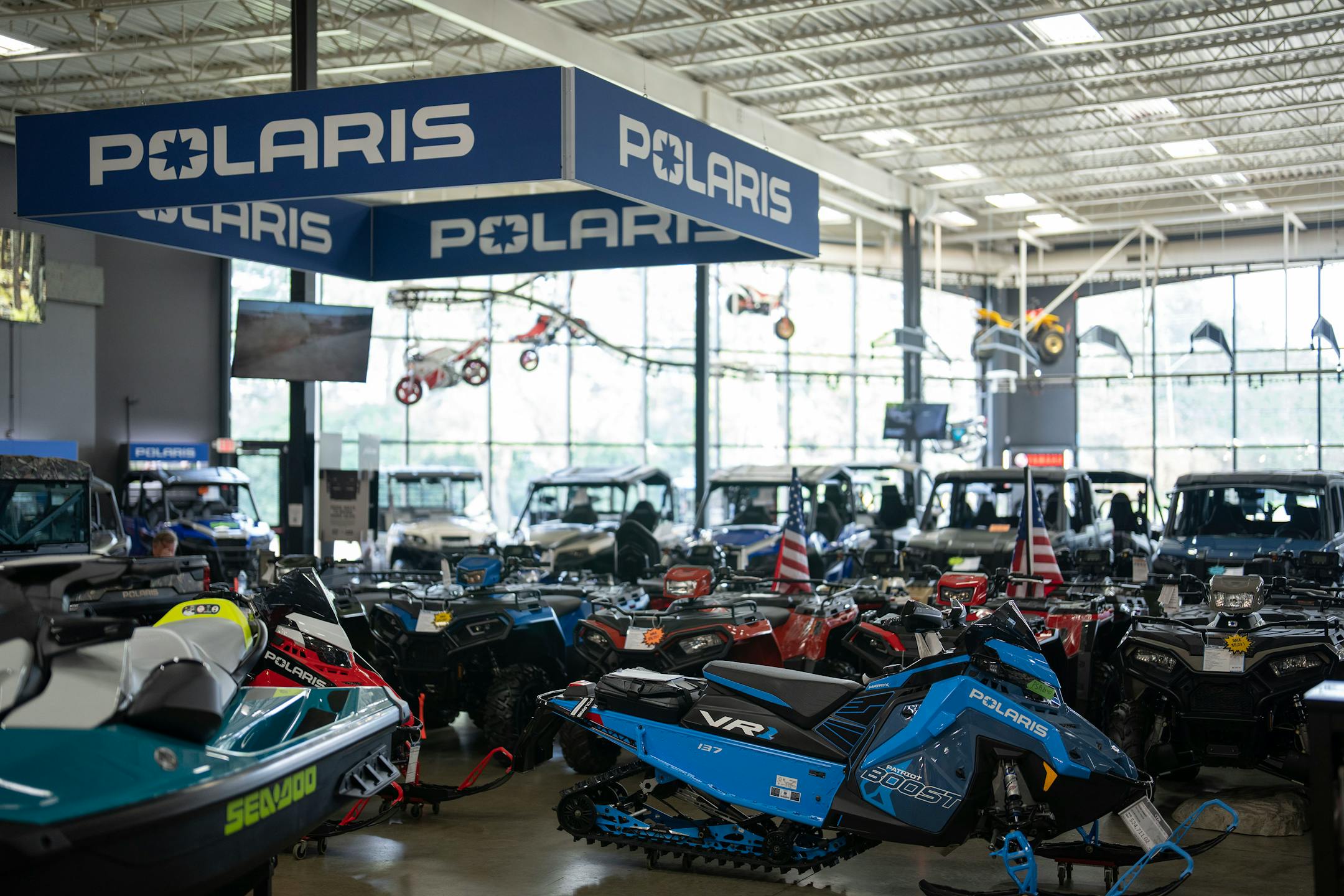
The Polaris portion of the showroom at Tousley Motorsports & Marine in White Bear Lake in 2024. (Alex Kormann/The Minnesota Star Tribune)

Polaris will likely record a third consecutive quarterly loss amid a sputtering leisure industry and higher costs from tariffs.

On Tuesday, the Medina-based company said it lost $79 million during April, May and June on sales that dropped 6% mainly because of discounting.

CEO Mike Speetzen said the company is concentrating on controlling what it can — shifting as much of its supply chain as possible from China, continuing to wring costs out of manufacturing and discounting as conservatively as possible.

But this year has to be about positioning for the long term, he said, because short-term prospects for both tariffs and consumer sentiment are too choppy to predict.

“Our plants are running leaner and more efficient than ever, surpassing even pre-pandemic benchmarks, as well as maintaining the highest levels of quality that our customers and dealers come to expect. And we are bringing industry-leading products to the market,” Speetzen said during a quarterly conference call with investors. “I’m more confident than ever that [the company] will emerge from the cycle stronger, because the Polaris team is focused and executing on what we can control.”

Investors reacted positively. Polaris shares closed Tuesday at $57.81, up 14%.

The company on Tuesday announced the Ranger 500, a new, more budget-friendly $10,000 utility vehicle, hoping to capture more people reluctant to extend their budgets. Other Ranger models cost $5,000 to $20,000 more.

It also is a vehicle that its closest competitors — Yamaha and Bombardier Recreational Products — can’t match, Speetzen said.

“We believe this is the right product at the right price to address a customer base that makes up 50 percent of all utility vehicle purchases,” Speetzen said on the earnings call.

The company has had success launching a cheaper entry-level Bennington pontoon, leading Polaris to perform a few percentage points better in its marine unit than competitors, he said.

Operational costs increased to $395 million, up $65 million compared with the same time period a year ago.

Speetzen said the company is lobbying President Donald Trump’s administration hard. It feels at a disadvantage because Polaris is actually manufacturing in the U.S., where parts are more expensive because of levies on mostly Chinese goods.

Total tariff costs for the year will likely be $180 million to $200 million. That’s lower than the $260 million to $300 million predicted at the end of the first quarter as Trump reworks tariff plans.

Speetzen and Chief Financial Officer Robert Mack predicted the tariff costs to be around $230 million next year — if tariffs stay as they are today.

So even though the company is on track to take $40 million out of its operating costs, it can’t make up for the higher tariff costs at a time when consumers aren’t buying ATVs or motorcycles without discounts, they said.

Overall, the retail environment in the second quarter was flat, better than what the company expected. Polaris also recorded a loss in the first quarter.

Consumer sentiment, despite higher interest rates, is showing some optimistic signs, Speetzen said.

But the company is not counting on the environment changing much this year, and the third quarter traditionally is choppy, with some customers seeking out new models and others seeking big deals on the previous year’s, Mack said.

The company’s loss of $79.3 million translates to $1.39 a share. In the same quarter a year ago, Polaris made a profit of $68.7 million.

Analysts who follow Polaris had expected the powersports maker to break even in adjusted profits. Instead, it recorded 40 cents per share in adjusted earnings, down from $1.30 a share last year.

Speetzen said he doesn’t like all the attention his staff needs to give to the changing economics of tariffs. However, that’s the reality of this year.

And he said the company is making sure it continues to keep its innovation muscle so that it will have the best powersports vehicles in showrooms when the public is ready to buy again.

Speetzen points already to the Xpedition’s success. It’s a two-seat crossover, meaning it can be a utility vehicle on the farm or a worksite or a recreational ATV. Although overall sales in the category are down, Polaris grew its market share in the product niche from 35% to 55%.

Speetzen said the same about its Indian motorcycles, especially the Power Plus model. While sales for the industry as a whole were down by the mid-teens, Polaris’ motorcycle sales were up single digits.

Patrick Kennedy of the Minnesota Star Tribune contributed to this story.

about the writer

about the writer

Catherine Roberts

Senior business editor

As senior business editor, Catherine Roberts oversees business special projects as well as the accountability, retail, public company, workplace and energy beats.

See Moreicon

More from MN Fortune 500

See More
Hormel headquarters in Austin, MN. ] GLEN STUBBE * gstubbe@startribune.com Friday September 11, 2015 Despite woes throughout the food industry, partly due to consumers turning away some from processed foods, Hormel has managed to continue prospering -- even though a good part of its business -- Spam, chili -- is about as processed as you can get. But the company's turkey and pork offerings are riding a hot protein trend. And over the past two years, it's made some of the biggest acquisitions in
Glen Stubbe/The Minnesota Star Tribune

The Spam-maker has experienced a string of tough years, including 2025, but analysts predict a stronger year to come.

card image
card image