
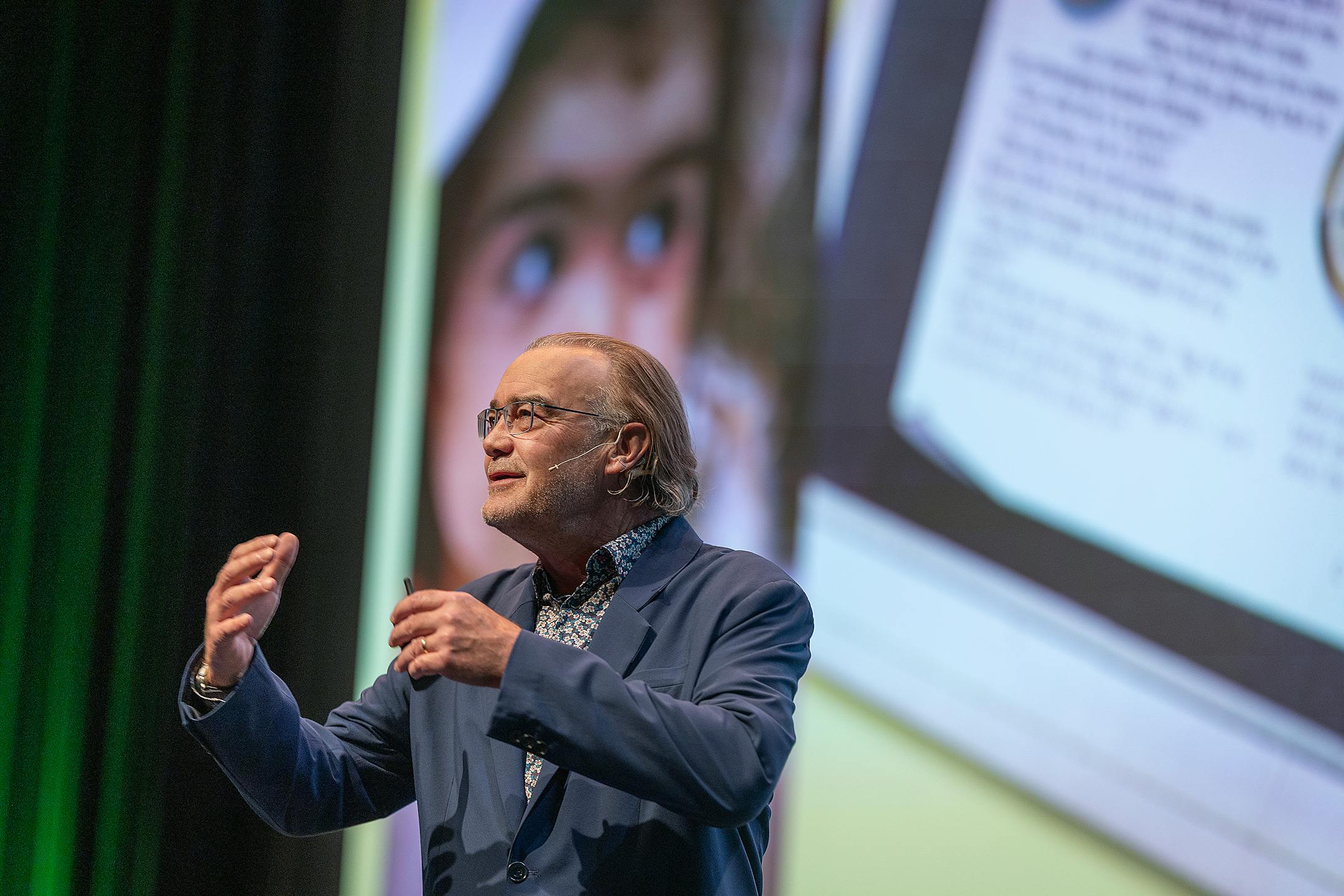
North Star Summit keynote speaker on the AI threshold already crossed, and what’s still coming

October 7, 2025

Minnesota native Peter Leyden kicks off Minnesota Star Tribune’s ideas festival with prediction about how advances in AI, energy and bioengineering will usher in a new “golden age.”

The Minnesota Star Tribune

The world is on the brink of a new era of extraordinary progress in technology, despite today’s political and economic turbulence, technology expert and futurist Peter Leyden said Tuesday.

Leyden, who kicked off the Minnesota Star Tribune’s inaugural ideas festival, said this moment — defined by key advances in AI, clean energy and bioengineering — is a hinge point in U.S. history comparable to the aftermath of World War II, the Civil War and the founding of the United States, and will rival or surpass the impact of the Industrial Revolution.

“We are watching the old system going down, the new system being built,” Leyden said at the North Star Summit, held at Walker Art Center. “We basically have to figure out how we’re going to make it through this and reinvent America for the next 25 years.”

Leyden, a Minnesota native, terms 2025 to 2050 as the “great progression.”

“Up until now, basically anything to do with intelligence … had to have a human being around it,” he said. “Now, machines can do that, and this is the dumbest they’re ever going to be.”

A former Wired editor who once reported for the Star Tribune, Leyden has spent three decades helping audiences understand the forces reshaping technology and society. He now leads Reinvent Futures, a firm that advises corporate and civic leaders on navigating change.

Leyden drew a direct line from today’s AI moment to the dawn of the internet in the early 1990s: the digital revolution needed decades to build out infrastructure; AI is arriving atop that foundation and is ready to scale now.

“The arrival of generative AI, the big bang that really happened two and a half years ago, is going to be seen as a world-historical threshold we crossed,” Leyden said.

That’s because, just as the internet opened up informational sources to everyone, generative AI is accessible to everyone.

The implications, he said, go beyond productivity. For example, AI tutors could personalize educational instruction and close achievement gaps no matter the household wealth of students’ families.

“Don’t think of this just as empowering the rich; it is essentially empowering everybody,” he said.

Neel Kashkari, president and CEO of the Federal Reserve Bank of Minneapolis, said in another summit session that he views the AI boom as similar to the automation of agriculture.

“People forecast the end of labor,” Kashkari said. “Labor changed. People went from working on farms to in factories, and the nature of work changed. So I do believe that the nature of jobs is going to change. The way we’re going to use these tools is going to change, and people are going to be forced, either willingly or unwillingly, to take on more productive jobs where their skills are better utilized.”

However, Kashkari said he thinks it is too soon to know AI’s ultimate implications on the economy, workforce and society.

At the same time generative AI is booming, energy sources are transitioning from commodities to technologies — and that is causing steep declines in cost.

Solar, Leyden said, is already cheaper to build than coal or gas plants, and electric-vehicle adoption is accelerating worldwide, buoyed by plunging battery prices. In major Chinese cities, roughly half of new cars are electric, he said.

“We’ve got to wake up,” Leyden said of the risk that the United States falls behind.

Adding to generative AI and energy shifts is a boom in bioengineering technology where Minnesota’s medical and life sciences sectors could lead, he said.

Sequencing a human genome once cost billions; today it’s under $100, he said, unlocking advances in synthetic biology from lab-grown meat to engineered crops and new therapies.

“We will still have a cut of good beef in 2040, but McDonald’s hamburgers are going to be cultured,” he said, meaning lab-grown.

about the writer

about the writer

Emmy Martin

Business Intern

Emmy Martin is the business reporting intern at the Minnesota Star Tribune.

See Moreicon

More from Business

See More
card image
Evan Ramstad/The Minnesota Star Tribune

DigiKey seven years ago made a huge bet on staying in Thief River Falls. It built the state’s largest building, adopted new processes and sees no limits to its opportunities.

card image
Berkshire Hathaway Chairman and CEO Warren Buffett, left, and Vice Chairman Charlie Munger, briefly chat with reporters Friday, May 3, 2019, one day before Berkshire Hathaway's annual shareholders meeting. An estimated 40,000 people are expected in town for the event, where Buffett and Munger preside over the meeting and spend hours answering questions. (AP Photo/Nati Harnik) ORG XMIT: NENH1