Osprey pair are faithful to nest site and return annually.

Plus: Why don’t birds sleep in their nest? How much do birds sleep?

For the Minnesota Star Tribune
September 4, 2025 at 1:30PM
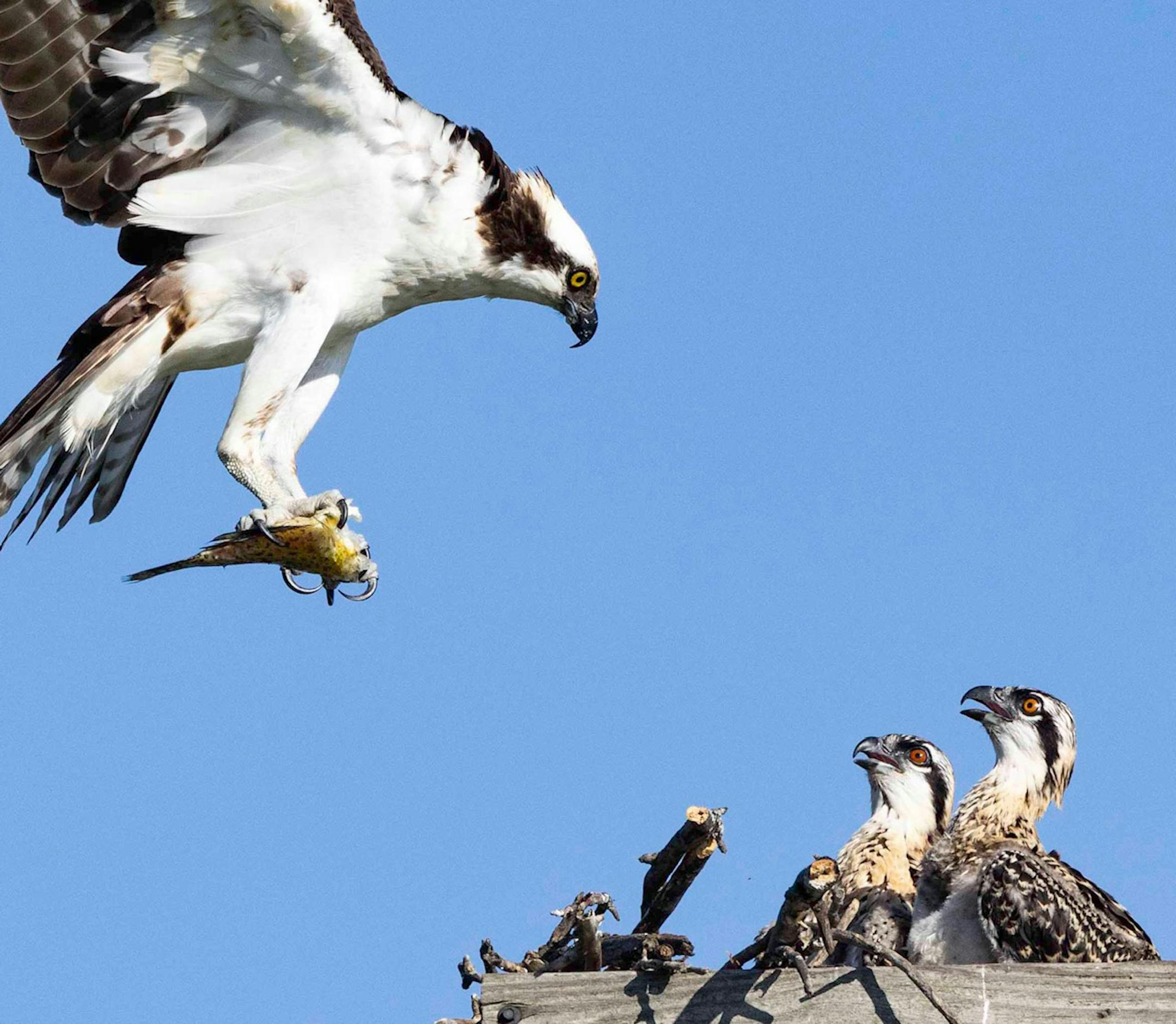
Two young osprey birds on a manmade platform nest look up expectantly, bills open, as its parent flies to the nest with a fish in its talons.
An osprey parent brings a fish for its twins. (Chuck Kartak)

Q: A pair of osprey come back to nest on the top of the same telephone pole near my house, year after year. I’m wondering whether they migrate together and do they pair up for life?

A: Osprey are well-studied birds, so we have many answers about how they live their lives. These fish-eating raptors establish long-term relationships that last as long as they both live, what some call mating for life. If one osprey dies, the other will find a new mate, particularly if this happens during nesting season. The reality is that a single osprey can’t raise its chicks alone — it requires one bird to guard the exposed nest while the other hunts for fish. The pair do not migrate together nor do they spend the winter months as a pair in the tropics. But they have a strong attachment to their nest and both will return in the spring to the site they used the previous year. How lucky you are to live nearby and be able to watch these handsome birds raise their family! And, you’ll be glad to know, their average lifespan is 15 to 20 years.
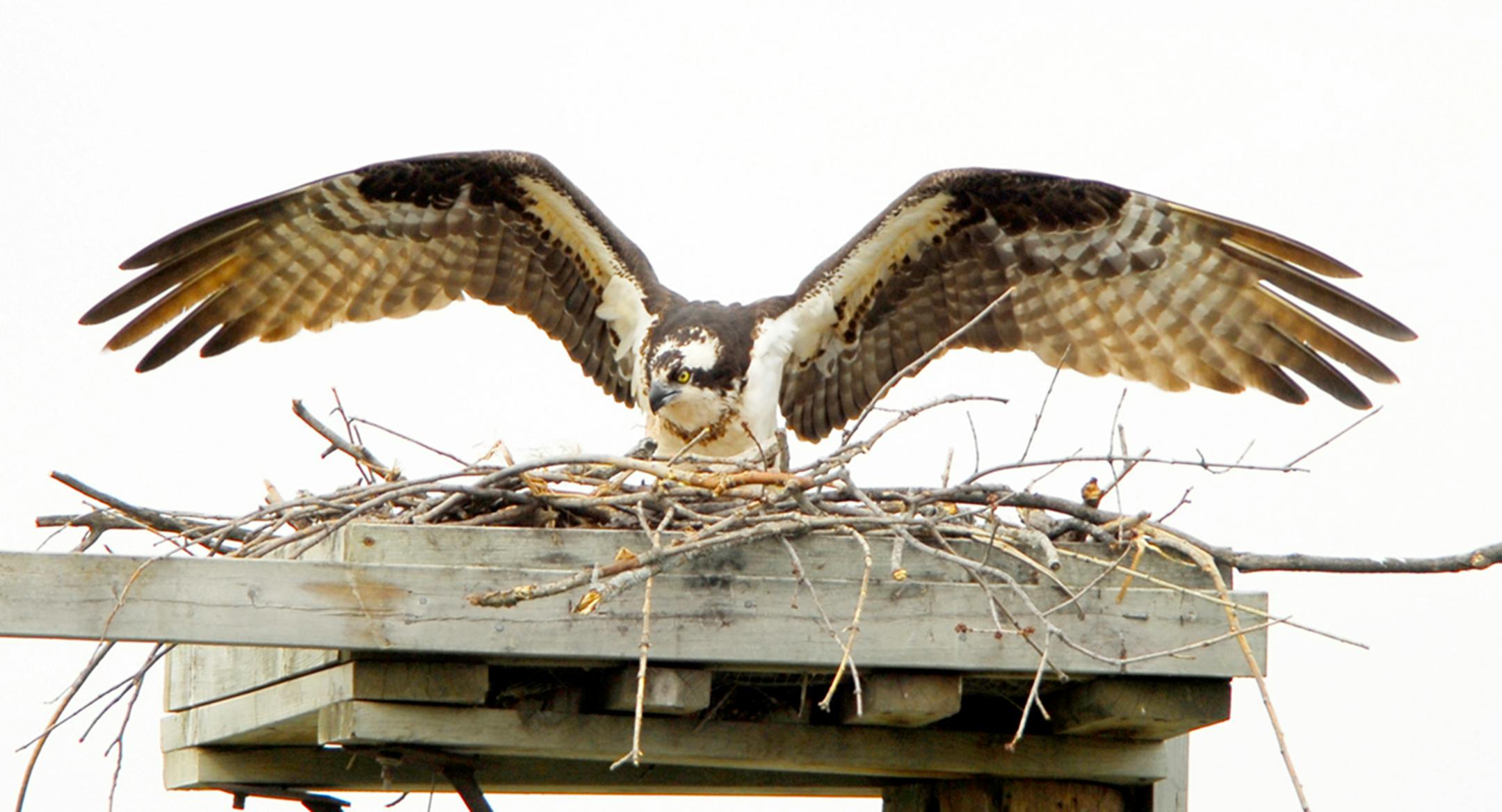
An osprey with wings spread wide at its nest of twigs over top of a manmade platform.
Osprey are loyal to their nest site. (Jim Williams)

Not for sleeping

Q: Why don’t birds sleep in their nests after their kids leave?

A: Good question. Nests require a great deal of effort and energy to build, and some are so strong (think Baltimore oriole) that they’re still visible the next spring. So it might seem that they’d provide a soft sleeping spot, but birds don’t see it that way: They regard their nests as nurseries, not as a night roost after their youngsters leave. By that time, bird nests are usually stretched out and pounded down by nestlings’ jumping and scooting around, and frankly, they’re often very poopy, as well. Add in the fact that they’re often perched in deciduous trees and shrubs whose leaves fall in autumn, making nests very visible to possible predators. Deer mice have been known to adopt birds’ nests for the winter, making a cover and sleeping away in comfort, and bumblebee queens sometimes take over abandoned nests.

Night songs

Q: I heard a robin singing its sweet song at 2:45 on an early summer morning and it led me to wonder about birds and their sleep patterns.

A: That’s an excellent question, and it seems to me that birds get a lot less sleep than most humans do most of the year, but they don’t seem to suffer for it. During spring and fall migration, they sleep very little: Most fly at night, then spend many daylight hours searching for food to fuel the next leg of their journey. Nesting season also doesn’t allow for much sleep, as parents race during all the hours of daylight to find food for their growing brood. Even after the young leave the nest, parents spend several weeks feeding them as they move around the neighborhood. This is true in the songbird world, and raptors spend even more time nurturing their young fledglings.

Winter, with its long nights and short days, may be the time when birds catch up on sleep. Some birds temporarily go into an almost hibernation condition on cold nights, lowering their metabolism, heart rate and body temperature to conserve energy. I’ve often wondered how a bird like a chickadee feels after waking from its torpor on a winter morning.

Unusual duo

Q: There is a robin’s nest under in an eave on my building this summer. But the strange thing is that I could see two adult female robins in the nest, and it seems they both were taking care of the young birds.

A: What a great observation of something that occurs very rarely in nature. It’s highly unusual for two female robins to share a nest, but apparently it does happen. It would be intriguing to know whether both females laid their eggs in this nest, and whether they were caring for up to eight youngsters. I can’t imagine how the nest could hold such a crowd of young birds. There’s a fun YouTube video on this subject: If you search Google for “Two robin moms,” you’ll find it.

Suet bashing

Q: I was interested in your recent column that mentioned crows dunking food in birdbaths. We have a different situation at my house: A crow will fly up to our suet feeder and knock off a hunk of suet. After the suet falls to the ground, the crow drops down and eats it. I don’t remember crows doing this in the past, and it’s fun to see. Almost as much fun as watching adolescents and adults interact later in the season, with the young birds complaining about being hungry and the adults ignoring them.

A: I can tell you’re a crow fan, a very good thing. Crows are a very smart species — they study a problem, then devise a solution. In this case, their beaks are too large to pull bites out of your suet feeder, as smaller birds do, so they knock it out. And after weeks of feeding their offspring, crows need the kids to strike out on their own and feed themselves, a process that can be very noisy until the young crows stop relying on their parents.

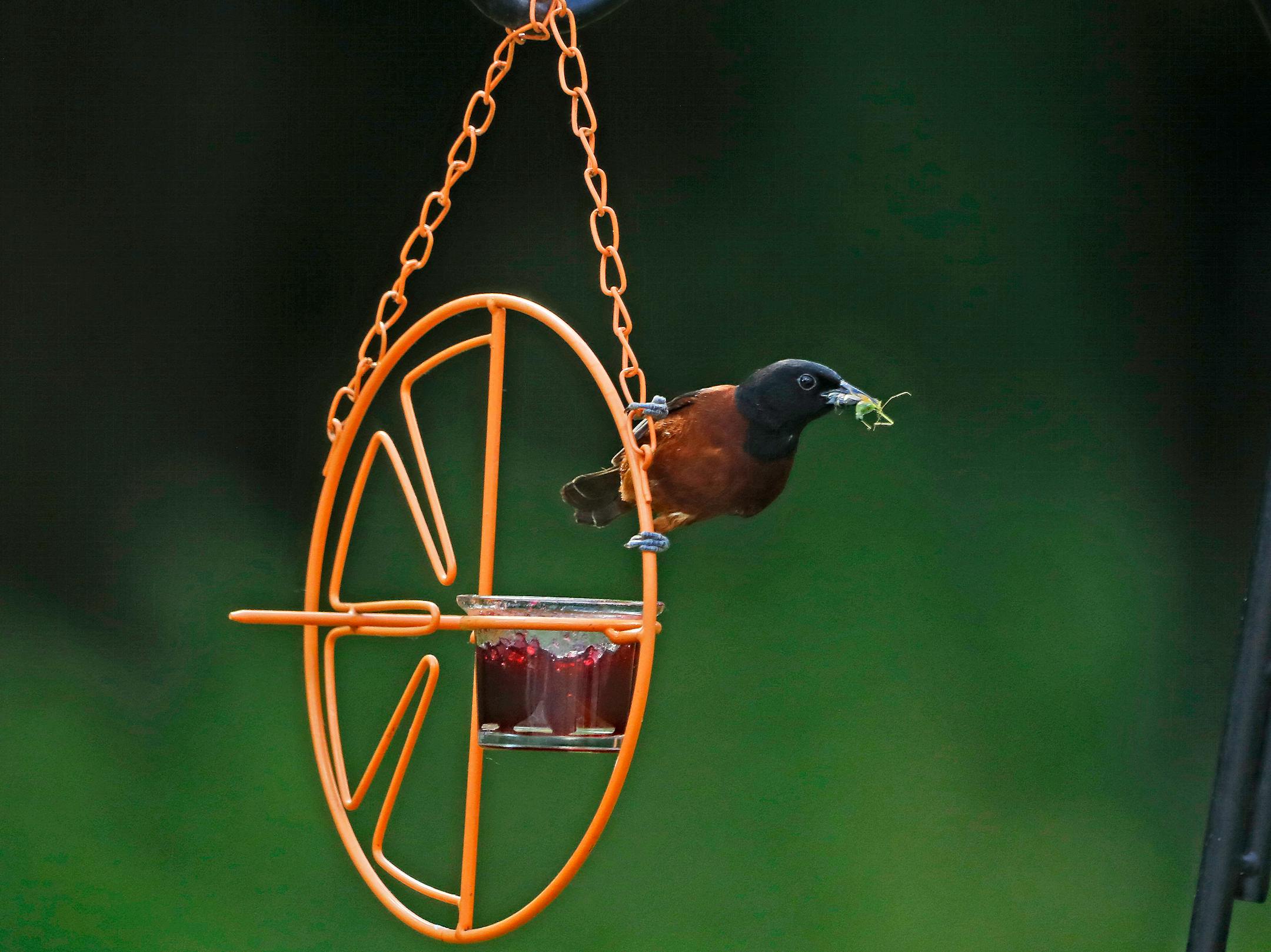
An orchard oriole with an insect in its beak perches on an orange metal oriole feeder with grape jelly in the feeder cup.
An orchard oriole with insect. (John Raterink)

Unusual oriole

Q: The orioles like my jelly feeder and for the first time, I had an orchard oriole show up. How common is the orchard oriole in our area?

A: You are so lucky to have this smaller, darker cousin of the Baltimore oriole visiting your feeder. They can be spotted in our area in the spring as they pass through on their way north to breed, and a few do remain. Their favorite habitats are open areas with scattered trees, such as an orchard, or riversides and some suburbs. Their summer diet is made up of insects, berries and nectar, so grape jelly is a good fit.

Insects lacking

Q: I’m concerned that we don’t seem to have as many birds or bugs this year. Are you having the same experience?

A: I am concerned about insects, since I’m not seeing many this summer. The butterfly census in my backyard seems to be much reduced — there are very few monarchs, only a few tiger swallowtails, etc. And wild bees are almost nonexistent in my gardens, although there are many bumblebees. Some people say “good riddance,” but birds need insects, especially during nesting season, when something like 98% of songbirds feed their youngsters an insect diet so they grow quickly on the high-protein food. As for bird numbers, I’m seeing the usual populations at my feeders, and good numbers when I visit parks and open spaces. We’ll have to wait for the verdict from biologists and naturalists after they analyze this year’s data.

Sparrows everywhere

Q: My yard and gardens have been taken over by house sparrows — suddenly they’re all over the place. Is this unusual?

A: This is very much the norm for house sparrows. Their breeding season begins in early May and runs through September, enough time to allow them to raise three broods and sometimes four each year. That’s a lot of sparrows, possibly 20 or more, produced by one pair each summer. Your question inspired me to look into sparrow parenting, and I learned that they’re considered good parents to their offspring. In my backyard, the newly fledged young sparrows spend much of their day pulling shelled peanuts out of the feeder. But, because the nuts are too hard for them to swallow, they dunk them in the birdbath, often losing the nut in the process. The result is a daily layer of peanuts on the bottom of the birdbath basin. Their usual focus is seeds and grains.

Note to readers: Reader Ryan Corman was interested in a recent column that touched on the vivid red of scarlet tanagers. “I’ve been looking for an uncommon red to paint my GTO, but the color I was leaning toward is everywhere now. After reading the column, I realized that GM Torch Red can be tweaked to be an amazing tanager shade. I’m going to speak to the paint guys tomorrow. Thanks for the reminder about these beautiful birds, they make a joyful noise and are wonderful to view. What’s not to love?”

St. Paul resident Val Cunningham, who volunteers with bird organizations and writes about nature for local, regional and national newspapers and magazines, can be reached at valwrites@comcast.net.

about the writer

about the writer

Val Cunningham

See Moreicon

More from Home & Garden

See More
A barred owl on a tree branch in daylight.
Bob Hilbert

Plus homely cardinals, missing goldfinches and a life-and-death battle between a hawk and a snake.

Plants in the home of Brendan and Alexi Coffey in Redding, Conn., on Dec. 7, 2020.
Kelley Proxmire had carpet cut specifically to fit the space in her own dining room, making it look larger. Proxmire uses lots of green plants in her work, and is adamant that they look healthy. Illustrates DESIGN-STAGE (category l), by Jura Koncius, (c) 2014, The Washington Post. Moved Thursday, August 28, 2014. (MUST CREDIT: Kevin Allen.)