Why did the merganser’s brood include some wood ducks?

Maybe egg dumping accounts for the mixed flock, or maybe the ducklings just got lost.

For the Minnesota Star Tribune
July 31, 2025 at 1:30PM
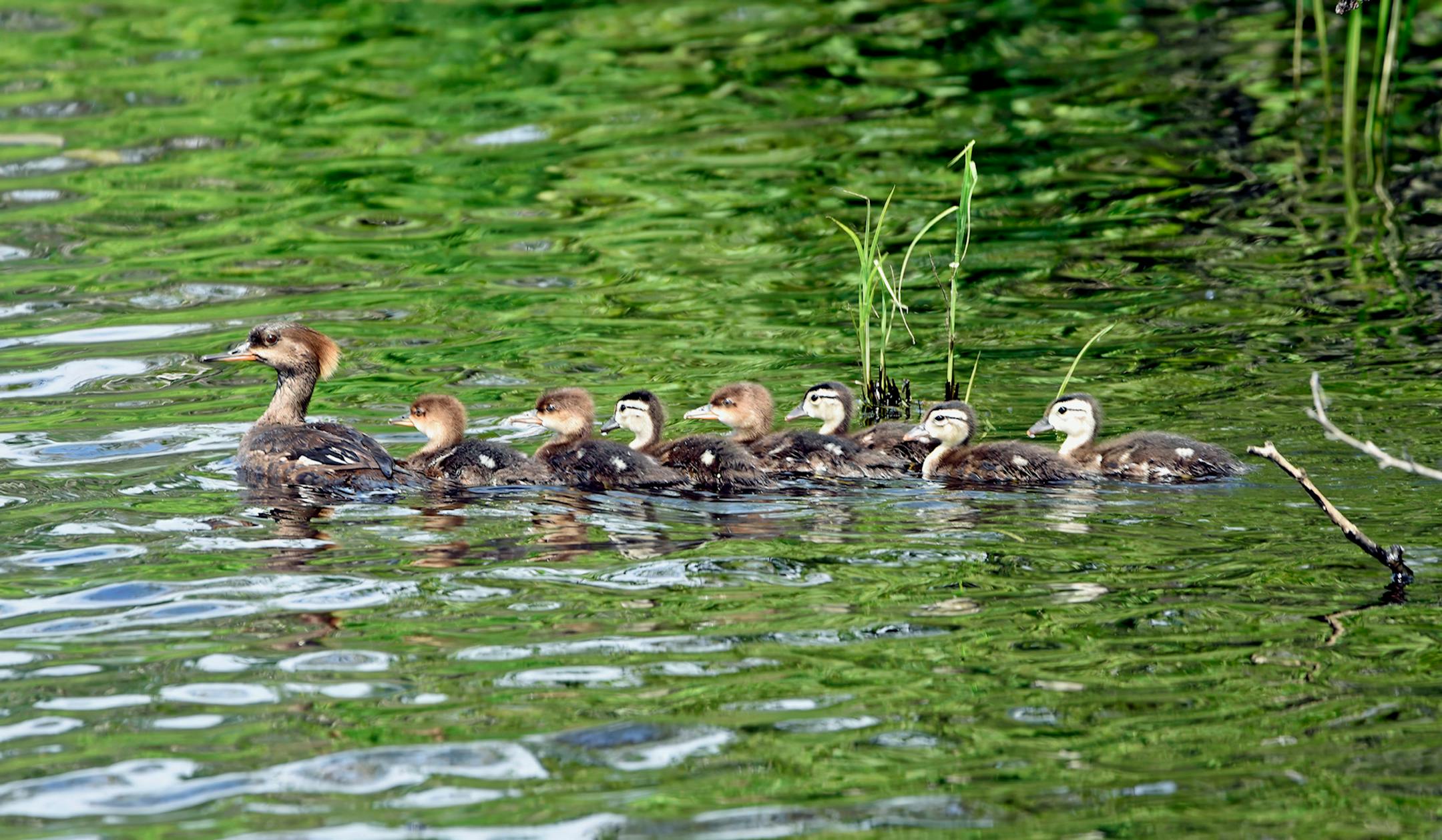
A mother duck on the water closely followed by a string of seven ducklings, two of which are a different species.
Woodies and hoodies: Mom and two different species of ducklings. (Bob Hilbert)

Q: I snapped a photo of a female hooded merganser leading her ducklings in the water. But here’s the strange part: They weren’t all the same species as their mother — some were wood ducks, some were merganser chicks. Is this common, and how did it happen?

A: You sent an intriguing photo and that’s a great question, too. Both wood ducks and hooded mergansers nest in cavities, either in holes in trees or nest boxes put up by humans. Sometimes these ducks engage in “egg dumping,” with a female adding some of her eggs to another’s nest. The current thinking on this is that females engage in this practice, called nest parasitism, because “It’s an easy way to spread your genes around in case your own nesting attempt isn’t successful,” says Nate Huck, who specializes in waterfowl for the DNR.

Sometimes wood ducks add eggs to another wood duck’s nest, at other times eggs in a nest might be from two or more species, as in this case. It may be more common than previously thought: Huck cited a paper based on research in Louisiana and Mississippi that recorded 13% of wood duck nests parasitized by another species and 24% of hooded merganser nests with eggs from another duck species.

How about the different feeding styles between the two species of ducks? Mergansers dive and chase their prey underwater, while wood ducks feed from the surface. Are the little woodies in the photo going to starve without feeding lessons? “We don’t know a lot about this,” Huck says, “but I think it’s safe to say that the woodies’ genetics can make up for what they don’t learn from Mom.” This is reassuring, that the ducklings are hard-wired to feed themselves, with or without a parent to show them how.

(There’s one other possible explanation for this kind of scenario: Young ducks on the water may become separated from their mother and join up with a passing adult female and her brood. In 2018 a merganser in northern Minnesota was spotted with an extraordinary lineup of ducklings: audubon.org/magazine/heres-why-mama-merganser-has-more-50-ducklings.)

Doing the right thing

Q: My wife found a little bird, an Eastern phoebe, still alive and seemingly OK, lying on the patio. It apparently fell out of its nest on the ledge over the deck. I donned surgical gloves and put the little bird back. Did I do the right thing?

A: You did exactly the right thing, and kudos to you for caring for a tiny creature. I hope it stays put in the nest and was able to fledge a week or so later.
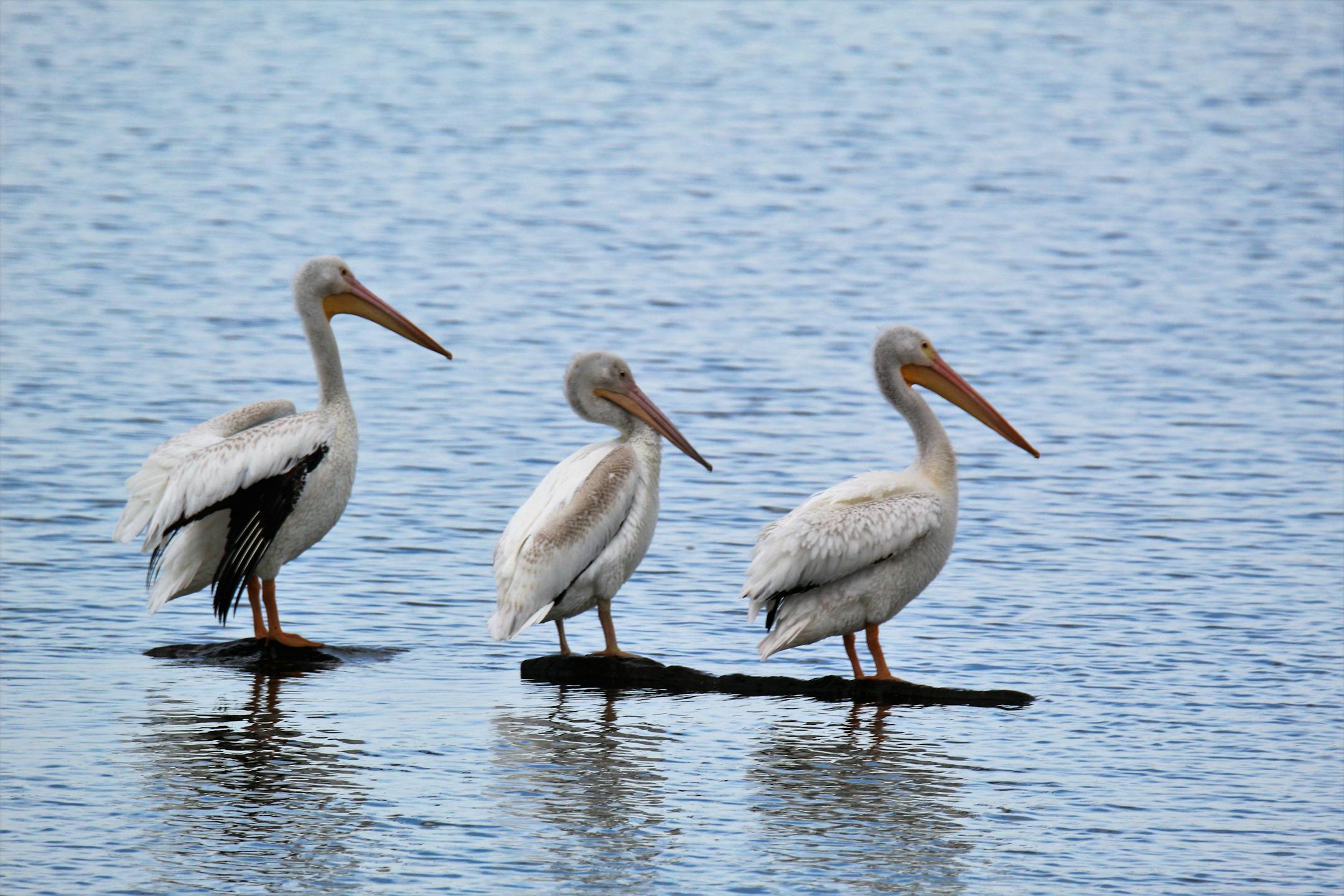
Three white pelicans stand on a sandbar at water's edge.
Young white pelicans lounge near the water. (Darlene Herbster)

Pelican puzzle

Q: In early July we were seeing small flocks of pelicans around Crosby, Minn. We’re puzzled as to why they’d be flocking so early in the season and wonder if it might be the molt migration you wrote about recently.

A. Good questions, and for starters, I’d speculate that the flocks you’re seeing are made up of young pelicans. They’re not mature enough to mate and raise a family, so they move around during the summer. Your location is not all that far from Mille Lacs, which might attract these large white birds, and Leech Lake, where there is a large summer nesting colony of pelicans. They’re fascinating to watch in the air, gracefully soaring and gliding, and in the water, where they paddle in search of prey, often working as a group to corral a school of fish and drive them toward shallow water for easy pickings. Unlike their brown pelican cousins, white pelicans do not plunge dive after their prey.

And unlike many waterfowl, they do not lose all their flight feathers at once, instead replacing wing feathers one after another, thereby retaining their ability to fly, so they have no need to migrate to molt.

Raucous robin

Q: A robin perches in a tree outside our condo and sings all day long, every single day, no breaks. He’s louder than a dog barking and this has been going on for weeks. Is this summer behavior or hot weather behavior?

A. I agree, and sympathize, because I’ve experienced the same thing, robins singing (sometimes it’s more like screeching) the same song over and over, and they can be very loud. I suspect you’re hearing a young male robin who hatched this spring and is practicing his father’s song, continuously. He’ll keep it up until the sounds he makes match the song he has in his head. This is an important stage for young songbirds, and they need to get their species’ song right or they won’t be able to attract a mate or hold a breeding territory. It can be a bit maddening to listen to, however.

Turkey day care

Q: I’ve observed Canada geese practicing shared care of goslings, as you recently wrote about. In the past 15 years the number of wild turkeys in my area has increased dramatically and hens with poults are a common sight in my yard. I’ve seen two or more hens minding 12 to 15 poults, seemingly sharing the care of their broods. I haven’t read anything about this; is it a common strategy for turkeys or just an occasional accident?

A. I’ve seen references to adult female turkeys banding together to raise their young, primarily to provide protection against predators, just as you observed. This strategy makes a lot of sense for wild birds attempting to keep their youngsters safe from the many predators in their world.

Cool jay

Q: I have nine water features in my yard along with a couple of birdbaths. Until a few days ago I had never seen a bird use the birdbaths to cool off. Then on a very hot day I saw a jay settle, belly down, on its left side in one of the basins. After about 30 seconds it rolled over onto its right side for another 30 seconds. No splashing, just cooling off. Just FYI.

A: That’s a fascinating observation, I’ve never seen a bird doing this but it makes perfect sense. You have an amazing number of water features in your yard; I’ll bet the birds show up in droves, especially on hot days.

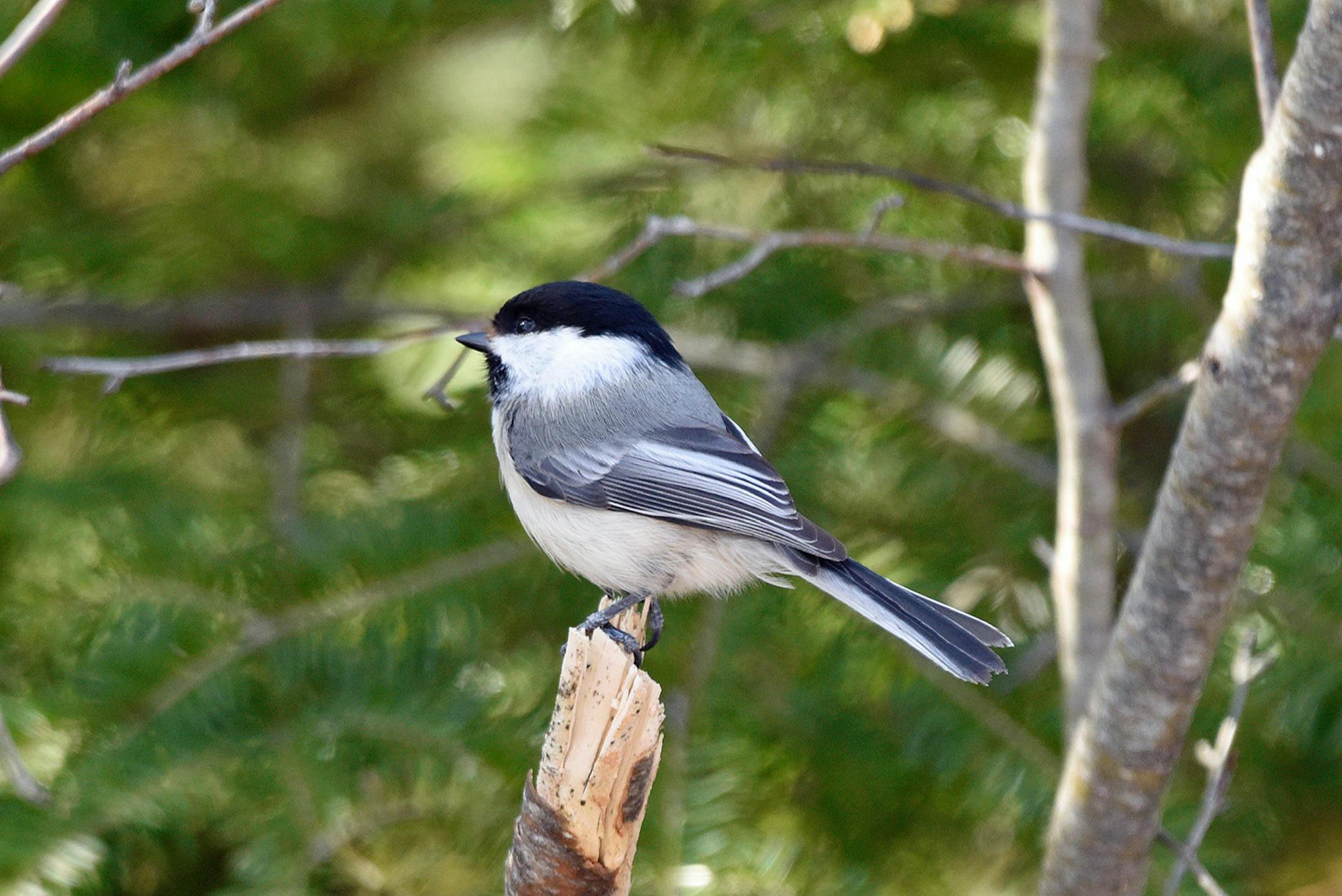
A chickadee perches on a tree stump.
Chickadees move around the neighborhood. (Bob Hilbert )

Disappearing ‘dees

Q: Chickadees were nesting in the birdhouse in my yard, but now they’ve disappeared. I was seeing them until mid-June. Do you have any insights on what might have happened?

A: I think you can safely assume that the chickadees using your nest box have fledged and spread out in the neighborhood. You might want to keep your eyes and ears tuned because young chickadees are very chatty — you may hear them at feeders or bouncing around from tree to tree.

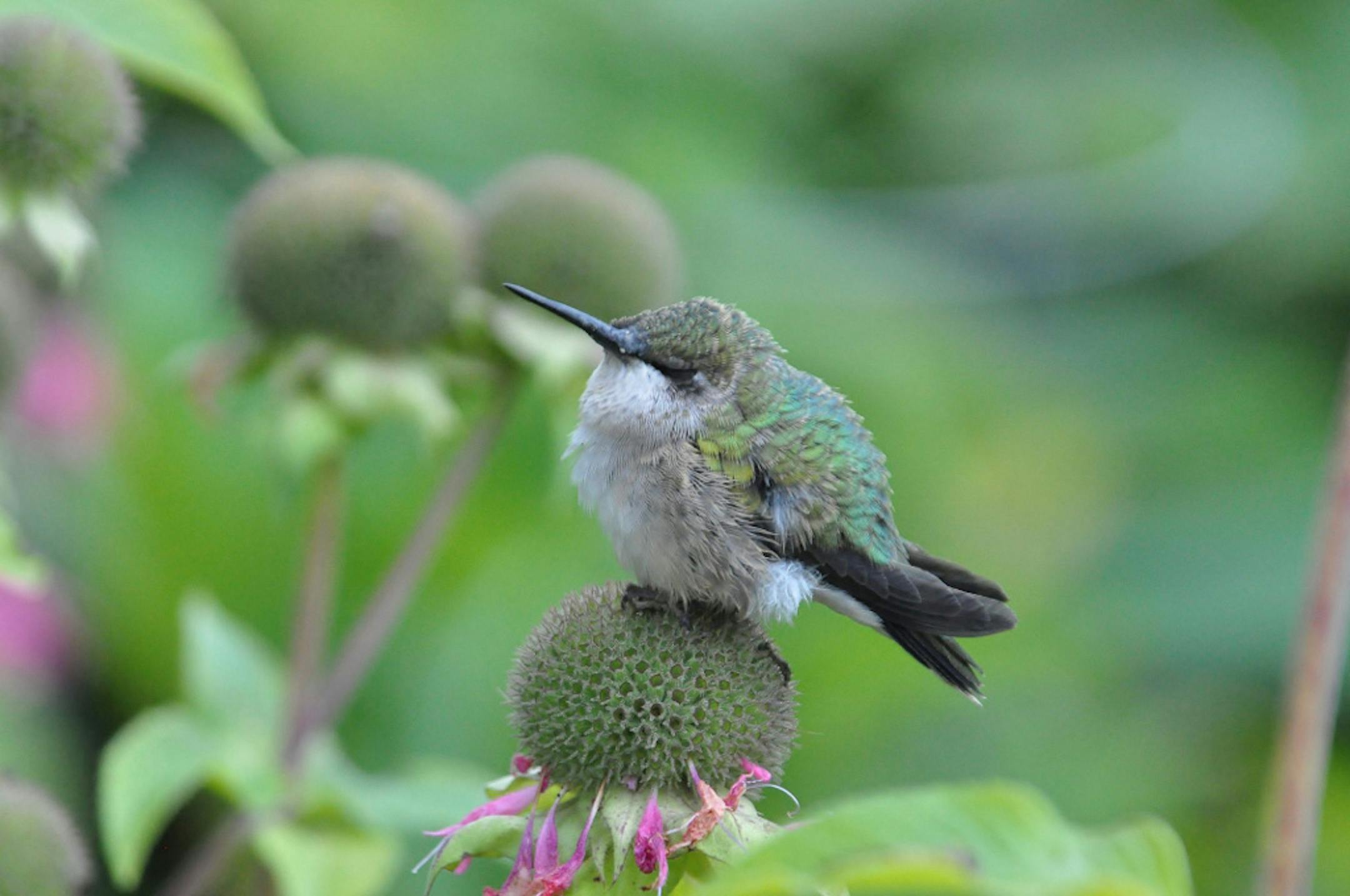
A plump hummingbird rests on a flower head that has dropped most of its petals.
A young hummingbird dozes on a flower head. (Beth Siverhus)

Hummingbird schedule

Q: When do hummingbirds leave?

A: Male ruby-throated hummingbirds generally begin to migrate out of our area starting in mid-August. Females and this year’s young birds head out several weeks later, in September or sometimes October. It boggles the mind to think of these tiny birds traveling thousands of miles to their winter homes.

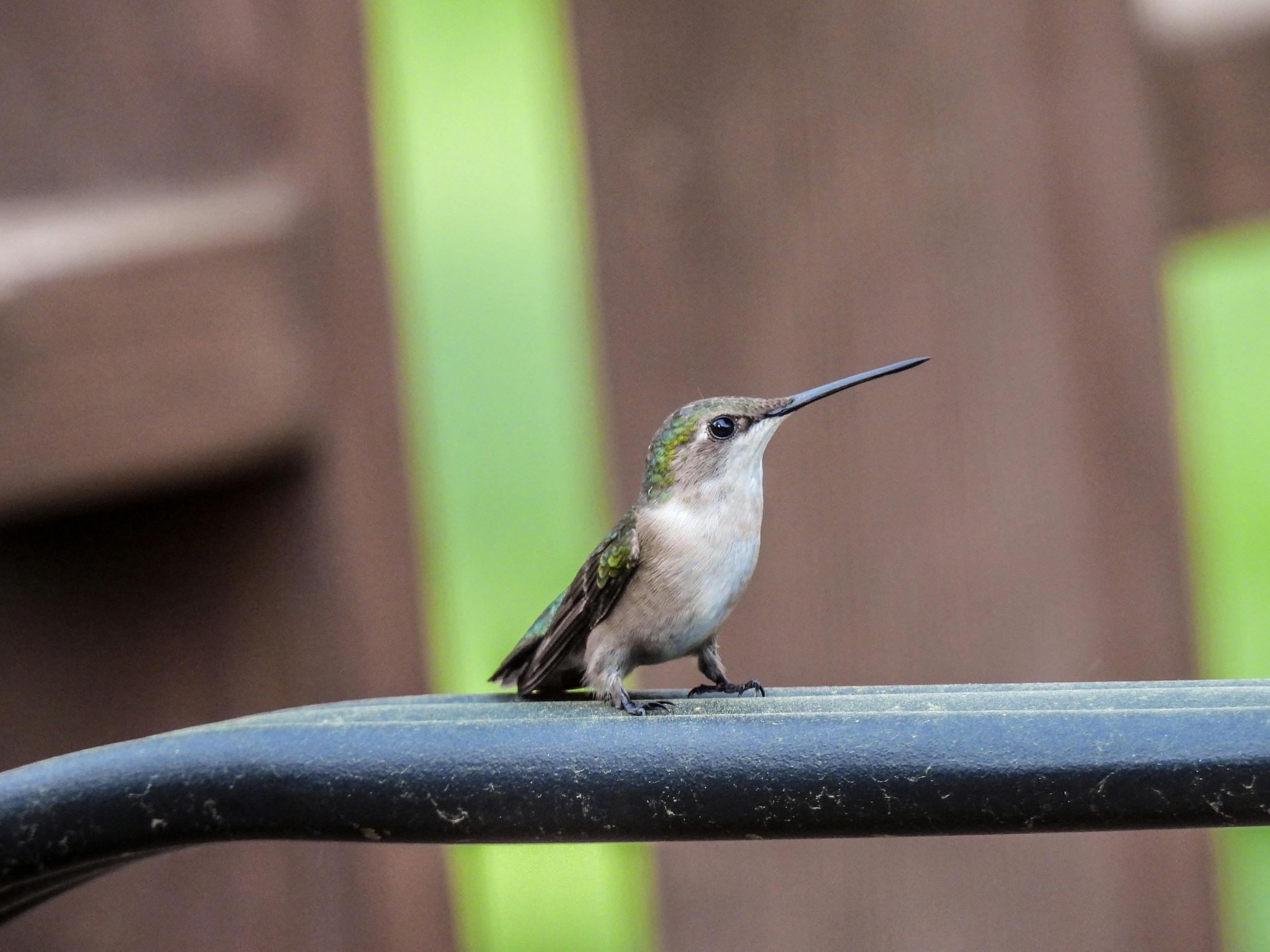
A female hummingbird perches on a metal rail.
A female hummingbird in a brief pause. (Rich Carlson)

Note to readers: In a recent Q and A column, feeding grape jelly to orioles and other birds was discussed. Mary Carlson of White Bear Lake writes that she sometimes has a hard time finding large jars of grape jelly, but has found that birds from orioles to hummingbirds to catbirds and chickadees enjoy the strawberry spread she finds at Costco. And after a piece about cardinals feeding brown birds that don’t look like adults, Joe Szabo of Arlington Heights, Ill., raised another possibility: In his backyard, a pair of cardinals were feeding a brown-headed cowbird fledgling, the result of a female cowbird laying one of her eggs in the cardinals’ nest.

St. Paul resident Val Cunningham, who volunteers with bird organizations and writes about nature for local, regional and national newspapers and magazines, can be reached at valwrites@comcast.net.

about the writer

about the writer

Val Cunningham

See Moreicon

More from Home & Garden

See More
A barred owl on a tree branch in daylight.
Bob Hilbert

Plus homely cardinals, missing goldfinches and a life-and-death battle between a hawk and a snake.

Plants in the home of Brendan and Alexi Coffey in Redding, Conn., on Dec. 7, 2020.
Kelley Proxmire had carpet cut specifically to fit the space in her own dining room, making it look larger. Proxmire uses lots of green plants in her work, and is adamant that they look healthy. Illustrates DESIGN-STAGE (category l), by Jura Koncius, (c) 2014, The Washington Post. Moved Thursday, August 28, 2014. (MUST CREDIT: Kevin Allen.)