Analysis: Why the Vikings are a perfect test case for the NFL’s international ambitions

The Vikings, who play their next two games in Dublin and London, have embraced games in other countries more openly than many teams, especially under coach Kevin O’Connell.

Columnist Icon
The Minnesota Star Tribune
September 28, 2025 at 1:56AM
A NFL field is set up for fans to try a free kick at Dublin Castle ahead of Sunday's game between the Vikings and Steelers in Dublin. (Frank Augstein/The Associated Press)

DUBLIN – When the NFL announced in May the Vikings would become the first team to play back-to-back international games in different countries, the messages the team’s employees received from their counterparts around the league had a near-universal theme.

“I hear all the time [from other teams], and they said we got screwed,” equipment manager Mike Parson deadpanned last month.

There was a time when the Vikings might have had the same feeling. When General Manager Kwesi Adofo-Mensah appeared on the “Access Vikings” podcast in June, I asked him how he first reacted when the NFL proposed the idea to the Vikings. Adofo-Mensah smiled and said, “Do you want the clean version, or no?”

But by the time the rest of the league found out about the plan, for the Vikings to play the Steelers in Dublin on Sept. 28 before going to London to face the Browns on Oct. 5, Adofo-Mensah and the rest of the team’s decisionmakers had come to see the upside. The Vikings would trade two trips to difficult AFC North stadiums for early-season games in something closer to neutral environments, including a London game where their weeklong adjustment to the six-hour time change would theoretically give them an edge over the Browns.

“You can look at it through the glass half-empty, or the glass half-full, and try to make it an advantage piece,” Tyler Williams, Vikings executive vice president of player health and performance, said in August. “And when we’re talking about our people, that’s what we do here. In my opinion, if you’re gonna go over there once and go on that short trip, and they want you to have a second game there, I want that second game right away.”

The Vikings have embraced international games more openly than many teams, especially under coach Kevin O’Connell, who seems to appreciate the business interests driving some of their regular overseas trips. Williams and his staff, too, are a big reason why the Vikings often jump at the chance; they believe they will meet the challenge of getting players ready to play on the other side of the world more effectively than their competitors. Their itinerary for Dublin closely followed the one they used before victories in London in 2022 and 2024; if they win on Sunday, it wouldn’t be surprising to hear O’Connell praise Williams’ staff in his postgame remarks.

In some ways, it makes the Vikings a perfect test case for an assignment the NFL might ask other teams to repeat.

Tourists leave a souvenir shop in Dublin decorated in the colors of the Steelers and Vikings. (Frank Augstein/The Associated Press)

A sprawling road map

The league’s interest in international games is only growing, with Friday’s announcement that the NFL will play at least three regular-season games over the next five years in Rio de Janeiro after São Paulo held sold-out games in Brazil this season and last. Germany, which has already played host to the NFL in Frankfurt and Munich, will become the first country to stage games in three cities, when Berlin is home to the Falcons and Colts in November.

ADVERTISEMENT

The NFL’s first game in Ireland on Sunday is the result of more than a decade of lobbying by the Rooney family, the owners of the Steelers. When the roughly 75,000 tickets went on sale in June for the game at Croke Park, 600,000 people were in the online queue, said Gerrit Meier, the managing director of NFL International. The league has estimated one-third of the ticket interest came from Irish fans, one-third from the U.S. and one-third from the rest of Europe.

After Ireland, the league will play its first game in Spain on Nov. 16, with Madrid playing host to the Commanders and Dolphins. Next year, the Rams will move a home game to Melbourne, Australia.

The NFL currently allows for eight international games a season; Commissioner Roger Goodell said this week the league could double that total by 2030. In an interview with CNBC on Friday, he went as far as to say the Vikings’ two-game trip will be studied by the NFL.

“It starts to give you a sense of, can you do certain things that are going to be necessary from a scheduling standpoint and a training standpoint?” he said.

Peter O’Reilly, NFL executive vice president of club business, international and league events, said in a conference call Monday that the league hears almost daily from countries interested in holding a game.

The games mean dollars: Vikings and Steelers fans descended on Dublin this week, where hotels were at full capacity and tickets for attractions like the Guinness storehouse tour were sold out. In London, where the Vikings have global marketing rights, the team will hold an all-day fan event in Battersea Park the day before the Browns game. Vikings Director of International Marketing Keisha Wyatt said the team expects 150,000 fans will come through the space, where a Vikings-branded boat will be docked outside as a stage for entertainment.

“We’re now in a state where teams are very interested in raising their hand to play in certain markets, especially where they have global marketing rights,” O’Reilly said. “And we’re hearing from more and more countries and cities who are interested in being part of this international games roadmap.”

Let’s do the math: There are 14 countries — Argentina, Austria, Canada, China, Colombia, France, Ghana, Greece, Japan, New Zealand, Nigeria, South Korea, Switzerland and the United Arab Emirates — where at least one team has marketing rights, but where the NFL has yet to stage an International Series game.

Some countries seem like more immediate fits than others, for reasons ranging from geopolitical questions to stadium accommodations. For example, Canada (where the Vikings have marketing rights) would likely either need to build a new stadium or renovate one of the nation’s three buildings with more than 50,000 seats — Commonwealth Stadium in Edmonton, BC Place in Vancouver and Olympic Stadium in Montreal — to hold a game.

But it’s not difficult to imagine a game in Tokyo’s Japan National Stadium or Paris’ Stade de France, which played host to the past two Summer Olympics. Buenos Aires’ Estadio Monumental, which is being renovated for the 2030 World Cup, would seem a logical candidate too.

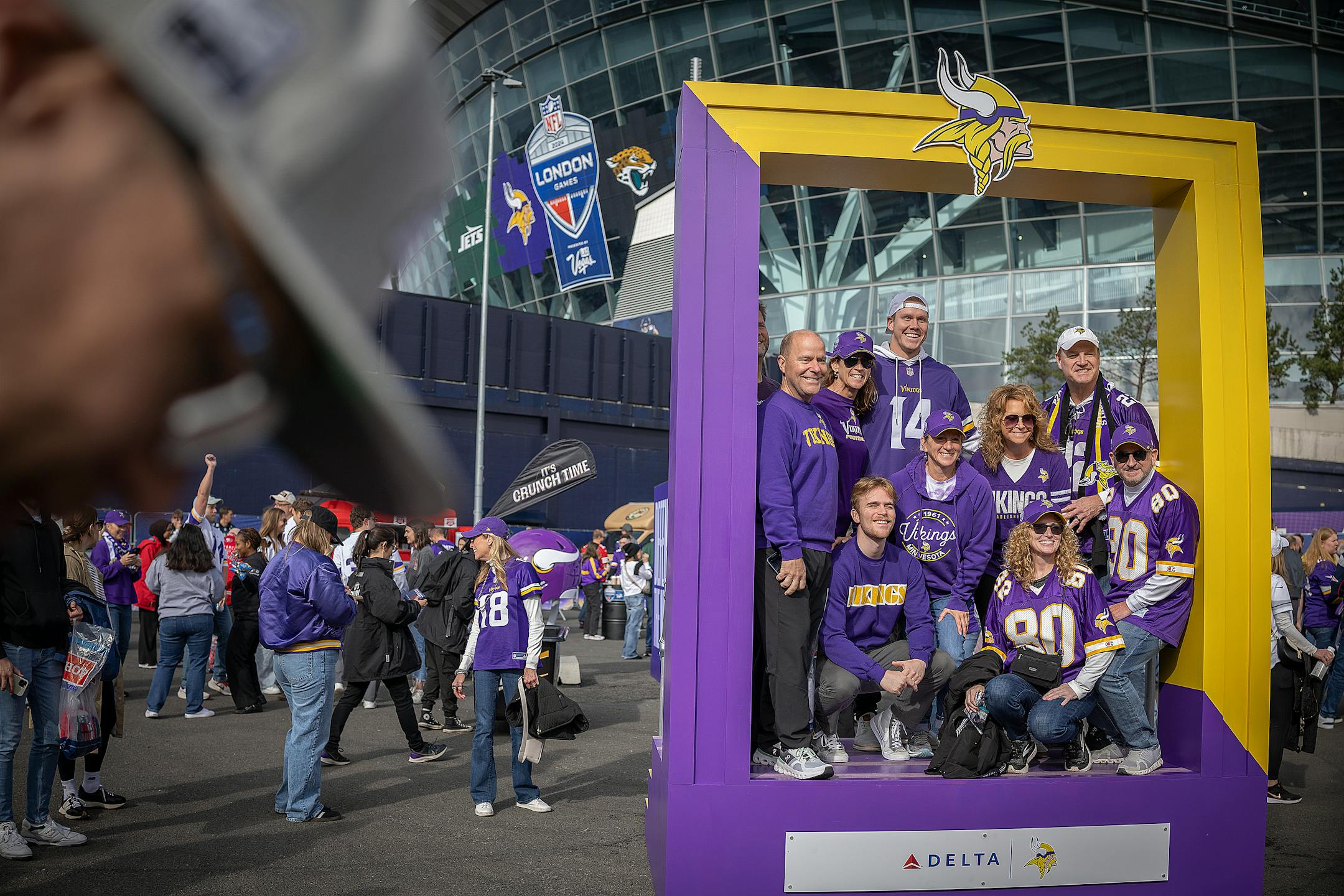
Vikings fans make their way through Tottenham Hotspur Stadium before last year's game in London, where the Vikings next week will play for the fifth time since 2013. (Elizabeth Flores/The Minnesota Star Tribune)

‘How did you pull it off?’

If Goodell gets his wish for 16 international games — and the commissioner is certainly savvy enough not to say things in public he hasn’t already talked about with owners in private — it could lead to each of the league’s 32 teams playing an annual international game. In even-numbered years, NFC teams would give up a home game, and in odd-numbered years, AFC teams would give up a game.

It might mean teams doing what the Vikings did this year, playing consecutive games as the road team in international cities. For the Vikings, a two-game road trip is also a means to square their international ambitions with a stadium lease that limits how many home games they can relinquish.

The team’s 2013 lease with the Minnesota Sports Facilities Authority stipulates that the Vikings can move only one more home game abroad until 2030, and can play three home games internationally from 2031 to ’45. The Vikings could attempt to renegotiate that deal to allow for more international games, but the MSFA likely won’t be keen on losing games at U.S. Bank Stadium. So, if the NFL asks teams to give up more home games and the Vikings are contractually prohibited from doing so, they could opt for two-game swings as the road team to do their part for international expansion.

It certainly seems like the league is interested in watching the Vikings over the next two weeks and soliciting their feedback on whether the arrangement was workable.

“We don’t know what the future holds in terms of international games as those potentially grow, and whether there could be more back-to-backs in the future,” O’Reilly said. “But along with what the Jaguars have done previously [playing back-to-back weeks in London], and then this year with the Vikings, this is a chance to learn what that experience is for the clubs, what that experience is for fans and partners. With the football side, obviously, [it’s] the most critical thing to always get right, and the focus at the center of any discussion.”

The league won’t root outwardly for teams this weekend, but if the NFL wants to further explore having teams play back-to-back international games, a pair of victories for the Vikings in Dublin and London certainly wouldn’t hurt the league’s sales pitch.

In that case, the colleagues who called Williams to joke, “What did you guys do to the NFL to get this?” might be the ones dialing him back to ask, “How did you pull it off?”

“We’ve looked it at like, this is going to happen more often. The NFL is increasing their brand globally,” Williams said, adding. “Even the Minnesota Vikings brand [values] being over there more.”

A street in Dublin is decorated for the Vikings-Steelers game there on Sunday. (Frank Augstein/The Associated Press)

Sign up for the free Access Vikings newsletter to get exclusive analysis from Ben Goessling in your inbox every Friday. Subscribe to the Access Vikings podcast on Spotify, Apple Podcasts and YouTube.

about the writer

about the writer

Ben Goessling

Sports reporter

Ben Goessling has covered the Vikings since 2012, first at the Pioneer Press and ESPN before becoming the Minnesota Star Tribune's lead Vikings reporter in 2017. He was named one of the top NFL beat writers by the Pro Football Writers of America in 2024, after honors in the AP Sports Editors and National Headliner Awards contests in 2023.

See Moreicon

More from Vikings

See More
card image
Elizabeth Flores/The Minnesota Star Tribune

Vikings receiver Justin Jefferson said this season is among the most difficult of his career, but he wouldn’t call it a waste of one of his prime years.

card image
card image