That blur you see in the No. 2 Vikings jersey is making the most of his second chance

Vikings defensive coordinator Brian Flores is drawn to players looking to prove people wrong. Undersized cornerback Isaiah Rodgers, with a gambling suspension on his résumé, is just that type of player.

The Minnesota Star Tribune
October 19, 2025 at 4:13AM
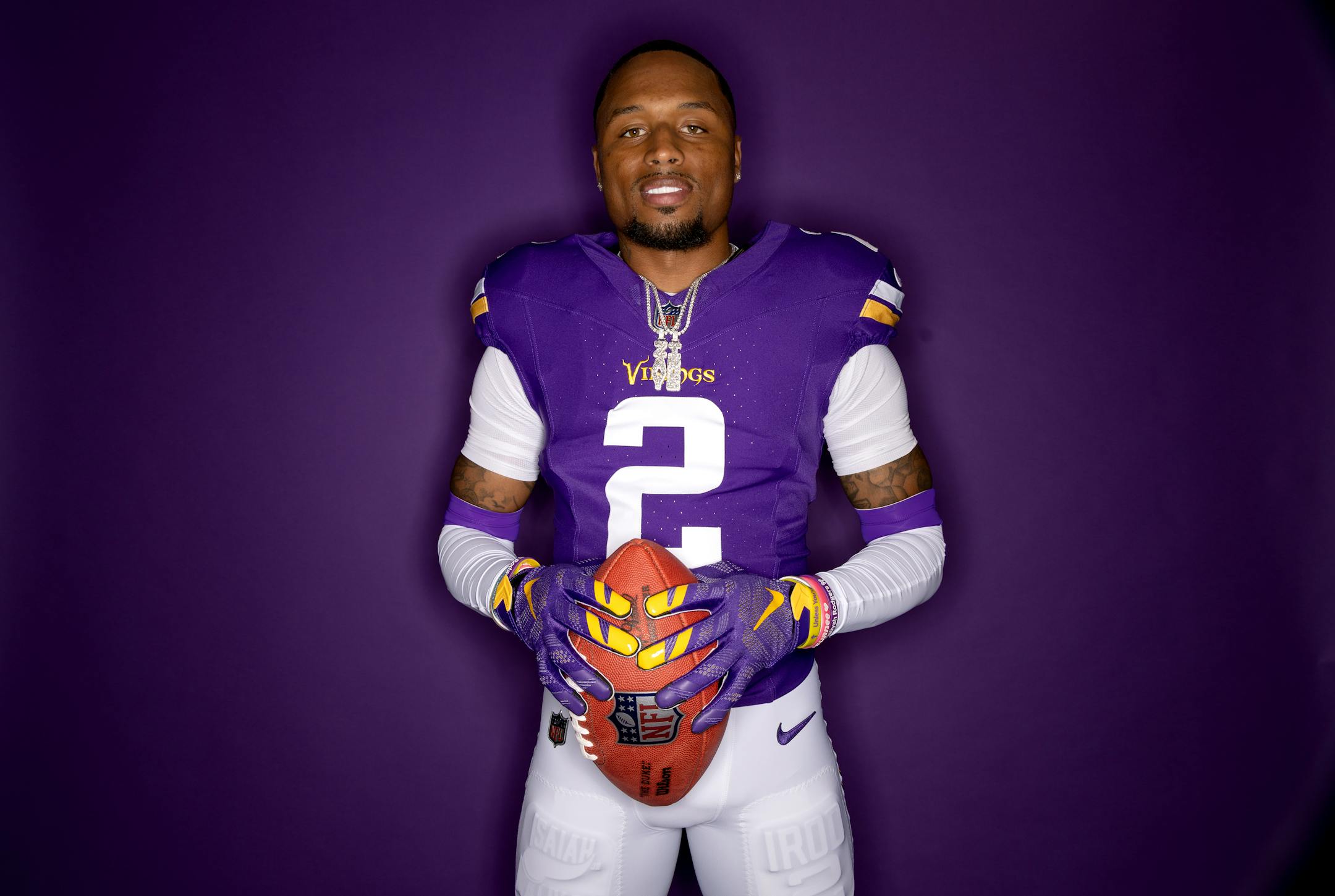
Vikings cornerback Isaiah Rodgers said that "instead of trying to prove all the doubters wrong, I try to prove people who believe in me right.” (Carlos Gonzalez/The Minnesota Star Tribune)

Isaiah Rodgers sprinted diagonally across the Croke Park grass, in furious but ultimately vain pursuit of DK Metcalf, the Steelers receiver who ran a 10.37-second 100-meter dash while trying to qualify for the U.S. Olympic trials four years ago.

Rodgers, the reigning NFC Defensive Player of the Week at the time, wore a white Vikings jersey with the number 2, which he’d picked for the first time in his career after signing with the Vikings in March. He’d played a season in Philadelphia, winning a Super Bowl title with the Eagles after the 2023 gambling suspension that paused his career for a year and prompted his exit from the Colts. But the two-year, $11 million deal he received from the Vikings to be a starting cornerback was what Rodgers regarded as his second chance.

“People may view it like, ‘OK, his second chance could have been in Philly, coming back after the suspension,’ ” Rodgers said. “But I didn’t have that second chance I wanted, with me going into my contract year with the Colts, projected to be that starting guy. That was my first chance. I felt like coming here was most likely gonna be my second chance, finally being back to the player I want to be and showcasing my talents.”

That’s why he picked No. 2.

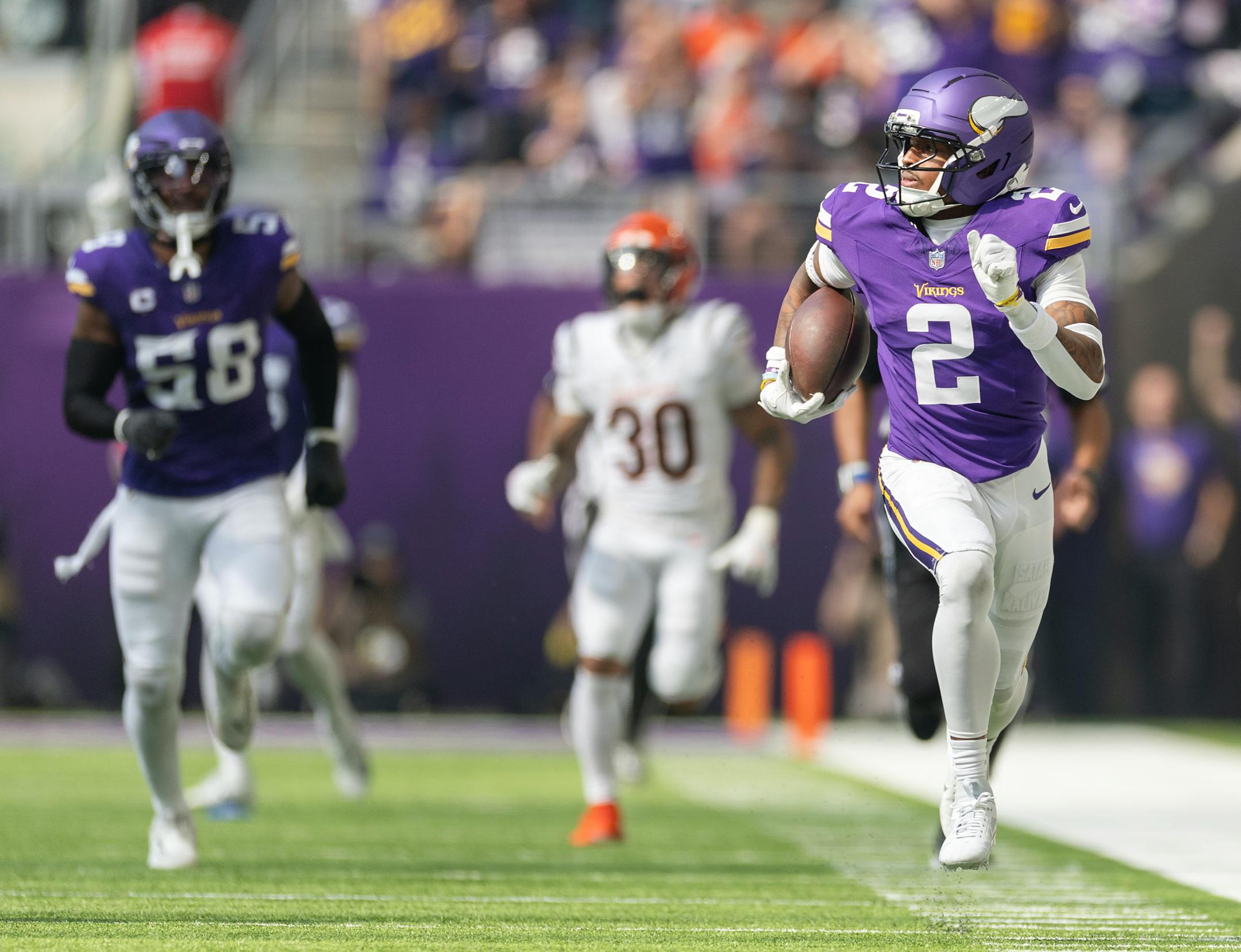
Already in five games that jersey number has flown across the field faster than any in the NFL’s eight years of tracking player speeds, and reached the U.S. Bank Stadium end zone twice in a sequence never before accomplished in league history. Rodgers will wear it Sunday against a team he hadn’t planned to leave, while playing for a team that might keep him for a long time.

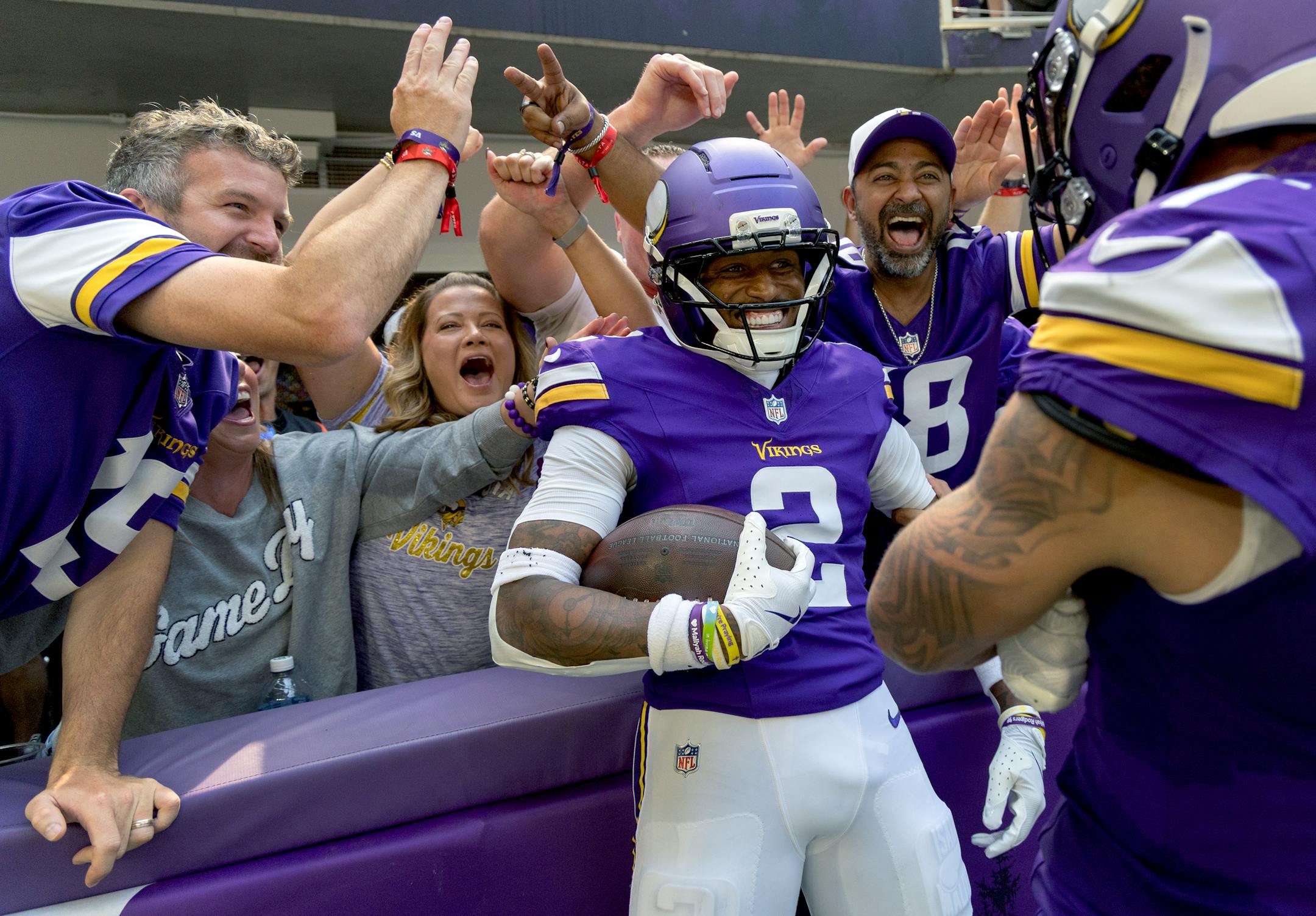
The 27-year-old cornerback has so far made the most of his second chance, becoming one of the steals of NFL free agency with a combination of playmaking and coverage skills the Vikings’ secondary badly needed. He won Defensive Player of the Week honors in Week 3 after becoming the first player in NFL history to finish a half with two forced fumbles, as well as fumble and interception returns for touchdowns. After that week’s 48-10 win over the Bengals, Pro Football Focus made Rodgers the first player to record a perfect 99.9 game score since it started grading players in 2006.

The next week in Dublin, he raced off the left side of the Steelers’ line to block Chris Boswell’s 30-yard field goal attempt. While chasing Metcalf on his 80-yard touchdown, Rodgers recorded a top speed of 23.32 miles per hour, the fastest speed NFL Next Gen Stats had recorded since it began tracking player data in 2017.

View post on X

“For me, the biggest thing that stood out was his ball skills and his ability to run,” Vikings defensive backs coach/passing game coordinator Daronte Jones said. ”We’ve been fortunate in the past with guys that have had ball skills, like Pat P. [Patrick Peterson] and Steph [Gilmore]. But the combination of that and the speed, and the coverage ability he provides, was what we felt could help us defensively."

ADVERTISEMENT

The Vikings needed only a modest deal to sign the 5-foot-10 cornerback whose stature had limited college interest in him to programs like UMass and meant he lasted until the 211th pick of the 2020 draft.

His second chance came from a coordinator who’s been drawn to players looking for a shot to prove people wrong. Vikings defensive coordinator Brian Flores had “that look in his eye,” as coach Kevin O’Connell has put it, when detailing his vision for what Rodgers could become in Minnesota. After the show of faith, Rodgers regards his time with the Vikings as a chance to reward them.

“I‘ve been waiting on this my whole career,” he said. “Like, every scout or whatever that said, ‘Isaiah’s small; he can’t play in this league, he can’t play a whole full season,’ instead of trying to prove all the doubters wrong, I try to prove people who believe in me right.”

Vikings cornerback Isaiah Rodgers (2) returns an interception for a touchdown against the Bengals on Sept. 21. (Elizabeth Flores/The Minnesota Star Tribune)

Very fast, but ‘too small’

Rodgers had passed off Metcalf and dropped into an underneath zone on the left side of the Vikings defense when he saw the receiver catch a throw between linebacker Eric Wilson and safety Harrison Smith and sprint from the left hash toward the right sideline. Metcalf reached 21.17 mph on the touchdown. Rodgers, who covered 67 vertical yards and more than 40 yards of width from the left numbers to the right sideline, had gone faster.

After the speed was announced, Lafayette College football performance director Joel Reinhardt, who was at UMass when Rodgers played there, saw his phone light up with texts from his former colleagues on the Minutemen staff. When Rodgers was in college, Reinhardt said, they’d clocked him at 23.5 mph in a game.

Rodgers shrugs and says matter-of-factly, “I was faster in college.”

He wasn’t always the fastest in his family. Speed coursed through the Rodgers family’s genes, with his older sister Deja becoming a sprinter at Murray State and his cousin Dominique Rodgers-Cromartie running a 4.29-second 40-yard dash at the 2008 NFL combine before the Cardinals took him in the first round.

“I used to get kind of bullied, because my sister was faster than me,” Isaiah Rodgers said. “I was just trying to catch up with them.”

When he was trying to make sense of the world after the death of his father, Craig, who was killed in a confrontation with police when Isaiah was 15, sports became his outlet.

He honed his speed as a sprinter on the track and field team at Blake High School in Tampa, and in the fall he became the one the Yellow Jackets called on to neutralize an opposing player whose speed had been touted in scouting meetings. “And then we’d play the game, and I’d be like, ‘He’s not that fast to me,’ ” Rodgers said.

Starting for the first time as a junior, Rodgers intercepted four passes while also playing receiver and returning kicks. He reached the first of his two Florida state track meets. But he was only a two-star recruit in football because of a familiar theme: his size.

He weighed less than 140 pounds when he graduated from high school. Schools like Oregon State and South Florida came to see him but left unconvinced.

“I literally was told to my face I was too small,” he said. “I think my heart was bigger than my physical frame. I kept going and realizing that if I make it to the big leagues, they’ll wish they took a chance on me.”

UMass, then an independent, was the first team that did. “They believed in me,” he said. “I wanted to show guys from Tampa, ‘It doesn’t matter your size; you can still go Division I.’ That’s how I view UMass. It wasn’t about wins or losses or this program that has the most championships. I wanted to go somewhere where I was going to be able to play.”

Rodgers was starting by his third game for the Minutemen. He intercepted 11 passes in four years, returning three for touchdowns, and led the nation in kick return yards while bringing a punt back for a touchdown as a senior.

Still, there was no invitation to the NFL combine. Scouts thought he might be a return man, but at 170 pounds he was too small to be an every-down corner. His agency organized a pro day for him in March 2020, scrambling to find space with facilities closing in the early days of the pandemic and enlisting former Titans scout Richard Shelton to oversee it.

Rodgers-Cromartie was there to watch his cousin eclipse his 40 time with a 4.28. The time was considered unofficial, since it wasn’t recorded by current NFL scouts, but as video of the session started to circulate through the NFL ecosystem, coaches began to notice.

Jones, who scouted Rodgers through the 2019 season while working for the Bengals, already knew about him. He called UMass defensive backs coach Aazaar Abdul-Rahim, whom he knew from growing up in the Washington, D.C., area, to ask about Rodgers before the draft.

Abdul-Rahim is now the co-defensive coordinator at Maryland. When the Vikings had their eye on Rodgers this spring, Jones called him again. Their conversation centered on two things: Rodgers’ confidence and calmness in coverage.

“He’s never stressed in coverage, or when the ball comes his way,” Jones said. “You never want a DB that’s stressed, so you have to coach that out of someone. But most DBs who can run and have ball skills are confident, so he’s not unusual in that way.”

When he watches Rodgers in coverage now, Jones finds he can exhale, too. It all comes back to the speed.

“When you have a guy who can run with their guy, it helps calm that down,” Jones said. “Now, the ball may still go up, and he’s still got to make the play. But it won’t be because he can’t run.”

Vikings cornerback Isaiah Rodgers celebrates with fans after returning a fumble for a touchdown against the Bengals. (Carlos Gonzalez/The Minnesota Star Tribune)

Moving into a bigger role

The Vikings filled Rodgers’ contract offer with incentives that could push its value as high as $15 million. He’d been a fan of Flores since his days in college, watching the Patriots while he was at UMass. Now he was sitting across from the coordinator, hearing the vision Flores had for Rodgers in the Vikings defense.

“It’s a bigger role than he’s had in the past,” Flores said. “But there’s some other circumstances, reasons why he hasn’t gotten those opportunities. But, you know, he’s confident. I had confidence in him.”

Rodgers had expected he’d have a chance like this after the 2023 season. He’d started nine games for the Colts in 2022 after being named to the NFL’s all-rookie team in 2020, and was set up to land a multiyear deal in free agency if he thrived in a contract year.

Then he was suspended by the NFL for the 2023 season after the league found he had violated its gambling policy by placing bets from the Colts’ facility and betting on his own team (including a $1,000 prop bet on how many rushing yards Jonathan Taylor would have in a particular game). The Colts waived Rodgers shortly after the June 2023 announcement, and though he signed with the Eagles two months later, he would have to sit out the season.

Rodgers told ESPN’s “Outside the Lines” in January 2024 the bets were mostly in the $25 to $50 range and were made on behalf of family members who lived in Florida, where sports betting at the time was not legal like it was in Indiana. But there was no ambiguity about the rules. He would have to serve his time.

“My cousin told me, ‘Your name is everywhere now. Good or bad, it’s how you respond to it,’ ” Rodgers said. “I knew that no matter what happened before, everything I would do after this would probably override that.”

He learned to laugh at the inevitable jokes the suspension would bring. “It’s always gonna be a thing,” he said. “Like, even I joke about it. I don’t say the word ‘bet.’ Little things like that, looking back at how young and dumb I was at the time. But rules are rules. You’ve got to do your time.”

He landed with a team that won Super Bowl LIX as Rodgers, who started three games in the regular season, had his biggest moments in the playoffs. He returned a Kyren Williams fumble 40 yards in Philadelphia’s divisional-round win over the Rams and broke up a third-down throw that forced a Chiefs punt in the first quarter of the Super Bowl.

He relished the run with the team that “welcomed me with open arms” and thought of returning in 2025, possibly to a starting spot if Darius Slay left in free agency. But the Vikings made him their first free-agent signing, offering the chance to work with Flores in the role he’d been waiting for.

Rodgers has played 93% of the Vikings’ snaps this season; he’s on pace for a $1.5 million bonus, with the chance for additional incentives if he’s named to the Pro Bowl or an All-Pro team. If he stays healthy and continues to perform as he has, both seem possible.

For now? He’ll don his No. 2 jersey Sunday, playing pregame catch with the fans at U.S. Bank Stadium who throw footballs for him to sign. Then, he’ll line up to start for the team that gave him what he’d always wanted.

“I wasn’t the type of guy to go out and ask for $20 million. I know I hadn’t shown that in my career,” he said. “It was more just finally wanting to have a fair chance.”

To get exclusive Vikings analysis from Ben Goessling in your inbox every Friday and complete coverage of every game, sign up for the Access Vikings newsletter.

about the writer

about the writer

Ben Goessling

Sports reporter

Ben Goessling has covered the Vikings since 2012, first at the Pioneer Press and ESPN before becoming the Minnesota Star Tribune's lead Vikings reporter in 2017. He was named one of the top NFL beat writers by the Pro Football Writers of America in 2024, after honors in the AP Sports Editors and National Headliner Awards contests in 2023.

See Moreicon

More from Vikings

See More
card image
Nick Wass/The Associated Press

Daniels, another member of the 2024 quarterback class, is returning from a dislocated left elbow that sidelined him for four weeks.

card image
card image