
Two years after law passed, Minnesota still lacks early prison release program

Advocates say the Department of Corrections is moving too slowly. Officials at the state agency say a cautious approach is needed as they implement the rehabilitative release law.

The Minnesota Star Tribune
October 14, 2025 at 11:17PM
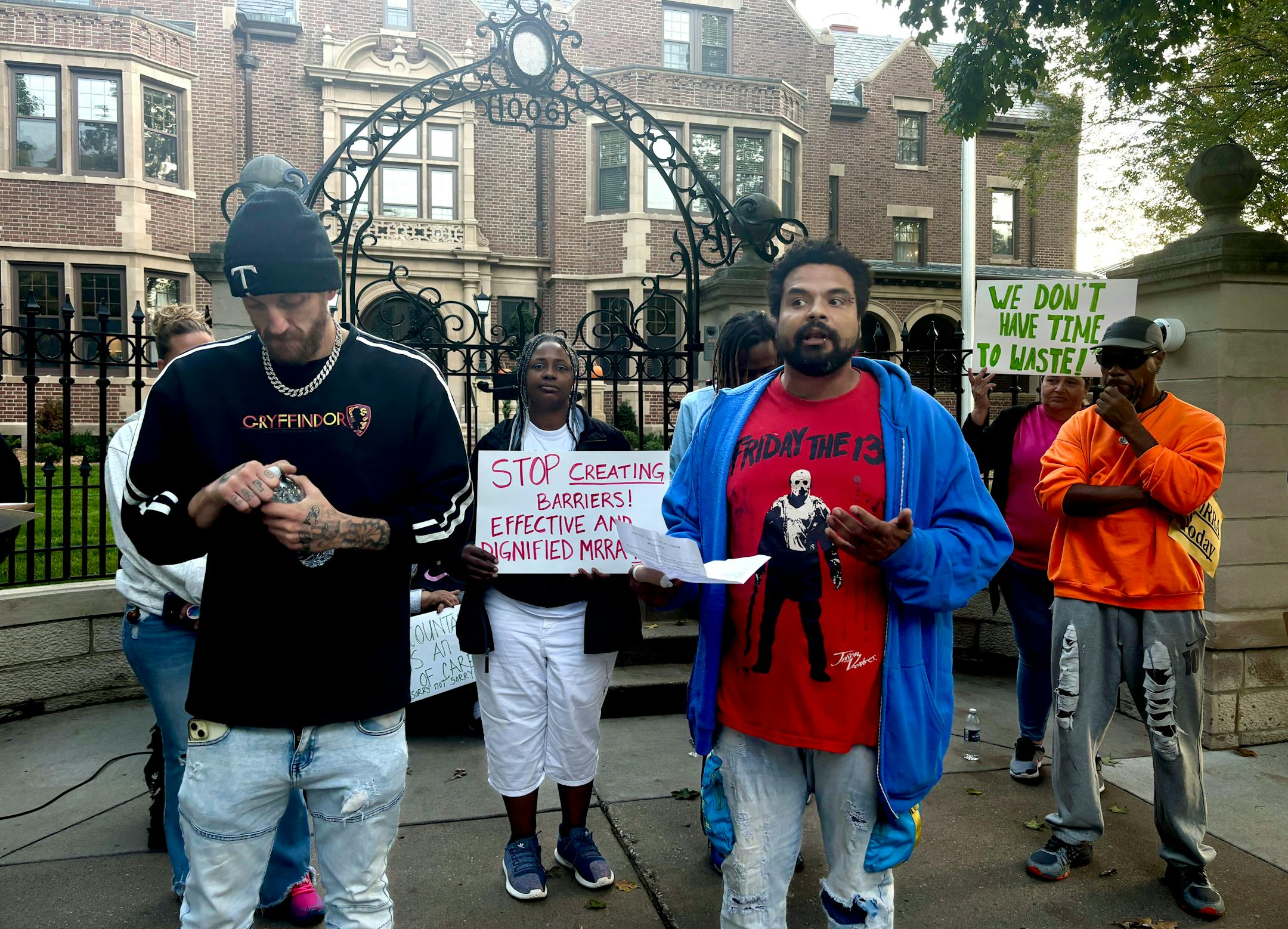
Jermale Kling, a formerly incarcerated advocate with the Minnesota Incarcerated Workers Organizing Committee (IWOC), speaks at a rally outside the governor's residence earlier this month demanding the implementation of the Minnesota Rehabilitation and Reinvestment Act. (Emmy Martin/The Minnesota Star Tribune)

Two years after Minnesota passed a law allowing inmates to shorten their sentences through rehabilitation, only six people have been released — far fewer than advocates expected.

The Minnesota Rehabilitation and Reinvestment Act (MRRA), passed in 2023, allows eligible inmates to reduce their sentences by up to 17% through individualized treatment and education plans.

Yet rolling out the new Department of Corrections (DOC) program has proven more complex than anticipated. Advocates say this has left thousands waiting for early release, despite earlier assurances that the system would be in place by now.

A pilot program slated to begin in February did not fully launch at the Moose Lake and Shakopee prisons until the summer.

The delays have frustrated proponents of the reform.

“Every day that passes without fulfilling this implementation is another day a child grows up without a parent, a job is left without an employee,” said Jermale Kling, a former prison inmate who now works with the Minnesota Incarcerated Workers Organizing Committee (IWOC), which held a small protest last week. “We’re not asking for sympathy, we’re demanding fairness.”

DOC Commissioner Paul Schnell said the department anticipates expanding the program in the coming weeks.

“I recognize and understand people’s frustration, and I will own that responsibility for some of the things that we’re learning because it’s so brand new,” he said. “And yet, I am not going to go to the governor or to the people of Minnesota and say, ‘This program is ready for prime time’ if I don’t believe it is.”

Pilot program’s sluggish start

Efforts to train staff, gather victim input and build the technology to track progress and outcomes have taken longer than expected, Schnell said.

“All of this work has been largely done through very manual processes,” he said.

Before the MRRA passed, Minnesota was one of a dozen states that did not have a rehabilitation program. However, unlike some other states, it uses determinate sentencing, in which individuals serve two-thirds of their prison term in custody and the remaining third on supervised release.

Under MRRA, inmates can work with the DOC to set up individualized rehabilitation plans that include medical or mental health treatment, counseling, education or job training goals. After leaving prison, people can shorten their supervision time by meeting goals like maintaining employment.

The program is not available to inmates serving life sentences.

The pilot program included 17 participants. Of the 11 who received preliminary approval, six have been released, four are still working toward release and one withdrew. Six cases were discontinued, Schnell said.

The department plans to integrate the early release program into each prison’s daily operations.

“This should not be done by a specialized unit,” he said. “This should be built into the very nature of the way we do what we do.”

Delays lead to frustration, confusion

Inmates say the delays have emotional costs. Activists have been protesting the wait even before the change went into effect.

“I saw so many people get their hopes up as far as having release plans to go home, to be called into their caseworker’s office and told, ‘I’m sorry, this isn’t happening. I’m sorry, you don’t qualify. I‘m sorry, the policy is not ready,’” said Darla Holland, who was released from prison five weeks ago after serving a sentence for fraud.

Elijah Milsap, who has been incarcerated for nine years at Oak Park Heights prison on a sex trafficking charge, said the MRRA gives him hope. But he is confused as to what it actually means.

“I think there needs to be clearer qualifications as far as what you get for the programs that you do,” he said.

With the closure of Stillwater prison, Milsap said he thinks the DOC should be more motivated to speed up the implementation of the MRRA to open up bed space.

Questions about racial equity in pilot

Only three of the 17 who participated in the pilot program were people of color — two Native Americans and one of Asian descent. Two of them were released.

Bobbi Holtberg, executive director of the Minnesota Alliance on Crime, said her coalition, which works closely with the Department of Corrections, will be monitoring the agency as it expands the program to ensure it better reflects the demographics of Minnesota’s prison population, she said.

The incarcerated population is 48.5% white, 39.4% Black, 9% Native and 2.7% Asian, according to July data from the DOC.

Holtberg said racial disparities in disciplinary actions behind bars could be one reason so few people of color were included in the pilot.

“Discipline weighs pretty heavily on whether an individual is eligible for MRRA,” she said. Schnell confirmed that disciplinary history is a factor in determining eligibility.

Holtberg said her organization is concerned that the policy “perpetuates the thought that Black incarcerated individuals are more dangerous — and that isn’t true."

DOC builds reform from the ground up

Schnell said the department also is working to engage crime victims — locating them, gathering their input and ensuring their feedback is incorporated into each person’s rehabilitation plan.

Holtberg said her organization supports the intent of the MRRA but wants to ensure victims are included early and meaningfully. The Minnesota Alliance on Crime and other victim service coalitions have been meeting with the DOC since before the law was passed.

“We believe wholeheartedly that by addressing individual rehabilitative needs, it increases safety and helps victim survivors,” Holtberg said.

Savings from reduced incarceration costs will be reinvested in victim services, community supervision, crime prevention and the state’s general fund.

A spokeswoman for Gov. Tim Walz’s office said the DOC is doing its “due diligence to consider victim impact.”

Walz’s “No. 1 bottom line proposition [is] he wants it done right,” Schnell said. ”He wants it done to produce better public safety outcomes. That was the explicit goal, and that’s what we want to deliver on.”

Families want faster rollout

Advocates and families, however, said the state’s pace undermines the law’s intent to reward rehabilitation and reintegration.

David Boehnke, an organizer with IWOC, said his group estimates at least 1,000 people qualify for release under the program. Schnell said he could not verify that figure or provide his own estimate, noting that the MRRA is an individualized program.

Kya Concepcion, with the racial and environmental justice organization Black Visions, said the “policy on paper isn’t freedom in practice” and called on the DOC to publish a detailed implementation timeline.

Schnell said that’s something the department is working on, with plans to begin by prioritizing people convicted of crimes that are not victim-related.

“We have to stop looking at it as rewarding the offender and start thinking about what is going to result in greater public safety,” Holtberg said.

about the writer

about the writer

Emmy Martin

Business Intern

Emmy Martin is the business reporting intern at the Minnesota Star Tribune.

See Moreicon

More from Business

See More
card image
Provided by Exact Sciences

The late Dr. David Ahlquist co-invented ColoGuard, which is helping drive Abbott Laboratories’ acquisition of Exact Sciences. After an ALS diagnosis in 2019, Ahlquist wasn’t done inventing.

card image
card image
