
Longtime advocate will steer Minnesota’s office for missing and murdered Native people

Guadalupe Lopez, an enrolled Leech Lake Band member, said her 25 years of advocacy is rooted in her youth.

The Minnesota Star Tribune
October 8, 2025 at 8:49PM
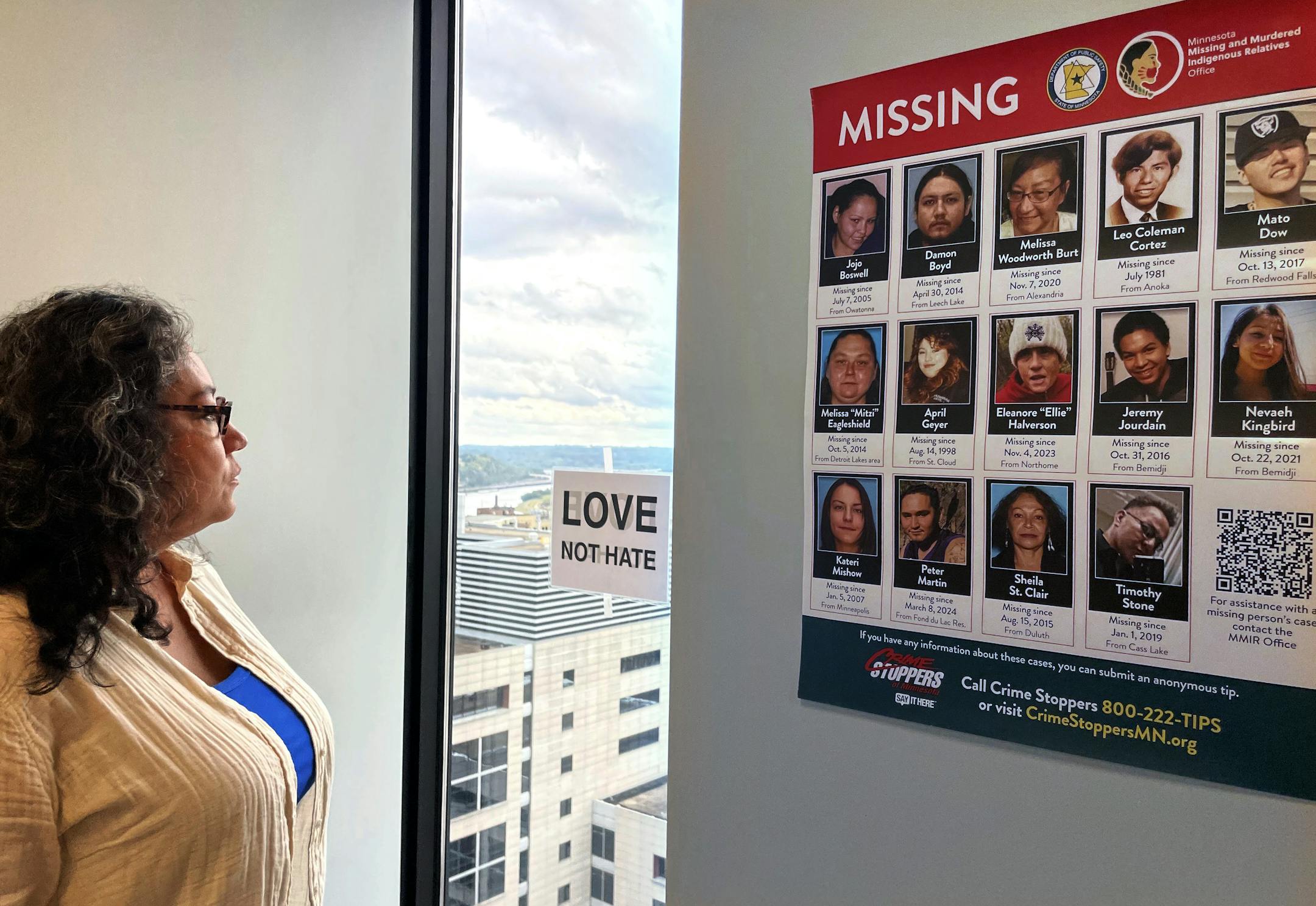
Guadalupe Lopez keeps the Missing and Murdered Indigenous Relatives posters — with 14 faces representing 14 unsolved cases and 14 families searching — in her St. Paul office. (Kim Hyatt/The Minnesota Star Tribune)

Guadalupe Lopez first learned to be an advocate as a kid helping her late mother, an American Indian boarding school survivor diagnosed with lupus.

“I had to learn how to navigate a lot of different systems — medical systems, social service systems — at a very young age” she said. “It gave me these leadership skills that I didn’t expect to have.”

Lopez has since built a 25-year career advocating for women, particularly Indigenous women. As new director of Minnesota’s Missing and Murdered Indigenous Relatives Office (MMIR), her mission is to reduce and end violence against Indigenous people.

The role aligns with her legacy of working in racial equity and gender-based violence. For 17 years, Lopez worked for the Minnesota Indian Women’s Sexual Assault Coalition, and in 2021, she became executive director of Violence Free Minnesota, a statewide nonprofit coalition.

“I am a huge fan of Guadalupe’s work,” said Jen Polzin, CEO of Tubman, the state’s largest provider of domestic violence shelter beds. “I’m excited to see how she can really help close the gap and give a larger, louder voice to the disproportionate impact on Indigenous communities.”

Native Americans make up 1% of Minnesota’s population, yet comprise nearly 10% of missing-person cases. The Centers for Disease Control and Prevention says murder is the third-leading cause of death among Indigenous women.

(Sign up for the Minnesota Star Tribune’s Lakes Country newsletter, covering Brainerd, Bemidji and beyond.)

Lopez is the third woman appointed to lead the MMIR office in St. Paul since it opened in 2021. It’s the first office of its kind in the nation. A sister office in Minnesota is modeled after it: the Missing and Murdered Black Women and Girls Office, which opened in 2023 and is also the first in the country.
As an enrolled member of the Leech Lake Band of Ojibwe who grew up in St. Paul, Lopez said leading the office feels like coming home.

“Being in Native communities is near and dear to my heart, and that’s where I feel the most connection and helpful,” she said. “It’s where I’m supposed to be. All roads led here.”

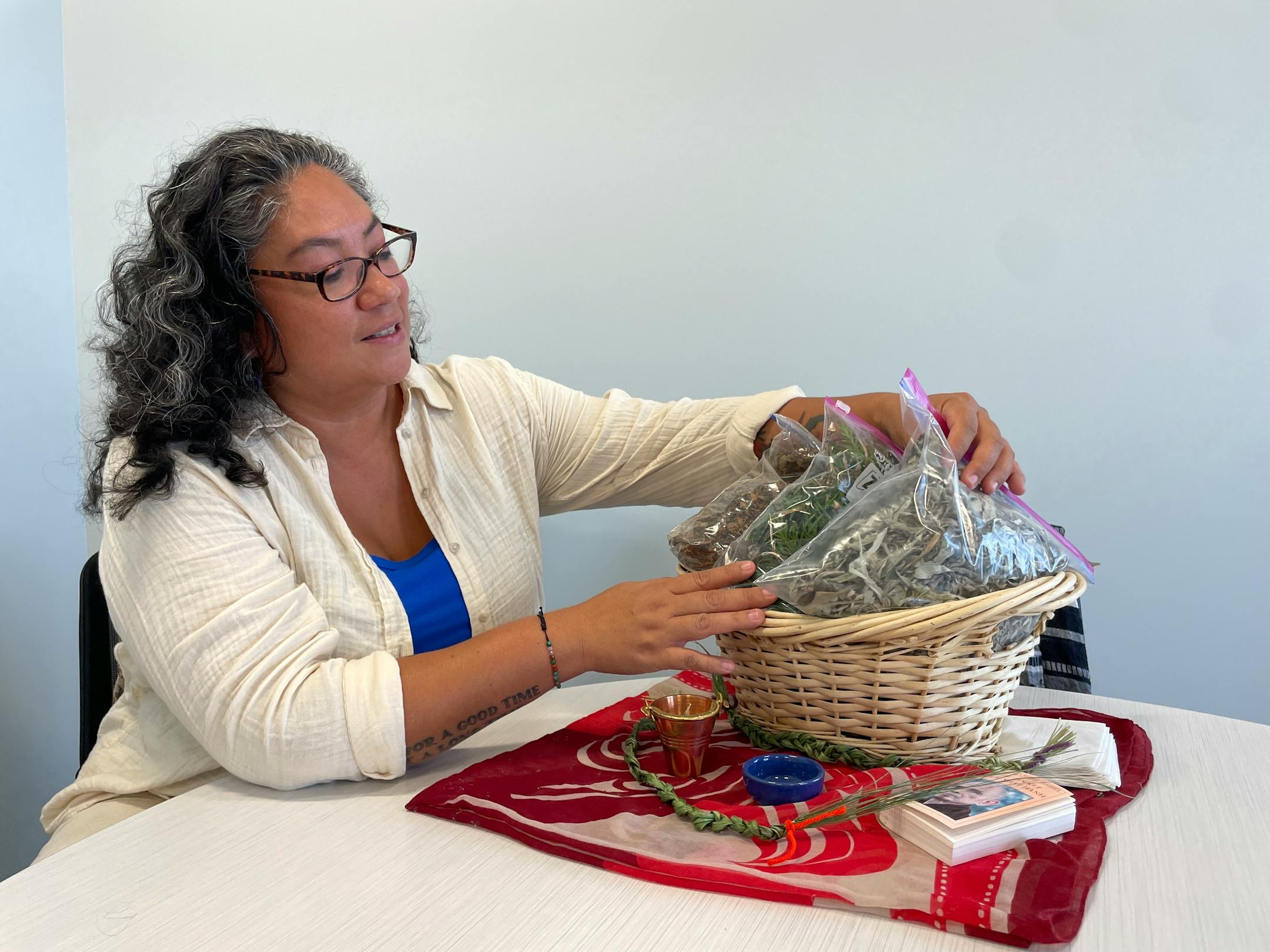
Guadalupe Lopez keeps sage and tobacco in her office for her team to use for spiritual self-care. (Kim Hyatt)

Lopez’s mother was Anishinaabe and her father is from Mexico. Homages to both cultures fill her new office in St. Paul.

Sage and essential oils in brightly colored bowls from Mexico are medicines for her team. Lopez prioritizes spiritual self-care to support families through her office, housed within the Department of Public Safety.

St. Paul is where Lopez’s advocacy career began at a shelter, Women of Nations. She was soon promoted to work with survivors filing orders for protections and domestic abuse no-contact orders.

Now she’s tackling system changes.

She will oversee a $774,000 annual budget and staff of four tasked with serving the entire state and its 11 tribes.

But there are misunderstandings about the role of the office, she said. It isn’t a law enforcement agency solving cases. Rather, it supports families and raises awareness of MMIR.

“We are definitely a connector,” she said. “We are not an investigative office, but it is important to make sure that we have those relationships with law enforcement so that we can be a liaison to families.”

In addition, she will help craft and advocate for policies, maintain communication with Public Safety officials on cases and coordinate with federal efforts such as the Bureau of Indian Affairs’ Cold Case Office.

There are many avenues of awareness, from specialty license plates that help fund the office, to a recently launched newsletter and tip reward fund. The office hosts marches and distributes search kits to reservations around Minnesota.

Then there are MMIR’s missing-person posters, with 14 faces representing 14 unsolved cases and 14 families searching.

Lopez has built close relationships with many of the families and also has a personal connection to such loss.

In 2018, Lynnae Leigh Strong was shot and killed in a St. Paul convenience store, but the shooter was never charged. Strong’s mother, Roberta, is like a mother to Lopez, particularly after her mother, Bernice Marshall, died from lupus in 2004.

With Strong’s murder, she saw firsthand the need for supporting families, Lopez said.

That trauma is compounded with historic injustices done to Native Americans, like her mother who was sent to the Pipestone Indian Training School as a child, Lopez said.

She said her mission is personal and rooted in love and loss, courage and resilience. To find solutions, she said it’s going to take everybody, not her office alone.

“We need all the medicine people. We need all the police officers … everybody with the gifts to honestly bring this epidemic to a close.”

Sofia Barnett of the Minnesota Star Tribune contributed to this story.

about the writer

about the writer

Kim Hyatt

Reporter

Kim Hyatt reports on North Central Minnesota. She previously covered Hennepin County courts.

See Moreicon

More from Politics

See More
card image
Mark Schiefelbein/The Associated Press

A Navy admiral commanding the U.S. military strikes on an alleged drug boat in the Caribbean told lawmakers Thursday that there was no ''kill them all'' order from Defense Secretary Pete Hegseth, but a stark video of the attack left grave questions as Congress scrutinizes the campaign that killed two survivors.

card image