
Push to solve cases of missing, murdered Indigenous people finally gets reward fund

Lawmakers allocated $250,000 in the 2022-2023 legislative session to initiate the tip fund that sat untouched until now.

The Minnesota Star Tribune
July 23, 2025 at 11:20PM
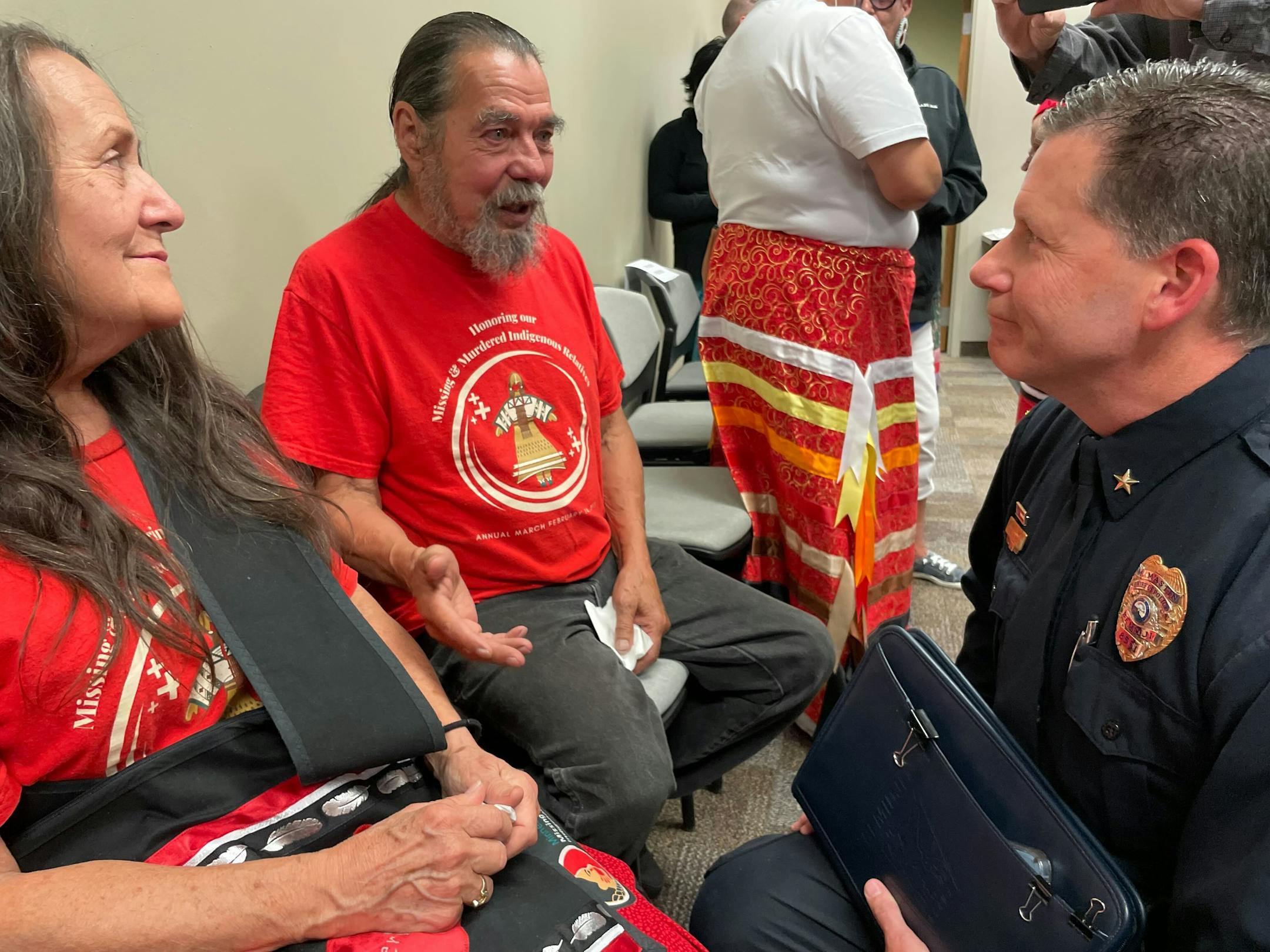
Bemidji Police Chief Mike Mastin talks with Kathy and Ira Mishow Sr., whose daughter Kateri Mishow went missing 18 years ago. Mastin joined officials Wednesday at the Department of Public Safety headquarters in St. Paul to announce a reward tip program for unsolved cases of missing and murdered Indigenous people. (Kim Hyatt/The Minnesota Star Tribune)

Two years after the state established a reward fund for information on unsolved cases of missing and murdered Indigenous people, leaders announced Wednesday that the program is officially open for tips.

It’s called the Gaagige-Mikwendaagoziwag Reward Fund, an Ojibwe phrase that translates to “they will be remembered forever.” Minnesota’s Missing and Murdered Indigenous Relatives (MMIR) Office, the nation’s first of its kind, oversees the fund, which some critics say was too slow to be launched after the MMIR Office opened in 2021.

“I think they dropped the ball,” said Jana Sweeney Williams, whose niece died suspiciously in Minneapolis last year. “Truly, time is of the essence when it comes to our communities.”

Lawmakers allocated $250,000 in the 2022-2023 legislative session to start the tip fund, and another $100,000 poured in this past year from sales of 4,500 specialty MMIR license plates. Until now, that pot of money sat untouched.

“Two years might not seem very long or important to other people … but it’s like forever,” said Theresa Jourdain of Cass Lake, who has been waiting nine years to know what happened to her son, Jeremy Jourdain.

He was 17 when he disappeared from Bemidji in 2016. Five years later, 15-year-old Nevaeh Kingbird disappeared from the same part of town.

The pair represent a fraction of Minnesota’s unsolved missing Indigenous people cases. Rates of violence are disproportionately higher in Indian Country, especially toward Native American women.

Of 716 missing Indigenous persons cases in the state last year, 57% were women. The MMIR office has 22 active cases that have completed the intake process; 16 of them are eligible for rewards up to $10,000.
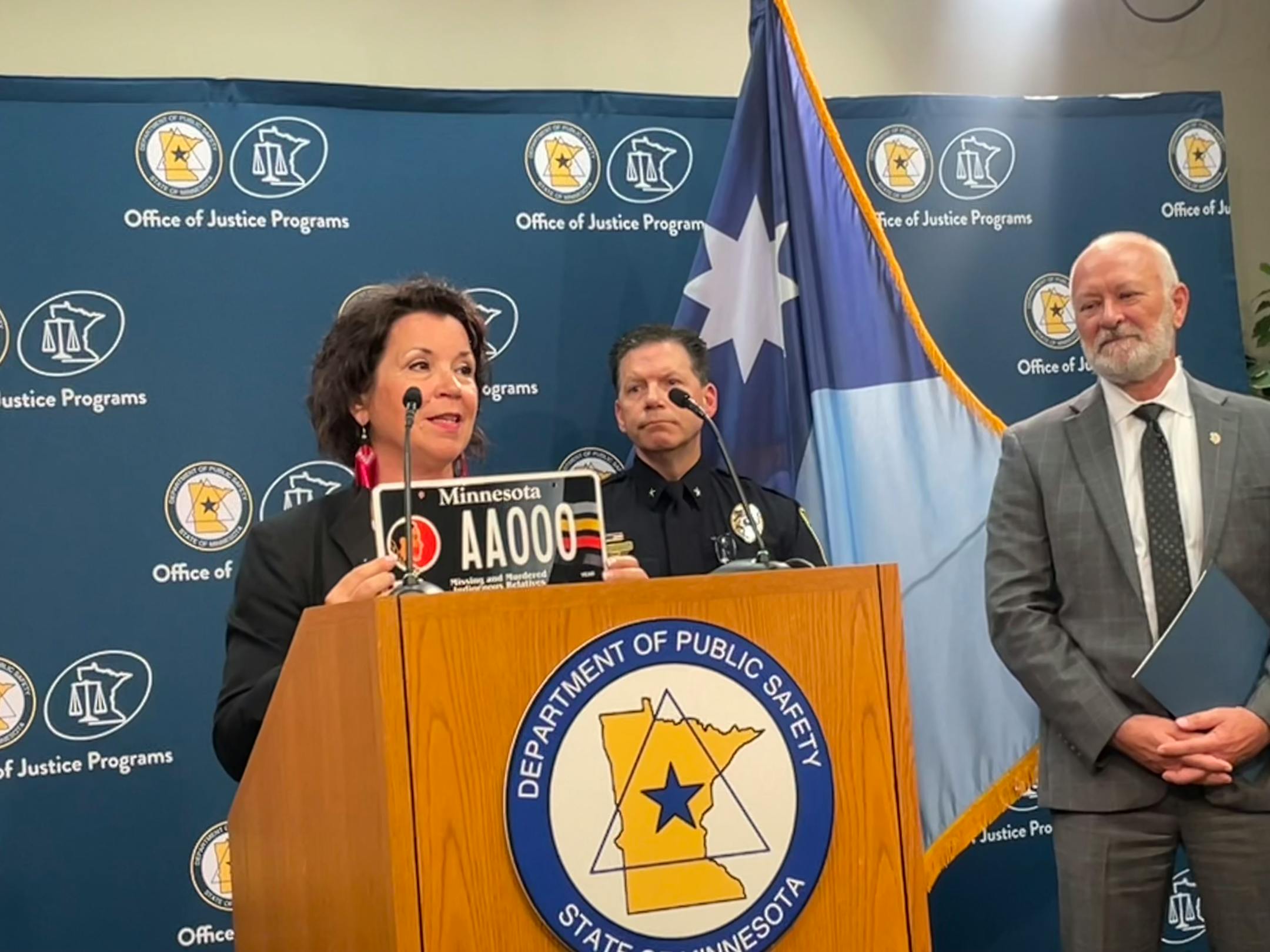
The reward funds were unveiled Wednesday at the Minnesota Department of Public Safety headquarters in St. Paul, where the MMIR Office is housed. Officials hope the money will help find answers for anguished families.

“Those two have been missing for far too long,” Bemidji Police Chief Mike Mastin said of Kingbird and Jourdain at Wednesday’s news conference. “It’s time to give these families closure. … This is that final encouragement that people need to share information.”

The MMIR Office does not accept tips. Instead, tips are submitted to law enforcement agencies directly or to Crime Stoppers. While anonymous tips are accepted, any monetary reward requires verification.

Law enforcement agencies determine reward amounts based on how much the information advances the case; up to $2,500 for identifying a person of interest, $5,000 for tips that lead to an arrest and $10,000 for locating remains.

“Sometimes money loosens the tongue. Sometimes it creates a discussion,” said state Sen. Mary Kunesh, DFL-New Brighton, who has championed the state’s MMIR initiatives from the formation of the office to co-authoring legislation to create the reward fund and coming up with the idea for MMIR license plates.

State Sen. Mary Kunesh, DFL-New Brighton, holds up a specialty MMIR license plate at the Department of Public Safety headquarters on Wednesday. Minnesota sold nearly 4,500 of the license plates generating $100,000 in profits to help fund rewards for information on missing or murdered Indigenous people. (Kim Hyatt/The Minnesota Star Tribune)

Kunesh said the reward fund was inspired by advocacy work in Duluth, which established a tip reward fund also called Gaagige-Mikwendaagoziwag.

Ana Negrete, MMIR Office interim director, said a number of factors contributed to the delayed rollout of the reward fund. It needed policies and procedures approved by DPS and an advisory board.

“Unlike Crime Stoppers, we at MMIR cannot directly take tips,” Negrete said. “So it was a matter of collaborating, consulting, reviewing, revising, over and over again.”

Negrete will be replaced next week by a newly appointed MMIR director, Guadalupe Lopez, from the Leech Lake Band of Ojibwe. Lopez recently stepped down as executive director of Violence Free Minnesota.

She will oversee the office, its annual budget of $774,000 from the state, and a staff of four people.

The 16 cases eligible for rewards for information include:

Jojo Boswell, Melissa Burt, Leo Coleman Cortez, Mato Dow, Melissa “Mitzi” Eagleshield, April Geyer, Eleanore Halverson, Jourdain, Kingbird, Allison Lussier, Peter Martin, Taylor Mahto, Kateri Mishow, Frank Ortley, Sheila St. Claire and Timothy Stone.

Relatives of Lussier, Mishow and Ortley attended Wednesday’s news conference. Mishow went missing in 2007 from Minneapolis. Her mother, Kathy, said she hopes the tip rewards will help finally bring closure.

“After she went missing, we received a tip Kateri might be in the river. My husband walked up and down the banks of the Mississippi every day for over a year. He didn’t find an answer. It’s been almost 20 years. We still don’t have any answers.”

about the writer

about the writer

Kim Hyatt

Reporter

Kim Hyatt reports on North Central Minnesota. She previously covered Hennepin County courts.

See Moreicon

More from Bemidji

See More
card image
card image