Vang: One Minnesota woman’s deportation story

She came to Minnesota as a child refugee in the 1980s. Last year America sent her away to Laos, where she didn’t know anyone.

Columnist Icon
The Minnesota Star Tribune
January 10, 2026 at 7:30PM
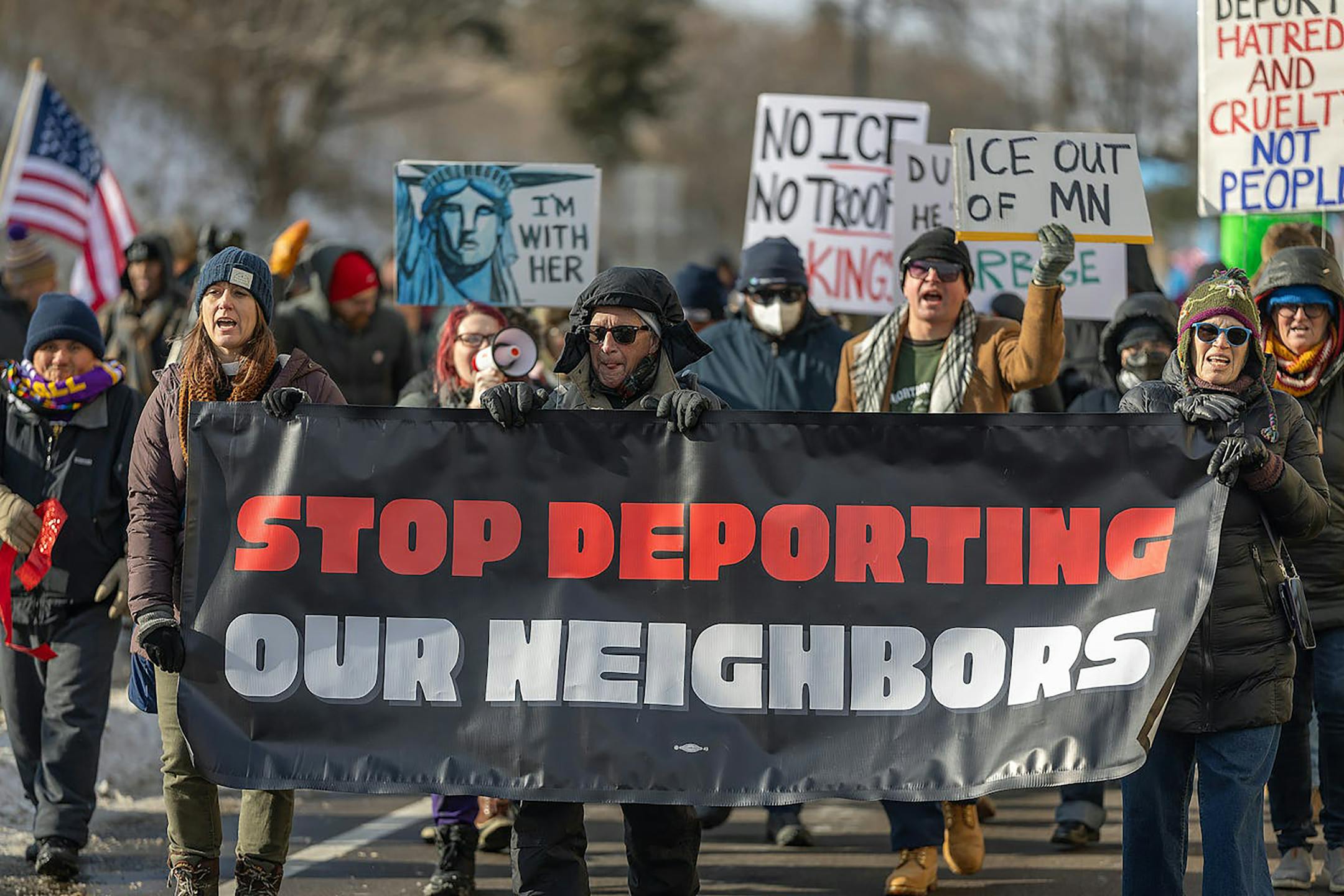
Marchers participate in a protest at Minneapolis-St. Paul International Airport last month: "Hundreds of people were deported to Southeast Asia last year alone," Ka Vang writes. (Elizabeth Flores/The Minnesota Star Tribune)

Opinion editor’s note: Strib Voices publishes a mix of material from eight contributing columnists, along with other commentary online and in print each day. To contribute, click here.

•••

She arrived in America in the early 1980s, part of the wave of Hmong refugees resettled here after the Secret War. Minnesota became her home. She grew up here and lived most her life here. Her family is here. And yet, last year, she was deported to Laos.

She asked that her name not be used due to safety concerns. In Laos, she now lives cautiously and quietly, afraid of drawing attention in a country she barely knows.

I am telling her story because Minnesotans deserve to understand what deportation actually does to a human life — what happens after the headlines fade, after the handcuffs are removed, after someone is forced to leave the only home they remember.

“I feel betrayed by America,” she told me. Though she never became a citizen, she was a lawful permanent resident with the right to work and reside in the U.S.

I am writing about this now because fear has returned to immigrant communities across Minnesota — visibly and unmistakably. Days after the federal government said it was deploying an additional 2,000 immigration enforcement agents to Minnesota, Renee Nicole Good was shot and killed by an ICE agent in Minneapolis. As Department of Homeland Security Secretary Kristi Noem came to Minnesota to publicly double down on an expanded ICE crackdown — framed as targeting fraud and longstanding removal orders — she called Good’s death justified.

History tells us what happens next: When enforcement expands, communities like ours are not pushed to the margins. We are placed directly in the crosshairs.

Asian Americans are often missing from immigration debates, squeezed between simplistic narratives of “good immigrants” and “criminals.” Yet since 2002, more than 17,000 southeast Asians have received final orders of removal, according to MN8, a St. Paul-based organization that advocates for this group. Many arrived as refugee children fleeing war and genocide. They built lives here, raised families here, paid taxes here. Decades later, they were marked for deportation over old convictions — often nonviolent offenses tied to poverty, trauma and youth.

This is true for the Hmong woman I interviewed who was deported to Laos last year. She and I grew up together and I know her well, which is why she agreed to speak to me for this column.

“I don’t want to talk [publicly] about the reason I was deported,” she said. “Those issues have been resolved, and I paid for my crime. Do I think my crime justified being deported? No!”

She described a deportation process that was confusing and deeply dehumanizing.

“I wasn’t sure of my rights because no one clearly explained them to me,” she told me.

She was shackled at her wrists and ankles in detention centers and while being transported. Her journey took her from the U.S. to Georgia, then to South Korea, and finally to Laos. Along the way she traveled with others being deported to India and other parts of Asia.

When she landed in Laos, she was told she needed a local sponsor to leave the detention center, which was also a military base, but which she said felt like a prison. She had no one in Laos to help her. She waited. There was food, she said. A bed.

After a few weeks, her father, who is still in the U.S., found someone willing to sponsor her release after being paid. She told me some deportees choose to stay in the detention center for fear of being homeless, exploited, trafficked or worse.

Outside the gates, there was nothing waiting. No social services. No resettlement agency. No plan.

“This country is not like America,” she told me. “There is no law and order.”

She described how another Hmong man who publicly complained about mistreatment while in detention later disappeared. That story and others have made her fearful about speaking about her experiences.

She spent a month in a hotel, then moved closer to the area where her ancestors once lived — not because family is there, but because it feels faintly familiar. Her entire immediate family remains in the U.S. She is lonely. She is afraid. Trust comes slowly. She avoids other deportees, even as informal networks have formed to help them survive.

“I will stay here for the rest of my life,” she said, crying, barely able to finish the sentence.

She survives now on money sent from family in the U.S. when they can manage it. She also sells artwork — creating something tangible in a place where she feels unmoored.

Groups like MN8 are trying to keep stories like hers from repeating. Since January of last year, its caseload has grown by 600%. Hundreds of people were deported to Southeast Asia last year alone.

Chenda Hing, a digital organizer with MN8, calls it a “double displacement and triple punishment.” First, they were forced from homelands by war, followed by a failed refugee resettlement in America, then returned to countries they no longer know.

A report by Asian Americans Advancing Justice noted that heightened immigration enforcement has disproportionately targeted Southeast Asian refugees, who are three to four times more likely than other immigrant groups to face deportation for old convictions.

Hing first learned about Southeast Asian deportation issues after attending a MN8 rally in 2016 to stop the deportation of eight Cambodians in Minnesota. The Trump administration didn’t care that these individuals carried generational trauma from surviving the “Killing Fields,” where over 1.3 million Cambodians were killed by the Khmer Rouge regime. Many of those targeted, Hing notes, had long since served their sentences and gone on to become caregivers, workers and community leaders. The efforts of the MN8, the detainees’ families and community supporters led to national attention, and eventually three of the eight Cambodian men were released.

Minnesota’s Asian, Latino and Somali communities have seen this pattern before. Immigrants and communities of color feel the pressure tightening again. And as Gov. Tim Walz prepares to leave public office, Minnesotans should be asking who will carry forward this state’s promise of refuge — not just in language, but in action.

The deportation system is like brain fog: paperwork no one explains, flights no one sees, lives erased quietly enough to avoid scrutiny. It assumes the public will stop paying attention once someone disappears.

But the people who vanish are not abstractions. They are the aunties who fed us after school. The elders who survived wars so we could grow up in peace. They carry our stories with them — whether we choose to see them or not.

If Minnesota truly believes in dignity, fairness and justice, this is the moment to stop looking away.

about the writer

about the writer

Ka Vang

Contributing Columnist

Ka Vang is a contributing columnist for the Minnesota Star Tribune. She focuses on historically marginalized communities.

See Moreicon

More from Contributing Columnists

See More
card image
Elizabeth Flores/The Minnesota Star Tribune

She came to Minnesota as a child refugee in the 1980s. Last year America sent her away to Laos, where she didn’t know anyone.

card image
card image