
Taylor Schlitz: Now kids are staging ICE raids in video games

For some in Gen Alpha, role-playing in Roblox might be their first experience with government power.

Columnist Icon
The Minnesota Star Tribune
February 9, 2026 at 11:00AM
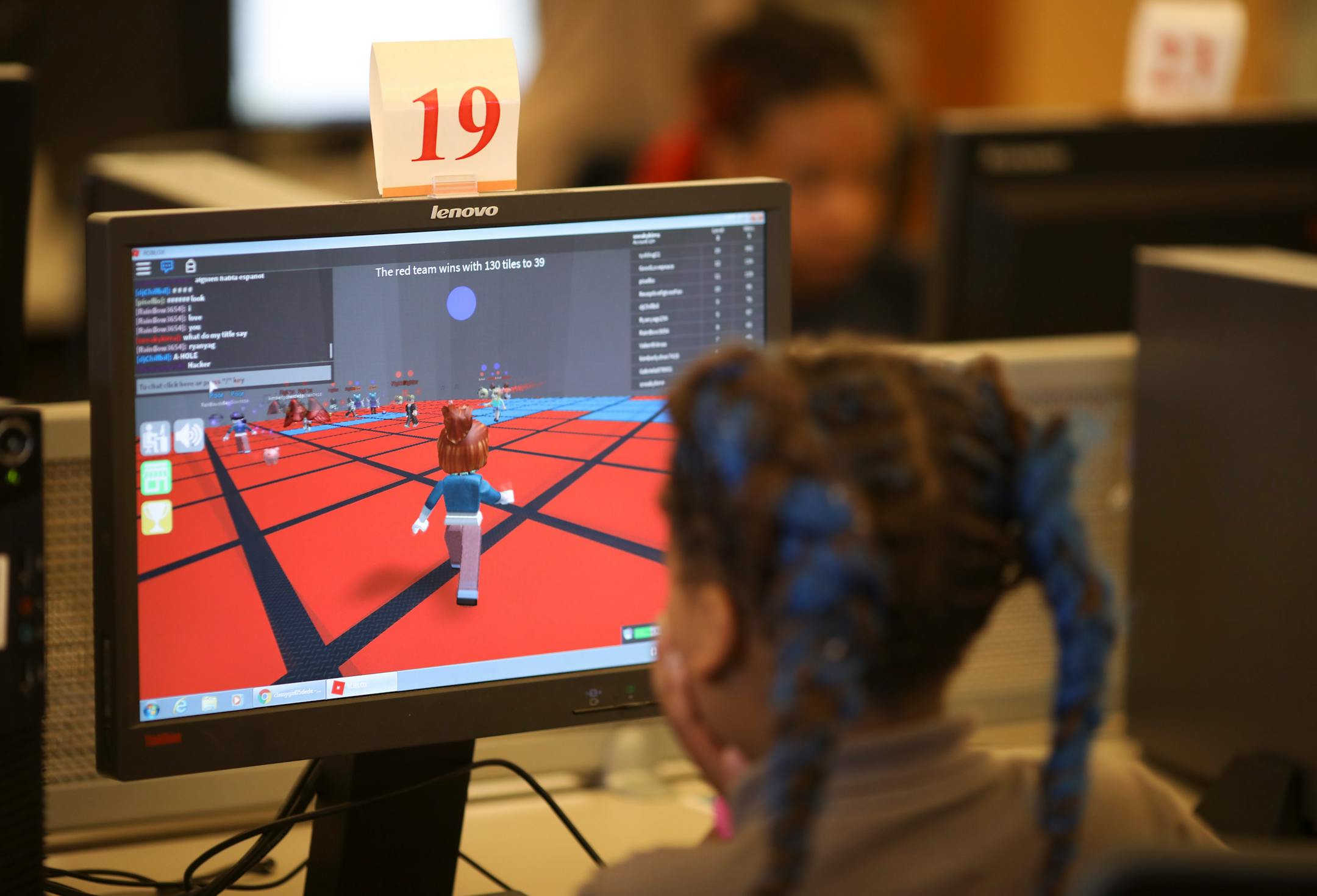
A child plays Roblox on a computer at the Rondo Library in 2017: "Games are not only games," writes Haley Taylor Schlitz. "They are social rooms." (Jeff Wheeler/The Minnesota Star Tribune)

Opinion editor’s note: Strib Voices publishes a mix of material from eight contributing columnists, along with other commentary online and in print each day. To contribute, click here.

•••

When adults see kids playing a video game, we tend to picture escape.

We imagine a world sealed off from the news, from politics, from the hard edges of real life. But for Gen Z and Gen Alpha, games are not only a place to disappear. They are where friends gather, where people narrate what is happening around them. And sometimes, they are where reality gets rehearsed.

That is why some videos circulating on TikTok are so unsettling. In these clips, players stage immigration “raids” inside a role-playing world of Roblox, with some players’ characters dressed like ICE agents. Roblox is one of the world’s most popular gaming platforms, and it is not a single game. It is a place where players build games inside the game, user-made worlds that run on player-created servers.

In a place like Brookhaven, a role-playing neighborhood in Roblox that millions of kids know like a second hometown, the rules are not written by a civics teacher. They are written by whoever is in the room. And in that room, a real-world terror is being translated into gameplay.

In Minnesota right now, this does not land as an internet oddity. It reflects what is taking place in our streets and risks turning someone else’s fear into a joke. Even if some kids are doing this out of curiosity, curiosity does not erase consequence. For immigrant children, and for classmates who live with the chronic stress of enforcement hovering over their families, “it’s just a game” is not a comfort. It is a dismissal.

And I cannot stop thinking about this question underneath those clips: What does it mean when the first place a child rehearses the power of the state is a game?

To answer that, adults have to understand something basic about Gen Z and Gen Alpha that is easy to miss if you did not grow up in these spaces.

Games are not only games. They are social rooms.

For many young people, digital worlds are where you meet your friends, where you hang out after school, where you joke, argue and test who you are. And it rarely happens on a single platform. Roblox might be the visible stage, but the meaning is often made elsewhere — in Discord servers where people talk through what happened, in livestreams and clips where moments are amplified, rewarded, challenged or normalized.

This is not about screen time. It is about civic formation.

When a child’s first sustained exposure to government power is a raid, authority becomes a costume before it becomes a concept. A uniform becomes a shortcut to status. A “raid” becomes an action you can initiate and end whenever you want, which is exactly the opposite of how it feels for the families who live under that threat. Repetition matters. What we rehearse starts to feel normal, even when it should not.

That is why the reenactments are troubling — not because children are uniquely cruel, but because they are absorbing a version of power we have allowed to dominate the public imagination.

But the story does not end there.

Some kids are also protesting ICE inside these same digital worlds, using a space that feels accessible and safe to say that what they are seeing is wrong.

It is easy for adults to dismiss that kind of protest as unserious because it does not look like the protests they remember. But not every child can safely stand in the street. Not every teenager can risk being photographed, questioned or followed. Not every family can absorb the consequences of public visibility.

In that context, a digital protest can function like mutual aid. It can be a lifeline. It can be the difference between feeling isolated and realizing others are carrying the same fear.

That matters because these moments, the reenactments and the protests alike, are doing more than filling time. They are recording something.

The archive is already digital.

When we talk about civic memory, we tend to think of newspapers, speeches, court records — the things adults decide are worth saving. But for this generation, the first draft of memory is being written in servers, clips, screenshots, role-play and group chats. It is being written before institutions agree on a narrative, before officials decide what language to use.

A child holding a protest sign in a game is recording what they believe the moral stakes are. A child reenacting a raid is recording something, too, whether they mean to or not — how familiar fear has become, how easily violence can be turned into play, how quickly another person’s pain can be treated as content.

If we want to understand what young people believe about the country they are inheriting, we have to look where they are actually living their lives with each other, especially when those spaces begin to mirror the worst parts of our reality.

Yes, companies can remove content. Yes, moderation matters. But deleting a video does not teach empathy. It does not help an immigrant child feel safe. It does not explain why some young people are drawn to the costume of force in the first place.

That work belongs to adults.

So here is what I want to say to parents, educators, and anyone raising kids right now: Check in.

Ask what they are playing, and who they are with. Ask what they are seeing about immigration enforcement and what they think it means. Ask how it made them feel. Then name the difference, clearly, between protest and harm. Kids can understand that line. They just should not be left alone to draw it.

Because young people are learning what kind of country this is in real time.

In Minnesota, they are learning it on the streets, at protests, in classrooms, in overheard conversations, and yes, inside games. We should not leave them alone with that lesson.

about the writer

about the writer

Haley Taylor Schlitz

Contributing Columnist

Haley Taylor Schlitz is a contributing columnist for the Minnesota Star Tribune focusing on Gen Z issues and perspectives. She is an attorney and writer based in St. Paul.

See Moreicon

More from Contributing Columnists

See More
card image
Jeff Wheeler/The Minnesota Star Tribune

For some in Gen Alpha, role-playing in Roblox might be their first experience with government power.

card image