
Taylor Schlitz: On this MLK Day, a letter from Minnesota

In 1963, the Rev. Martin Luther King Jr. wrote “Letter from Birmingham Jail.” His words are especially relevant today given what is happening in Minnesota.

Columnist Icon
The Minnesota Star Tribune
January 19, 2026 at 11:00AM
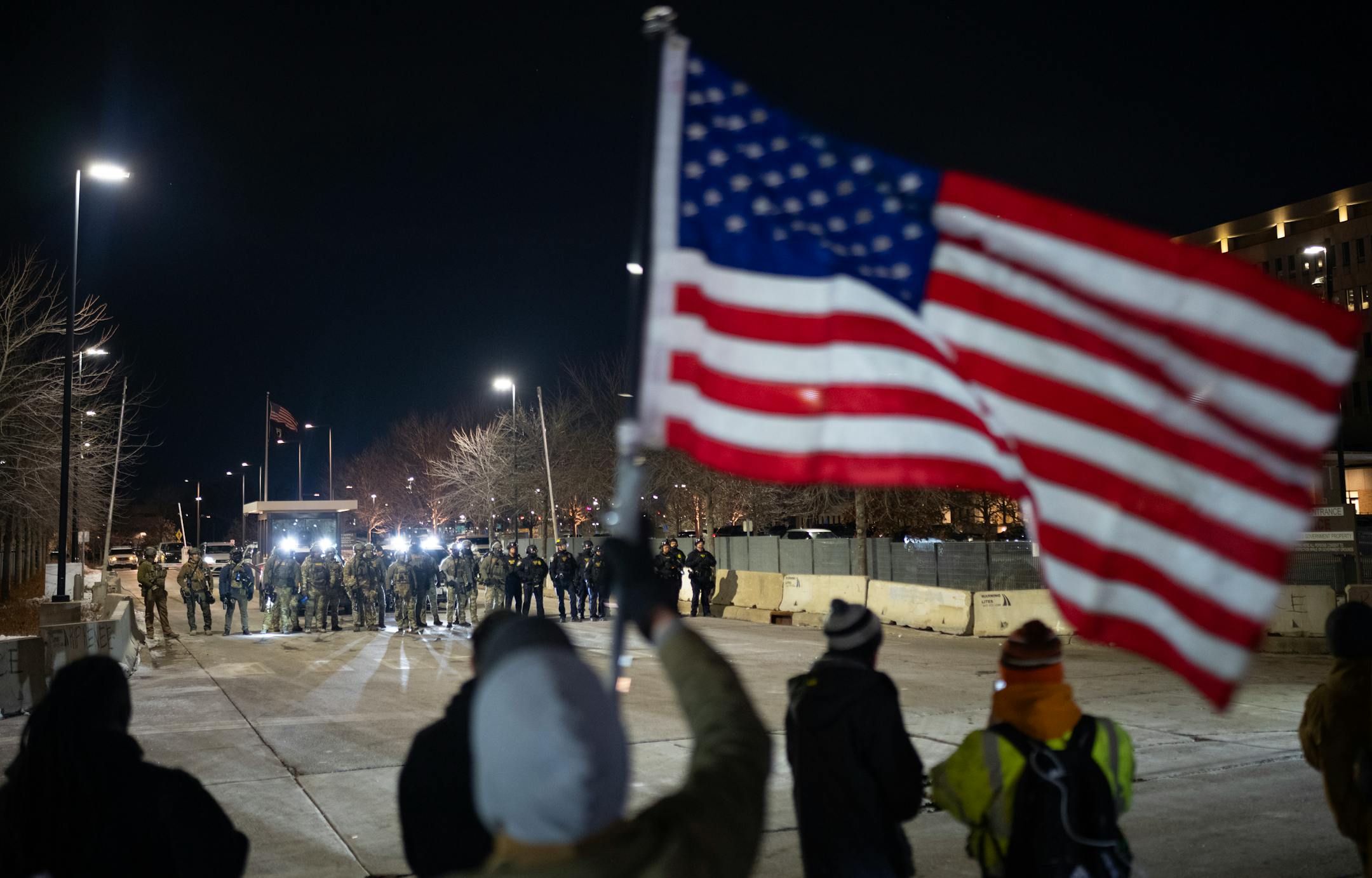
Protesters face federal agents at the Whipple Federal Building on Jan. 11. Haley Taylor Schlitz writes that Martin Luther King Jr. challenged critics who objected to demonstrations more than they did the conditions that created them. (Jeff Wheeler/The Minnesota Star Tribune)

Opinion editor’s note: Strib Voices publishes a mix of material from eight contributing columnists, along with other commentary online and in print each day. To contribute, click here.

•••

To Dr. King and my fellow Minnesotans,

A holiday is supposed to slow a nation down long enough to remember its standards. This year, MLK Day arrives with masked federal agents fanning out across the Twin Cities and beyond, with unmarked vehicles and street-level operations reshaping daily life, and with a growing chill that has many immigrants and other people of color, and many white residents too, thinking twice before leaving home, going to school or stepping into public spaces.

Dr. King, we are not living in your era, but we are facing a familiar question: Is “order” being used to protect the public, or to protect power from accountability?

I keep thinking about how people often meet you only through the safest doorway — a dream, a monument, a quote polished down until it can sit on a poster without asking anything of the reader. But your most demanding work was written in the middle of conflict, not after it. You wrote as someone being told to wait, to soften the message, to respect “proper channels,” even while the people you loved were living under improper conditions.

And I keep returning to one of the most basic ideas you insisted on in Birmingham. You were there because injustice was there. Not because it was convenient, not because it guaranteed applause. Because moral emergencies do not respect city limits, and because distance is one of the oldest excuses in American life.

That is the first reason this moment in Minnesota matters on MLK Day 2026. We are being encouraged to treat what is happening here as a local disturbance. A Minneapolis problem. A Minnesota problem. A protest problem. Something to be managed.

But what is happening here is not simply “tension.” It is an argument about the character of public power.

When a president threatens a state with “reckoning and retribution,” he is not using the language of neutral law. He is using the language of punishment. A government can enforce laws without promising vengeance. When it promises vengeance, it tells you what it believes the law is for.

And when the institutions that are supposed to steady the public start to fracture, the message becomes louder than any speech at a rally.

The news Minnesotans woke up to last week was not a minor internal shuffle. The Minnesota Star Tribune described a mass resignation from the U.S. Attorney’s Office in Minnesota, including senior prosecutors, stemming from directives after the killing of Renee Good by an ICE agent. The reporting described an internal directive that prosecutors “say nothing” about the federal investigation, and it noted that state investigators were cut out of the probe and that federal officials sought to investigate Good’s widow for possible federal charges.

Whatever your politics, you can feel the difference between a justice system that invites public trust and a justice system that treats public concern as something to be contained.

I am an attorney. I believe in rules and procedures, in evidence and due process, in institutions that protect people from impulsive power. That is exactly why this moment feels so dangerous. A justice system does not earn legitimacy by demanding quiet. It earns legitimacy by being worthy of witness.

You understood that power does not only suppress through force. It also suppresses through framing. It trains the public to treat discomfort as disorder, and disorder as the real threat. It persuades decent people that their primary civic duty is to keep things calm, even if calm is purchased with someone else’s fear.

When people ask today about Minnesota, “Why are there demonstrations?” I hear the question you confronted directly: Why are we focusing on surface behavior while refusing to confront what produced it?

In Birmingham, you challenged critics who deplored the demonstrations but did not show the same concern for the conditions that created them. You warned against analysis that fixates on effects and refuses to grapple with causes.

Minnesota is drowning in effects-talk. We are being pulled into arguments about tone, about disruption, about whether grief is being expressed in the “right” way. You can hear it in the complaints about protesters blowing whistles when masked agents roll through neighborhoods in unmarked vehicles. You can see it in the backlash to residents who follow and film ICE agents to document arrests, as if witnessing and recording the exercise of power is itself an offense. And you can feel it in the way some keep pushing public debate toward a discussion on manners, rather than grappling with what it means to live in a state where daily life is being deliberately reshaped by fear.

But the cause is what keeps demanding attention. The loss of life. The integrity of an investigation the public must be able to trust. The fear many communities feel when stepping outside can feel like a test of your skin, your accent, your name, and when citizens and lawful residents begin to move through public life as if visibility itself is risk.

If we do not grapple with causes, we will spend MLK Day doing what this country does too well. We will commemorate, and then we will return to the habits that made commemoration necessary.

Here is another thing you wrote that Minnesota needs right now, and it has nothing to do with nostalgia. You insisted on the interrelatedness of communities, and you rejected the narrow “outside agitator” idea. You insisted that no one in this country should be treated as an outsider anywhere within it.

That is the second reason this moment matters on MLK Day. Minnesota is being spoken about as if it is separable from the rest of the country, as if what happens here can be punished here, contained here. But this is not a Minnesota-only problem. It is a national test with a Minnesota address.

If a president can promise retribution against a state for its politics, that is not just rhetoric. It is a message to every other state. If federal institutions can be pressured into secrecy or political targeting, and the public is told to accept silence as strategy, that is not just an internal dispute. It is an instruction about what accountability will look like from here forward.

We will hear the dream recited this weekend. But a dream can become a lullaby. Repeated without its demands, it can become a way to pretend we have already arrived.

If the new dream is a nightmare, it is not because people are speaking out. It is because the public is being trained to accept intimidation as governance, and to accept silence as legitimacy.

So what does moral clarity look like in Minnesota this MLK Day?

It looks like refusing to confuse quiet with peace, and refusing to treat fear as normal.

It looks like insisting that investigations be credible, independent and transparent enough to earn public trust, not simply declared trustworthy by authority.

It looks like leaders who speak with discipline and courage, and citizens who do not outsource their conscience.

That is what your letter offered. Not comfort. A standard.

My dear fellow Minnesotans, if we are going to honor Dr. King this year, let’s do it without sedation. Let’s treat MLK Day as an audit, not a performance. Let’s be brave enough to focus on causes, not just effects.

And let’s remember the moral claim at the center of the holiday, the claim that makes it worth keeping on the calendar: Nobody is an outsider to justice. Not here. Not anywhere in this country.

If injustice is here, then responsibility is here, too.

about the writer

about the writer

Haley Taylor Schlitz

Contributing Columnist

Haley Taylor Schlitz is a contributing columnist for the Minnesota Star Tribune focusing on Gen Z issues and perspectives. She is an attorney and writer based in St. Paul.

See Moreicon

More from Contributing Columnists

See More
card image
Jeff Wheeler/The Minnesota Star Tribune

In 1963, the Rev. Martin Luther King Jr. wrote “Letter from Birmingham Jail.” His words are especially relevant today given what is happening in Minnesota.

card image
card image